Corney David, Haynes John-Dylan, Rees Geraint, Lotto R Beau
UCL Institute of Ophthalmology, London, UK.
PLoS One. 2009;4(3):e5091. doi: 10.1371/journal.pone.0005091. Epub 2009 Mar 31.
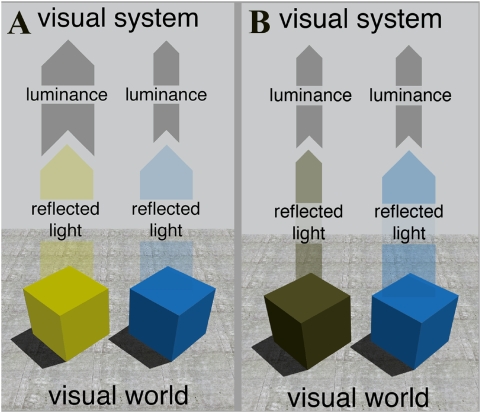
The perception of brightness depends on spatial context: the same stimulus can appear light or dark depending on what surrounds it. A less well-known but equally important contextual phenomenon is that the colour of a stimulus can also alter its brightness. Specifically, stimuli that are more saturated (i.e. purer in colour) appear brighter than stimuli that are less saturated at the same luminance. Similarly, stimuli that are red or blue appear brighter than equiluminant yellow and green stimuli. This non-linear relationship between stimulus intensity and brightness, called the Helmholtz-Kohlrausch (HK) effect, was first described in the nineteenth century but has never been explained. Here, we take advantage of the relative simplicity of this 'illusion' to explain it and contextual effects more generally, by using a simple Bayesian ideal observer model of the human visual ecology. We also use fMRI brain scans to identify the neural correlates of brightness without changing the spatial context of the stimulus, which has complicated the interpretation of related fMRI studies.
Rather than modelling human vision directly, we use a Bayesian ideal observer to model human visual ecology. We show that the HK effect is a result of encoding the non-linear statistical relationship between retinal images and natural scenes that would have been experienced by the human visual system in the past. We further show that the complexity of this relationship is due to the response functions of the cone photoreceptors, which themselves are thought to represent an efficient solution to encoding the statistics of images. Finally, we show that the locus of the response to the relationship between images and scenes lies in the primary visual cortex (V1), if not earlier in the visual system, since the brightness of colours (as opposed to their luminance) accords with activity in V1 as measured with fMRI.
The data suggest that perceptions of brightness represent a robust visual response to the likely sources of stimuli, as determined, in this instance, by the known statistical relationship between scenes and their retinal responses. While the responses of the early visual system (receptors in this case) may represent specifically the statistics of images, post receptor responses are more likely represent the statistical relationship between images and scenes. A corollary of this suggestion is that the visual cortex is adapted to relate the retinal image to behaviour given the statistics of its past interactions with the sources of retinal images: the visual cortex is adapted to the signals it receives from the eyes, and not directly to the world beyond.
亮度感知取决于空间背景:相同的刺激根据其周围环境可显得亮或暗。一种不太为人所知但同样重要的背景现象是,刺激的颜色也会改变其亮度。具体而言,饱和度更高(即颜色更纯)的刺激在相同亮度下比饱和度较低的刺激显得更亮。同样,红色或蓝色刺激比等亮度的黄色和绿色刺激显得更亮。刺激强度与亮度之间的这种非线性关系,称为亥姆霍兹 - 科尔劳施(HK)效应,最早在19世纪被描述,但从未得到解释。在此,我们利用这种“错觉”的相对简单性,通过使用人类视觉生态的简单贝叶斯理想观察者模型来解释它以及更普遍的背景效应。我们还使用功能磁共振成像(fMRI)脑部扫描来识别亮度的神经关联,而不改变刺激的空间背景,这使得相关fMRI研究的解释变得复杂。
我们并非直接对人类视觉进行建模,而是使用贝叶斯理想观察者对人类视觉生态进行建模。我们表明,HK效应是对视网膜图像与人类视觉系统过去可能经历的自然场景之间非线性统计关系进行编码的结果。我们进一步表明,这种关系的复杂性源于视锥光感受器的响应函数,而视锥光感受器本身被认为是对图像统计进行编码的一种有效解决方案。最后,我们表明,对图像与场景之间关系的响应位点位于初级视觉皮层(V1),如果不是在视觉系统更早阶段的话,因为用fMRI测量时,颜色的亮度(与其亮度相对)与V1中的活动相符。
数据表明,亮度感知代表了对刺激可能来源的一种稳健视觉响应,在这种情况下,由场景与其视网膜响应之间已知的统计关系所决定。虽然早期视觉系统(此处指感受器)的响应可能专门代表图像的统计信息,但感受器后的响应更可能代表图像与场景之间 的统计关系。这一观点的一个推论是,视觉皮层适应于根据其过去与视网膜图像来源的相互作用统计信息,将视网膜图像与行为联系起来:视觉皮层适应于它从眼睛接收到的信号,而不是直接适应于外部世界。