An Young Jun, Ahn Bo-Eun, Han A-Reum, Kim Hae-Mi, Chung Kyung Min, Shin Jung-Ho, Cho Yoo-Bok, Roe Jung-Hye, Cha Sun-Shin
Marine and Extreme Genome Research Center, Korea Ocean Research & Development Institute, Ansan 426-744, Republic of Korea.
Nucleic Acids Res. 2009 Jun;37(10):3442-51. doi: 10.1093/nar/gkp198. Epub 2009 Mar 31.
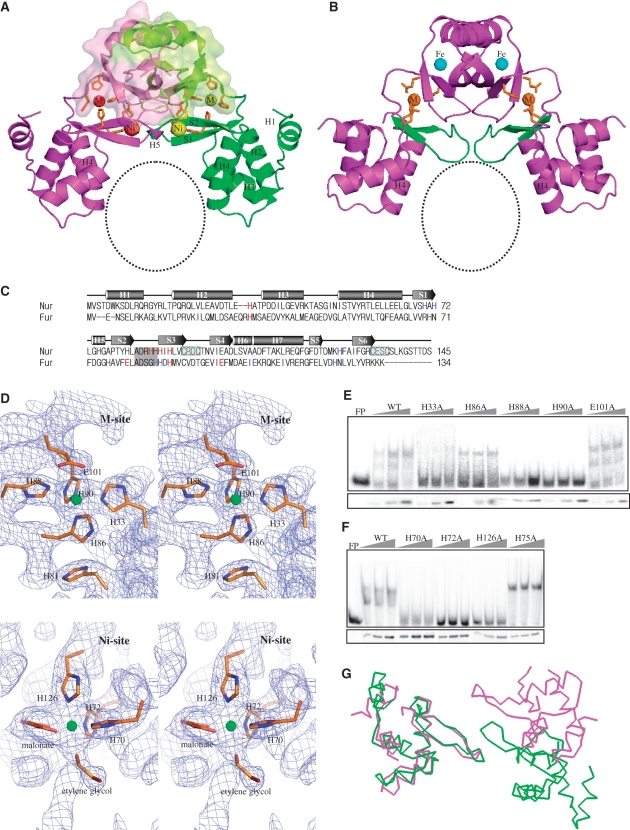
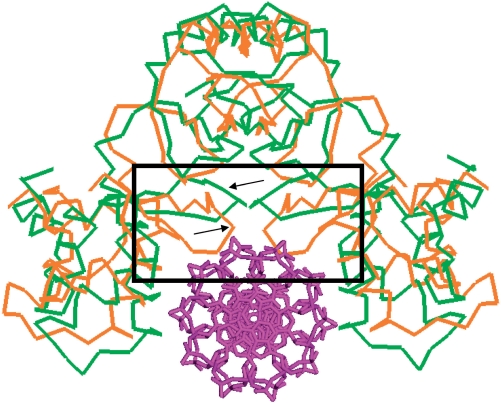
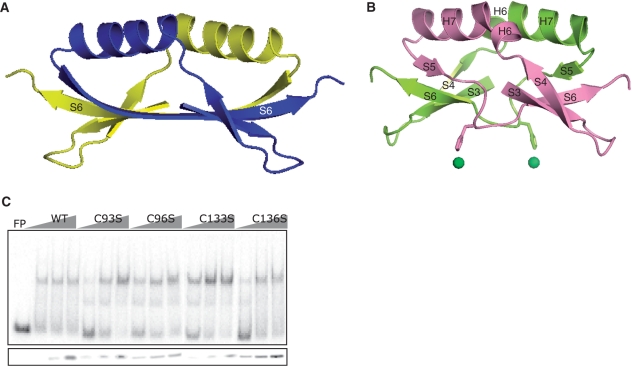
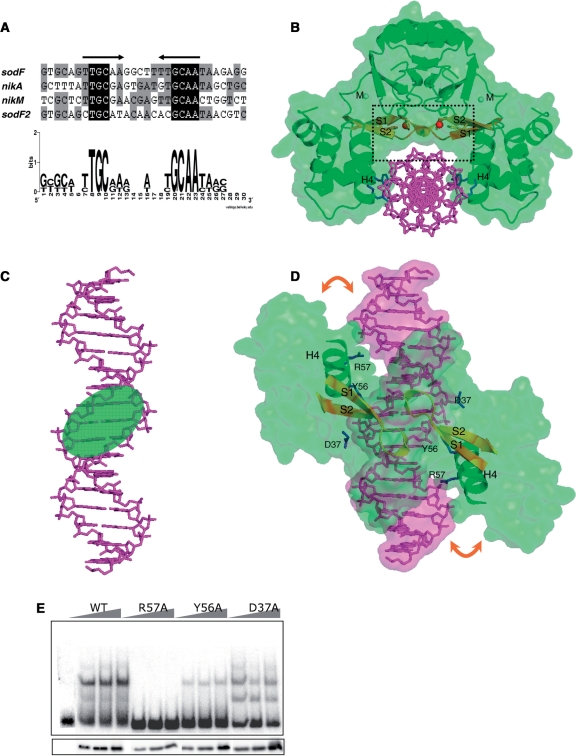
Nur, a member of the Fur family, is a nickel-responsive transcription factor that controls nickel homeostasis and anti-oxidative response in Streptomyces coelicolor. Here we report the 2.4-A resolution crystal structure of Nur. It contains a unique nickel-specific metal site in addition to a nonspecific common metal site. The identification of the 6-5-6 motif of the Nur recognition box and a Nur/DNA complex model reveals that Nur mainly interacts with terminal bases of the palindrome on complex formation. This contrasts with more distributed contacts between Fur and the n-1-n type of the Fur-binding motif. The disparity between Nur and Fur in the conformation of the S1-S2 sheet in the DNA-binding domain can explain their different DNA-recognition patterns. Furthermore, the fact that the specificity of Nur in metal sensing and DNA recognition is conferred by the specific metal site suggests that its introduction drives the evolution of Nur orthologs in the Fur family.
努尔是弗氏家族的一员,是一种镍响应转录因子,可控制天蓝色链霉菌中的镍稳态和抗氧化反应。在此我们报告努尔的2.4埃分辨率晶体结构。除了一个非特异性的常见金属位点外,它还包含一个独特的镍特异性金属位点。努尔识别框6-5-6基序的鉴定以及努尔/DNA复合物模型表明,努尔在复合物形成时主要与回文序列的末端碱基相互作用。这与弗氏蛋白和n-1-n型弗氏结合基序之间更分散的接触形成对比。DNA结合结构域中S1-S2片层构象上努尔和弗氏蛋白的差异可以解释它们不同的DNA识别模式。此外,特定金属位点赋予努尔在金属传感和DNA识别方面的特异性这一事实表明,它的引入推动了弗氏家族中努尔直系同源物的进化。