Bertagnolli Monica M, Eagle Craig J, Zauber Ann G, Redston Mark, Breazna Aurora, Kim Kyungmann, Tang Jie, Rosenstein Rebecca B, Umar Asad, Bagheri Donya, Collins Neal T, Burn John, Chung Daniel C, Dewar Thomas, Foley T Raymond, Hoffman Neville, Macrae Finlay, Pruitt Ronald E, Saltzman John R, Salzberg Bruce, Sylwestrowicz Thomas, Hawk Ernest T
Brigham and Women's Hospital, Boston, MA 02115, USA.
Cancer Prev Res (Phila). 2009 Apr;2(4):310-21. doi: 10.1158/1940-6207.CAPR-08-0206. Epub 2009 Mar 31.
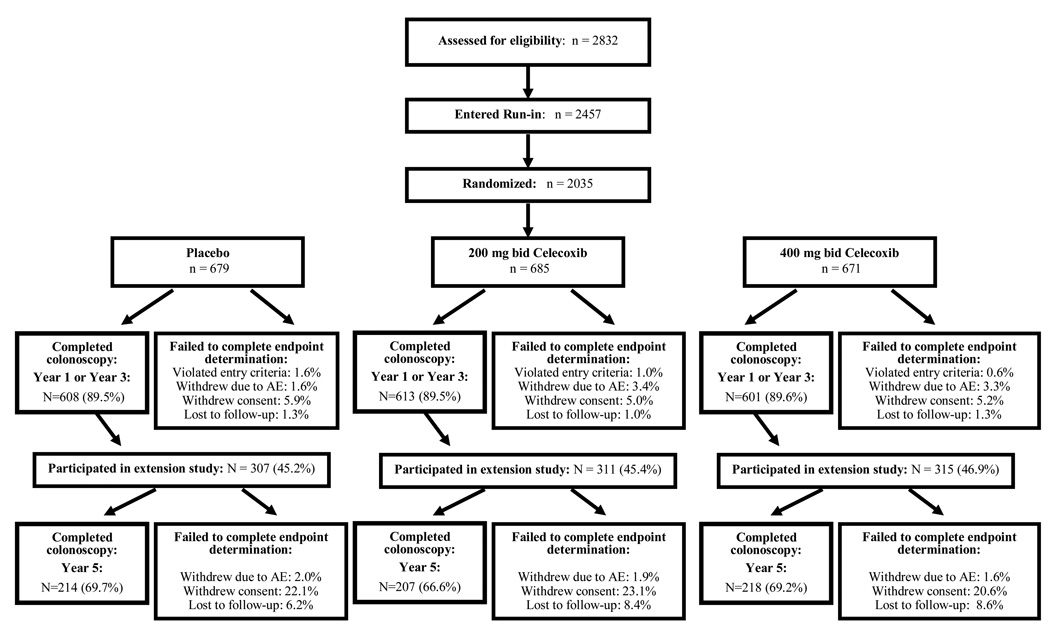
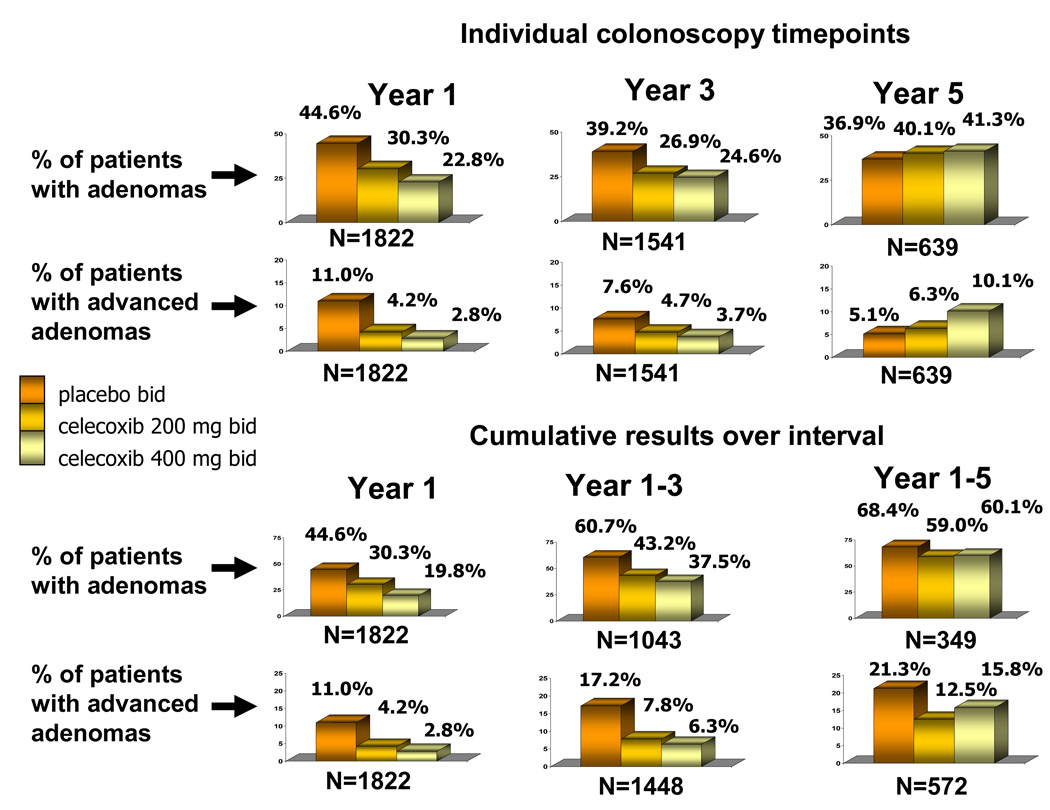
The Adenoma Prevention with Celecoxib Trial examined the efficacy and safety of the cyclooxygenase (Cox)-2 inhibitor, celecoxib, for sporadic colorectal adenoma prevention in patients at high risk for colorectal cancer. The trial randomized 2,035 subjects to receive either placebo, celecoxib 200 mg twice daily, or celecoxib 400 mg twice daily. The primary study safety and efficacy analyses involved 3 years of treatment. The results showed significant antitumor effect but also indicated increased cardiovascular adverse events in patients treated with celecoxib compared with placebo. A total of 933 patients participated in an extension of the Adenoma Prevention with Celecoxib Trial, with a planned total treatment and surveillance duration of 5 years. Study medication was stopped early, resulting in a median treatment duration of 3.1 years for those with a year 5 colonoscopy. Patients treated on the placebo arm had a cumulative adenoma incidence of 68.4% over 5 years of observation. This figure was 59.0% (P < 0.0001) for those receiving low-dose celecoxib, and 60.1% (P < 0.0001) for those receiving high-dose celecoxib. The cumulative incidence of advanced adenomas over 5 years was 21.3% of those taking placebo, 12.5% (P < 0.0001) of those taking low dose celecoxib and 15.8% (P < 0.0001) of those taking high-dose celecoxib. Investigator reported treatment emergent adverse events were similar across all treatment groups for categories including renal and hypertensive events and gastrointestinal ulceration and hemorrhage events. For a category composed of cardiovascular and thrombotic events, the risk relative to placebo was 1.6 (95% confidence interval, 1.0, 2.5) for those using 200 mg twice daily celecoxib and 1.9 (95% confidence interval, 1.2, 3.1) for those using 400 mg twice daily celecoxib. Secondary analysis showed an interaction between a baseline history of atherosclerotic heart disease and study drug use with respect to cardiovascular and thrombotic adverse events (P = 0.004). These results confirm the inhibitory effect of celecoxib on colorectal adenoma formation, and provide additional safety data indicating an elevated risk for cardiovascular and thrombotic adverse events, particularly for patients with preexisting atherosclerotic heart disease.
塞来昔布预防腺瘤试验研究了环氧化酶(Cox)-2抑制剂塞来昔布在预防散发性结直肠腺瘤方面对结直肠癌高危患者的疗效和安全性。该试验将2035名受试者随机分为三组,分别接受安慰剂、每日两次200毫克塞来昔布或每日两次400毫克塞来昔布治疗。主要研究的安全性和疗效分析涉及3年的治疗期。结果显示塞来昔布有显著的抗肿瘤作用,但也表明与安慰剂相比,接受塞来昔布治疗的患者心血管不良事件增加。共有933名患者参与了塞来昔布预防腺瘤试验的扩展研究,计划的总治疗和监测期为5年。研究用药提前终止,导致接受第5年结肠镜检查的患者中位治疗期为3.1年。在安慰剂组接受治疗的患者在5年观察期内累积腺瘤发生率为68.4%。接受低剂量塞来昔布治疗的患者这一数字为59.0%(P<0.0001),接受高剂量塞来昔布治疗的患者为60.1%(P<0.0001)。5年内高级别腺瘤的累积发生率在服用安慰剂的患者中为21.3%,在服用低剂量塞来昔布的患者中为12.5%(P<0.0001),在服用高剂量塞来昔布的患者中为15.8%(P<0.0001)。研究者报告的治疗期间出现的不良事件在所有治疗组中,在包括肾脏和高血压事件以及胃肠道溃疡和出血事件的类别方面相似。对于由心血管和血栓形成事件组成的类别,每日两次服用200毫克塞来昔布的患者相对于安慰剂的风险比为1.6(95%置信区间,1.0,2.5),每日两次服用400毫克塞来昔布的患者为1.9(95%置信区间,1.2,3.1)。二次分析显示,在心血管和血栓形成不良事件方面,动脉粥样硬化性心脏病的基线病史与研究药物使用之间存在相互作用(P=0.004)。这些结果证实了塞来昔布对结直肠腺瘤形成的抑制作用,并提供了额外的安全性数据,表明心血管和血栓形成不良事件的风险增加,特别是对于已有动脉粥样硬化性心脏病的患者。