Pattingre Sophie, Bauvy Chantal, Levade Thierry, Levine Beth, Codogno Patrice
INSERM U756 and Université Paris Sud 11, Faculté de Pharmacie, 5 rue Jean-Baptiste Clément, Châtenay-Malabry, France.
Autophagy. 2009 May;5(4):558-60. doi: 10.4161/auto.5.4.8390. Epub 2009 May 10.
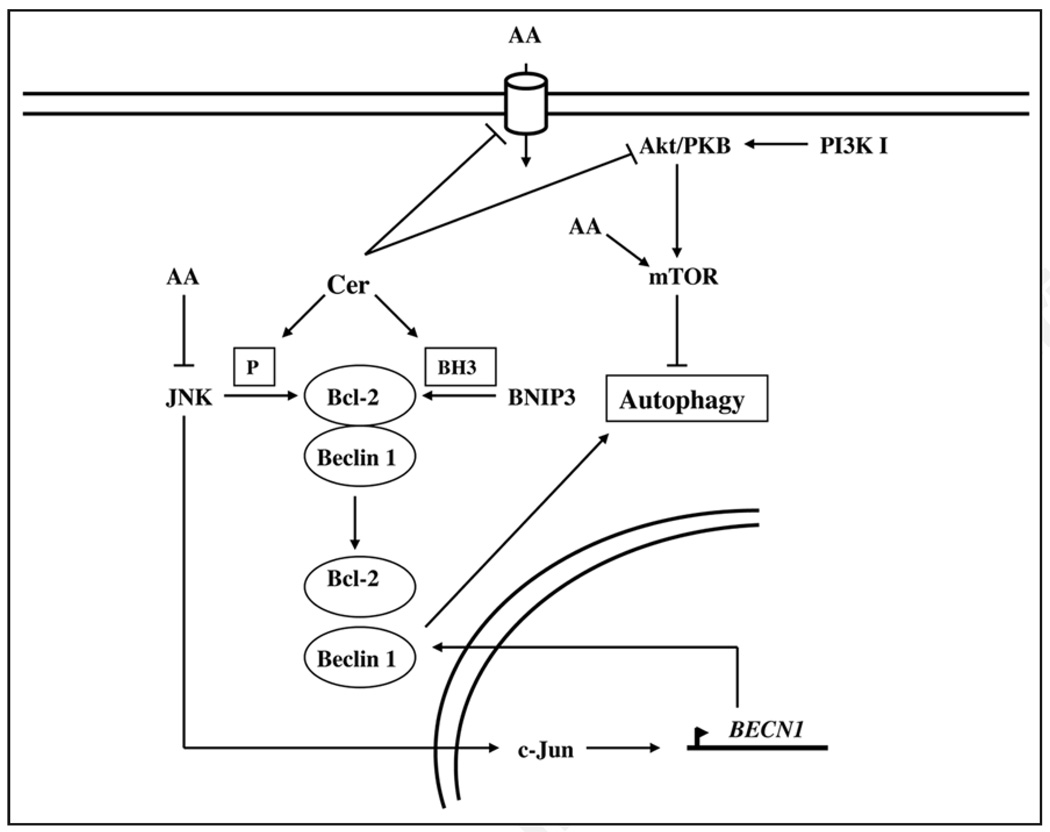
Ceramide is a sphingolipid bioactive molecule that induces apoptosis and other forms of cell death, and triggers macroautophagy (referred to below as autophagy). Like amino acid starvation, ceramide triggers autophagy by interfering with the mTOR-signaling pathway, and by dissociating the Beclin 1:Bcl-2 complex in a c-Jun N-terminal kinase 1 (JNK1)-mediated Bcl-2 phosphorylation-dependent manner. Dissociation of the Beclin 1:Bcl-2 complex, and the subsequent stimulation of autophagy have been observed in various contexts in which the cellular level of long-chain ceramides was increased. It is notable that the conversion of short-chain ceramides (C(2)-ceramide and C(6)-ceramide) into long-chain ceramide via the activity of ceramide synthase is required to trigger autophagy. The dissociation of the Beclin 1:Bcl-2 complex has also been observed in response to tamoxifen and PDMP (an inhibitor of the enzyme that converts ceramide to glucosylceramide), drugs that increase the intracellular level of long-chain ceramides. However, and in contrast to starvation, overexpression of Bcl-2 does not blunt ceramide-induced autophagy. Whether this autophagy that is unchecked by forced dissociation of the Beclin 1:Bcl-2 complex is related to the ability of ceramide to trigger cell death remains an open question. More generally, the question of whether ceramide-induced autophagy is a dedicated cell death mechanism deserves closer scrutiny.
神经酰胺是一种鞘脂生物活性分子,可诱导细胞凋亡和其他形式的细胞死亡,并触发巨自噬(以下简称自噬)。与氨基酸饥饿一样,神经酰胺通过干扰mTOR信号通路,并以c-Jun氨基末端激酶1(JNK1)介导的Bcl-2磷酸化依赖性方式使Beclin 1:Bcl-2复合物解离,从而触发自噬。在长链神经酰胺细胞水平升高的各种情况下,均观察到Beclin 1:Bcl-2复合物的解离以及随后对自噬的刺激。值得注意的是,需要通过神经酰胺合酶的活性将短链神经酰胺(C(2)-神经酰胺和C(6)-神经酰胺)转化为长链神经酰胺来触发自噬。在对他莫昔芬和PDMP(一种将神经酰胺转化为葡糖神经酰胺的酶的抑制剂)的反应中也观察到了Beclin 1:Bcl-2复合物的解离,这两种药物会增加细胞内长链神经酰胺的水平。然而,与饥饿相反,Bcl-2的过表达并不会抑制神经酰胺诱导的自噬。由Beclin 1:Bcl-2复合物的强制解离未加抑制的这种自噬是否与神经酰胺触发细胞死亡的能力有关,仍然是一个悬而未决的问题。更普遍地说,神经酰胺诱导的自噬是否是一种专门的细胞死亡机制这一问题值得更仔细的研究。