Giamas Georgios, Castellano Leandro, Feng Qin, Knippschild Uwe, Jacob Jimmy, Thomas Ross S, Coombes R Charles, Smith Carolyn L, Jiao Long R, Stebbing Justin
Department of Medical Oncology, Imperial College London, Hammersmith Hospital Campus, London, UK.
Nucleic Acids Res. 2009 May;37(9):3110-23. doi: 10.1093/nar/gkp136. Epub 2009 Apr 1.
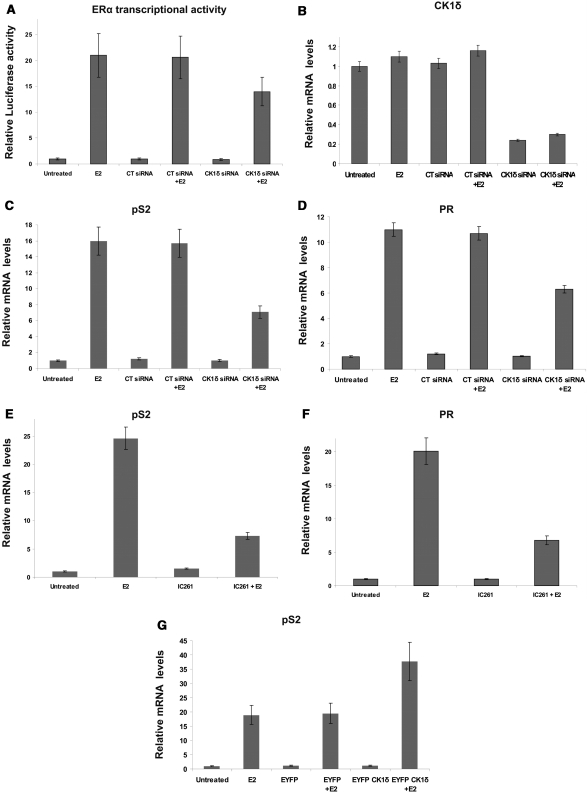
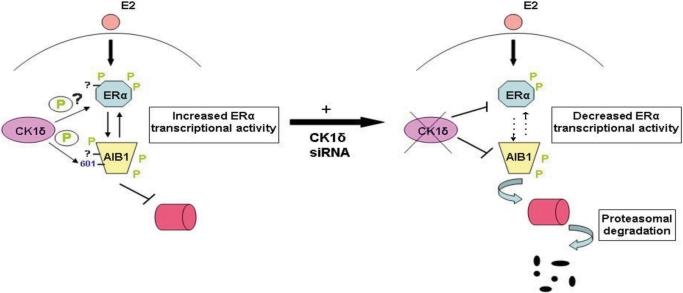
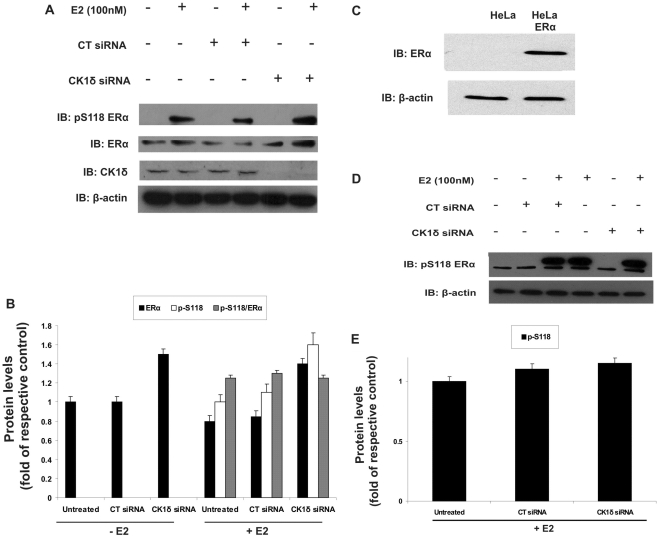
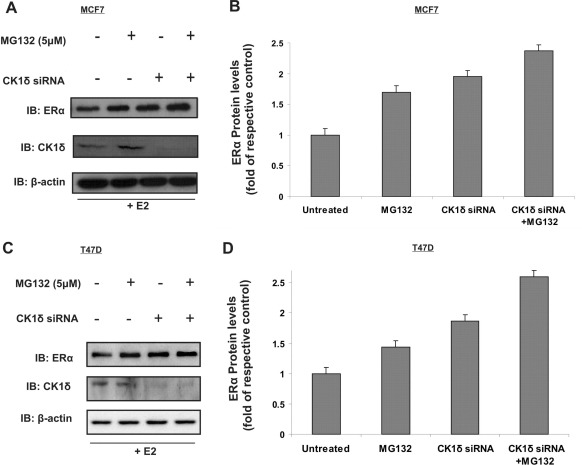
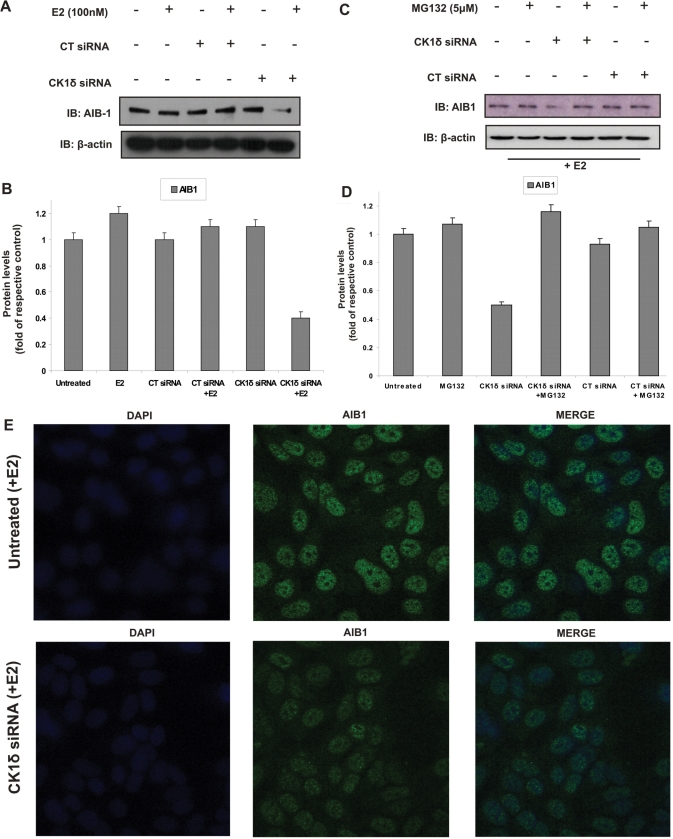
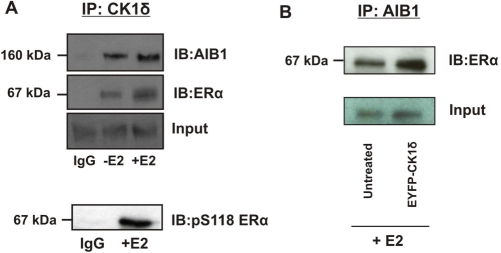
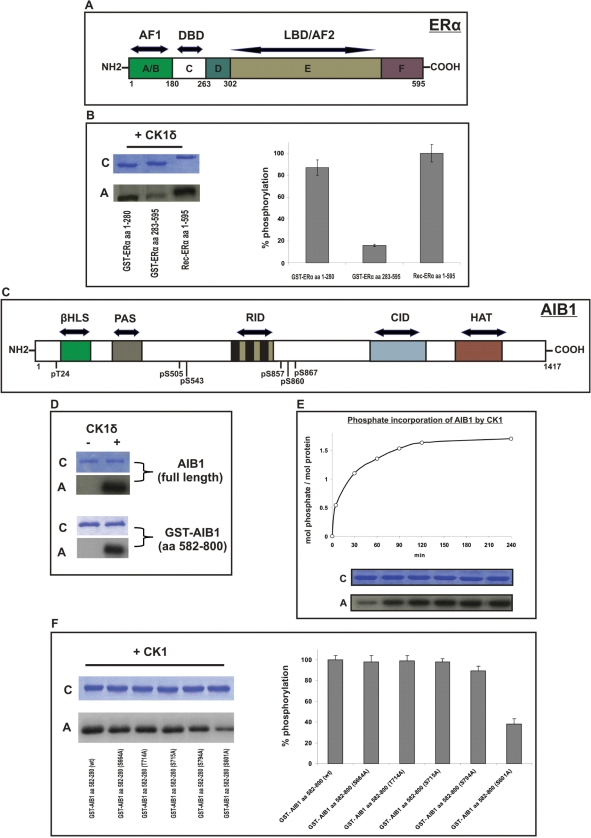
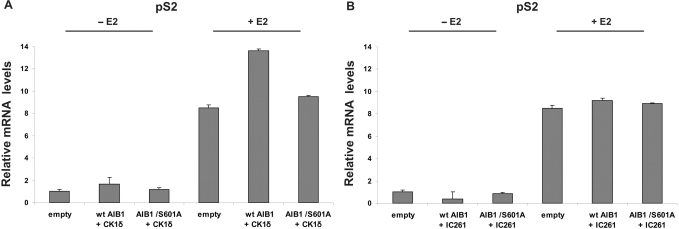
Oncogenesis in breast cancer often requires the overexpression of the nuclear receptor coactivator AIB1/SRC-3 acting in conjunction with estrogen receptor-alpha (ERalpha). Phosphorylation of both ERalpha and AIB1 has been shown to have profound effects on their functions. In addition, proteasome-mediated degradation plays a major role by regulating their stability and activity. CK1delta, a member of the ubiquitous casein kinase-1 family, is implicated in the progression of breast cancer. In this study, we show that both ERalpha and AIB1 are substrates for CK1delta in vitro, and identify a novel AIB1 phosphorylation site (S601) targeted by CK1delta, significant for the co-activator function of AIB1. CK1delta is able to interact with ERalpha and AIB1 in vivo, while overexpression of CK1delta in breast cancer cells results in an increased association of ERalpha with AIB1 as confirmed by co-immunoprecipitation assays from cell lysates. Using an siRNA-based approach, luciferase reporter assays and qRT-PCR, we observe that silencing of CK1delta leads to reduced ERalpha transcriptional activity, despite increased ERalpha levels, similarly to proteasome inhibition. We provide evidence that AIB1 protein levels are reduced by CK1delta silencing, in an estradiol-dependent manner; such destabilization can be inhibited by pre-treatment with the proteasome inhibitor MG132. We propose that differing activities adopted by ERalpha and AIB1 as a consequence of their interactions with and phosphorylation by CK1delta, particularly AIB1 stabilization, influence the transcriptional activity of ERalpha, and therefore have a role in breast cancer development.
乳腺癌的肿瘤发生通常需要核受体辅激活因子AIB1/SRC-3与雌激素受体α(ERα)协同作用过表达。已表明ERα和AIB1的磷酸化对其功能有深远影响。此外,蛋白酶体介导的降解通过调节它们的稳定性和活性发挥主要作用。CK1δ是普遍存在的酪蛋白激酶-1家族的成员,与乳腺癌的进展有关。在本研究中,我们表明ERα和AIB1在体外都是CK1δ的底物,并确定了一个由CK1δ靶向的新的AIB1磷酸化位点(S601),这对AIB1的辅激活功能很重要。CK1δ能够在体内与ERα和AIB1相互作用, 而乳腺癌细胞中CK1δ的过表达导致ERα与AIB1的结合增加,这通过细胞裂解物的免疫共沉淀分析得到证实。使用基于siRNA的方法、荧光素酶报告基因检测和qRT-PCR,我们观察到CK1δ的沉默导致ERα转录活性降低,尽管ERα水平升高,这与蛋白酶体抑制情况类似。我们提供的证据表明,CK1δ沉默以雌激素依赖的方式降低AIB1蛋白水平;这种去稳定化可以通过蛋白酶体抑制剂MG132预处理来抑制。我们提出,由于ERα和AIB1与CK1δ相互作用和被其磷酸化,特别是AIB1的稳定化,导致它们采取不同的活性,从而影响ERα的转录活性,因此在乳腺癌发展中起作用。