Friedman Joshua I, Majumdar Ananya, Stivers James T
Department of Pharmacology and Molecular Sciences, Johns Hopkins University School of Medicine, 725 North Wolfe Street, Baltimore, MD 21205, USA.
Nucleic Acids Res. 2009 Jun;37(11):3493-500. doi: 10.1093/nar/gkp161. Epub 2009 Apr 1.
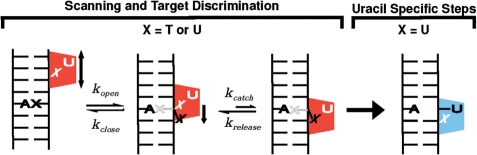
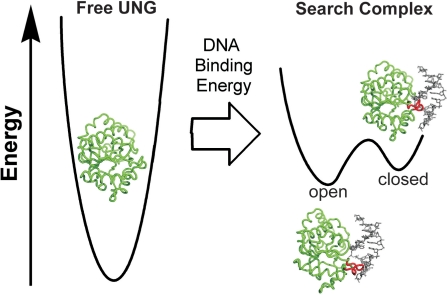
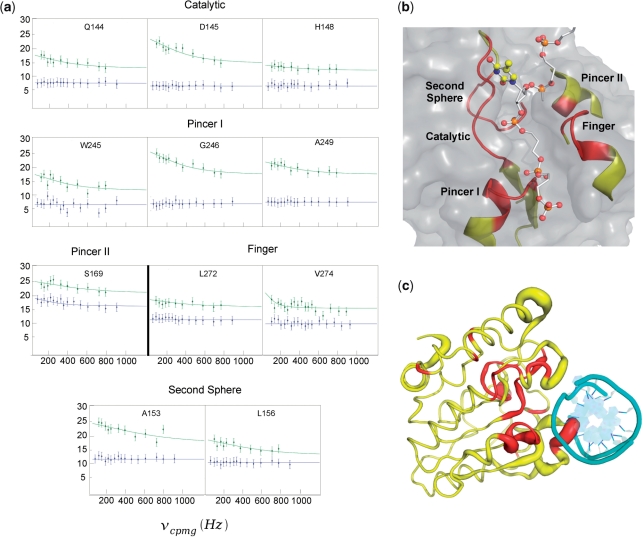
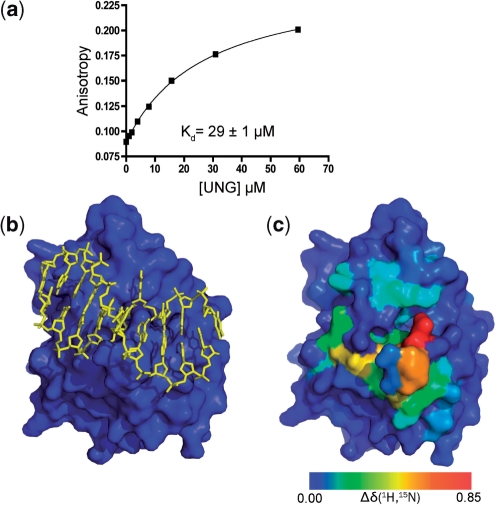
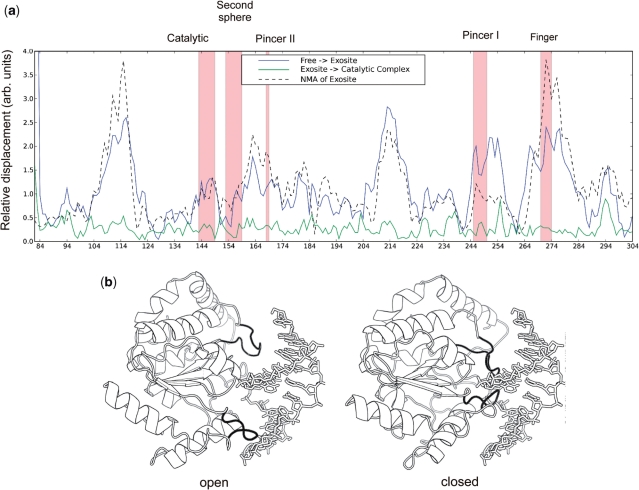
The DNA repair enzyme human uracil DNA glycosylase (UNG) scans short stretches of genomic DNA and captures rare uracil bases as they transiently emerge from the DNA duplex via spontaneous base pair breathing motions. The process of DNA scanning requires that the enzyme transiently loosen its grip on DNA to allow stochastic movement along the DNA contour, while engaging extrahelical bases requires motions on a more rapid timescale. Here, we use NMR dynamic measurements to show that free UNG has no intrinsic dynamic properties in the millisecond to microsecond and subnanosecond time regimes, and that the act of binding to nontarget DNA reshapes the dynamic landscape to allow productive millisecond motions for scanning and damage recognition. These results suggest that DNA structure and the spontaneous dynamics of base pairs may drive the evolution of a protein sequence that is tuned to respond to this dynamic regime.
DNA修复酶人尿嘧啶DNA糖基化酶(UNG)扫描基因组DNA的短片段,并捕捉罕见的尿嘧啶碱基,这些碱基通过自发的碱基对呼吸运动从DNA双链体中短暂出现。DNA扫描过程要求该酶暂时放松对DNA的握持,以便沿DNA轮廓进行随机移动,而与螺旋外碱基结合则需要更快时间尺度上的运动。在这里,我们使用核磁共振动态测量表明,游离的UNG在毫秒到微秒和亚纳秒时间范围内没有内在的动态特性,并且与非靶标DNA结合的行为重塑了动态格局,从而允许进行有效的毫秒级运动以进行扫描和损伤识别。这些结果表明,DNA结构和碱基对的自发动态可能驱动了一个经过调整以响应这种动态状态的蛋白质序列的进化。