Charles Cyril, Pantalacci Sophie, Tafforeau Paul, Headon Denis, Laudet Vincent, Viriot Laurent
Institut International de Paléoprimatologie Paléontologie Humaine, Evolution et Paléoenvironnements UMR CNRS 6046, Université de Poitiers, Poitiers, France.
PLoS One. 2009;4(4):e4985. doi: 10.1371/journal.pone.0004985. Epub 2009 Apr 2.
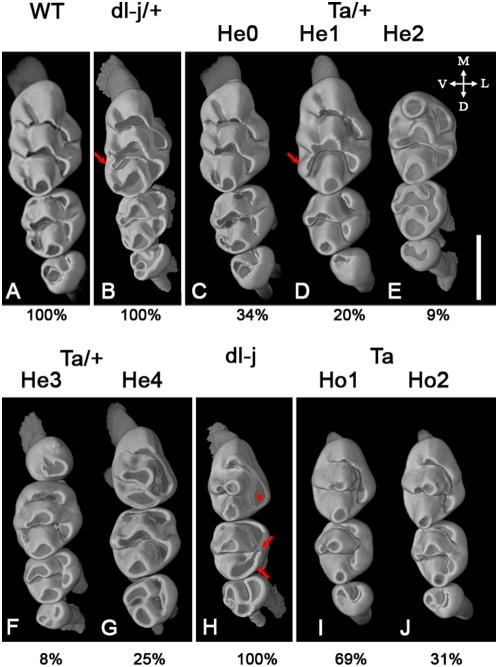
The Eda-A1-Edar signaling pathway is involved in the development of organs with an ectodermal origin, including teeth. In mouse, mutants are known for both the ligand, Eda-A1 (Tabby), and the receptor, Edar (Downless). The adult dentitions of these two mutants have classically been considered to be similar. However, previous studies mentioned differences in embryonic dental development between Eda(Ta) and Edar(dl-J) mutants. A detailed study of tooth morphology in mutants bearing losses of functions of these two genes thus appears necessary to test the pattern variability induced by the developmental modifications.
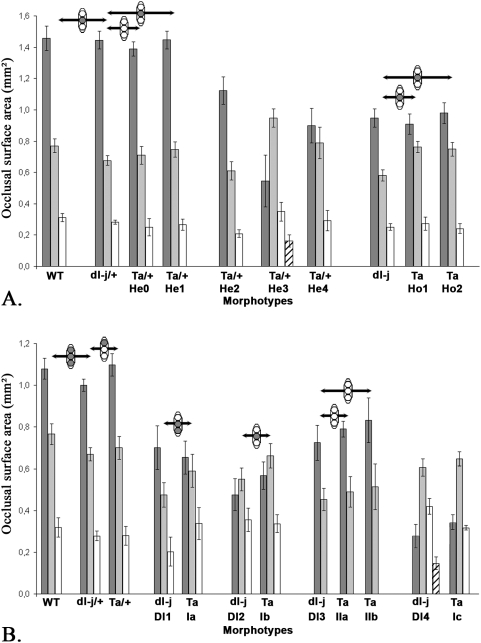
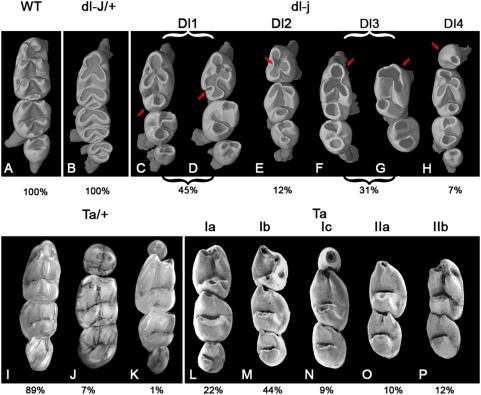
METHODOLOGY/PRINCIPAL FINDINGS: 3D-reconstructions of the cheek teeth have been performed at the ESRF (Grenoble, France) by X-ray synchrotron microtomography to assess dental morphology. The morphological variability observed in Eda(Ta) and Edar(dl-J) mutants have then been compared in detail. Despite patchy similarities, our detailed work on cheek teeth in Eda(Ta) and Edar(dl-J) mice show that all dental morphotypes defined in Edar(dl-J) mice resolutely differ from those of Eda(Ta) mice. This study reveals that losses of function of Eda and Edar have distinct impacts on the tooth size and morphology, contrary to what has previously been thought. CONCLUSION/SIGNIFIANCE: The results indicate that unknown mechanisms of the Eda pathway are implicated in tooth morphogenesis. Three hypotheses could explain our results; an unexpected role of the Xedar pathway (which is influenced by the Eda gene product but not that of Edar), a more complex connection than has been appreciated between Edar and another protein, or a ligand-independent activity for Edar. Further work is necessary to test these hypotheses and improve our understanding of the mechanisms of development.
Eda-A1-Edar信号通路参与包括牙齿在内的外胚层起源器官的发育。在小鼠中,已知配体Eda-A1(Tabby)和受体Edar(Downless)的突变体。传统上认为这两种突变体的成年牙列相似。然而,先前的研究提到了Eda(Ta)和Edar(dl-J)突变体在胚胎牙齿发育上的差异。因此,对这两个基因功能缺失的突变体的牙齿形态进行详细研究,似乎有必要来测试发育修饰所诱导的模式变异性。
方法/主要发现:通过X射线同步加速器显微断层扫描在法国格勒诺布尔的欧洲同步辐射装置(ESRF)对颊齿进行了三维重建,以评估牙齿形态。然后详细比较了在Eda(Ta)和Edar(dl-J)突变体中观察到的形态变异性。尽管存在一些局部相似性,但我们对Eda(Ta)和Edar(dl-J)小鼠颊齿的详细研究表明,Edar(dl-J)小鼠中定义的所有牙齿形态类型与Eda(Ta)小鼠的形态类型明显不同。这项研究表明,Eda和Edar的功能缺失对牙齿大小和形态有不同的影响,这与之前的想法相反。
结论/意义:结果表明Eda信号通路的未知机制与牙齿形态发生有关。有三个假设可以解释我们的结果:Xedar通路的意外作用(它受Eda基因产物影响,但不受Edar影响)、Edar与另一种蛋白质之间的联系比之前认为的更复杂,或者Edar具有不依赖配体的活性。需要进一步的工作来测试这些假设,并增进我们对发育机制的理解。