Ahluwalia Tarunveer Singh, Khullar Madhu, Ahuja Monica, Kohli Harbir Singh, Bhansali Anil, Mohan Viswanathan, Venkatesan Radha, Rai Taranjit Singh, Sud Kamal, Singal Pawan K
Department of Nephrology, Post Graduate Institute of Medical Education and Research, Chandigarh, India.
PLoS One. 2009;4(4):e5168. doi: 10.1371/journal.pone.0005168. Epub 2009 Apr 9.
Inflammatory cytokine genes have been proposed as good candidate genes for conferring susceptibility to diabetic nephropathy. In the present study, we examined the combined effect of multiple alleles of pro inflammatory cytokine genes for determining the risk of nephropathy in type 2 diabetic patients.
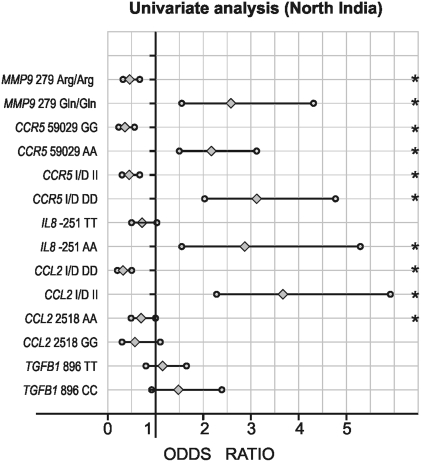
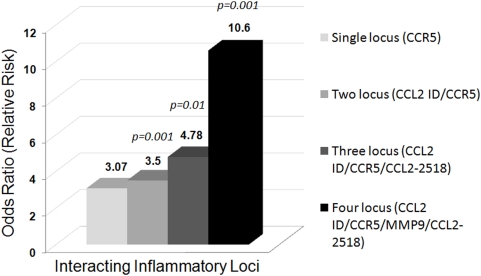
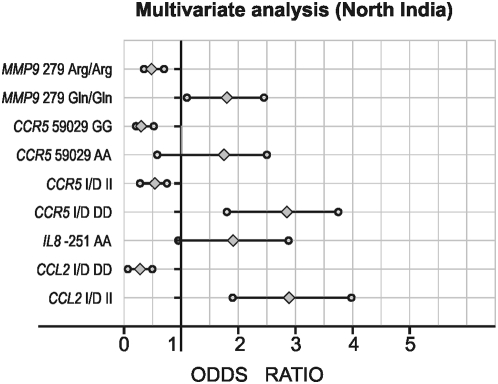
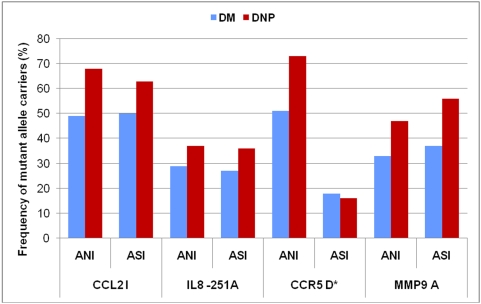
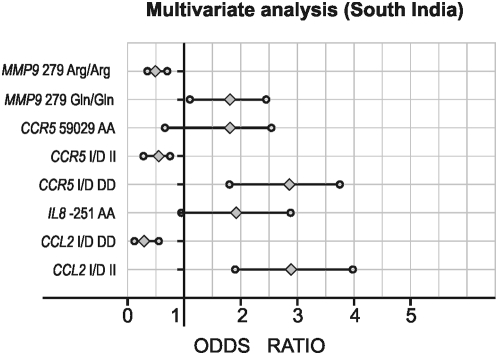
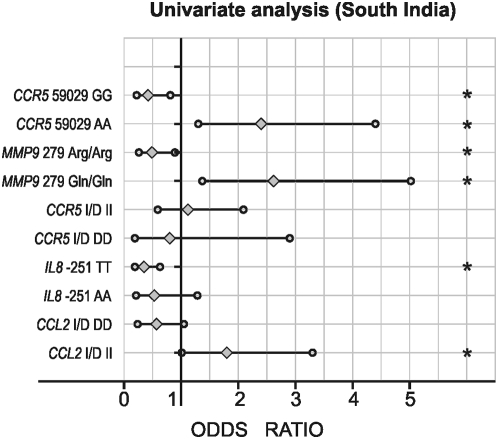
METHODOLOGY/PRINCIPAL FINDINGS: Eight single nucleotide polymorphisms (SNPs) of pro-inflammatory cytokine genes (CCL2, TGFB1, IL8, CCR5, and MMP9) were genotyped in two independently ascertained type 2 diabetic cohorts with (DN) and without nephropathy (DM); consisting of patients from North India (n = 495) and South India (n = 188). Genotyping was carried out using PCR, allele specific oligonucleotide-PCR (ASO-PCR), PCR-RFLP and TaqMan allelic discrimination assays and the gene-gene interaction among genetic variants were determined by multi dimensional reduction (MDR) software. Serum high sensitive CRP (hs-CRP) levels were measured by ELISA. The hs-CRP levels were significantly higher in DN as compared to the DM group (p<0.05). The CCL2, IL8, CCR5 and MMP9 polymorphisms were found to be associated with the risk of diabetic nephropathy. Frequency of CCL2 II, IL8 -251AA, CCR5 59029AA and MMP9 279Gln/Gln genotypes were significantly higher in DN than in DM group (p<0.05) and associated with an increased risk of nephropathy in both North and South Indian cohorts. CCR5 DD and IL8 -251AA genotypes were more prevalent in North Indian DN group only. The co-occurrence of risk associated genotypes (II, -2518GG (CCL2), DD (CCR5) and 279Gln/Gln (MMP9) conferred a tenfold increased risk of nephropathy among type 2 diabetics (p<0.0002).
The present study highlights that common variants of inflammatory cytokine genes exert a modest effect on risk of DN and a combination of risk alleles confer a substantial increased risk of nephropathy in type 2 diabetes among Asian Indians.
炎症细胞因子基因已被认为是导致糖尿病肾病易感性的良好候选基因。在本研究中,我们检测了促炎细胞因子基因多个等位基因的联合作用,以确定2型糖尿病患者发生肾病的风险。
方法/主要发现:在两个独立确定的有(DN)和无肾病(DM)的2型糖尿病队列中,对促炎细胞因子基因(CCL2、TGFB1、IL8、CCR5和MMP9)的8个单核苷酸多态性(SNP)进行基因分型;这些队列由来自北印度(n = 495)和南印度(n = 188)的患者组成。使用聚合酶链反应(PCR)、等位基因特异性寡核苷酸PCR(ASO-PCR)、PCR-限制性片段长度多态性(PCR-RFLP)和TaqMan等位基因鉴别分析进行基因分型,并通过多维度约简(MDR)软件确定遗传变异之间的基因-基因相互作用。通过酶联免疫吸附测定(ELISA)测量血清高敏C反应蛋白(hs-CRP)水平。与DM组相比,DN组的hs-CRP水平显著更高(p<0.05)。发现CCL2、IL8、CCR5和MMP9多态性与糖尿病肾病风险相关。DN组中CCL2 II、IL8 -251AA、CCR5 59029AA和MMP9 279Gln/Gln基因型的频率显著高于DM组(p<0.05),并且在北印度和南印度队列中均与肾病风险增加相关。CCR5 DD和IL8 -251AA基因型仅在北印度DN组中更常见。风险相关基因型(II、-2518GG(CCL2)、DD(CCR5)和279Gln/Gln(MMP9))的共同出现使2型糖尿病患者发生肾病的风险增加了10倍(p<0.0002)。
本研究强调,炎症细胞因子基因的常见变异对DN风险有适度影响,并且风险等位基因的组合使亚洲印度人2型糖尿病患者发生肾病的风险大幅增加。