Zhan Aibin, Li Cheng, Fu Jinzhong
Department of Integrative Biology, University of Guelph, Guelph, Ontario, N1G 2W1, Canada.
BMC Genet. 2009 Apr 9;10:17. doi: 10.1186/1471-2156-10-17.
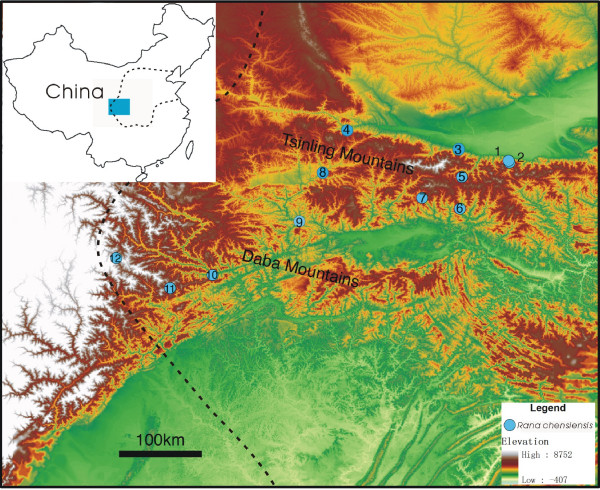
Amphibians in general are poor dispersers and highly philopatric, and landscape features often have important impacts on their population genetic structure and dispersal patterns. Numerous studies have suggested that genetic differentiation among amphibian populations are particularly pronounced for populations separated by mountain ridges. The Tsinling Mountain range of northern China is a major mountain chain that forms the boundary between the Oriental and Palearctic zoogeographic realms. We studied the population structure of the Chinese wood frog (Rana chensinensis) to test whether the Tsinling Mountains and the nearby Daba Mountains impose major barriers to gene flow.
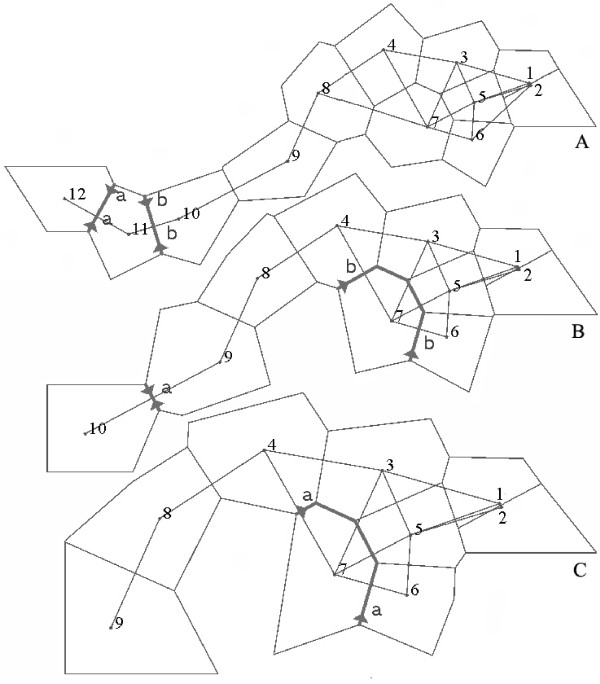
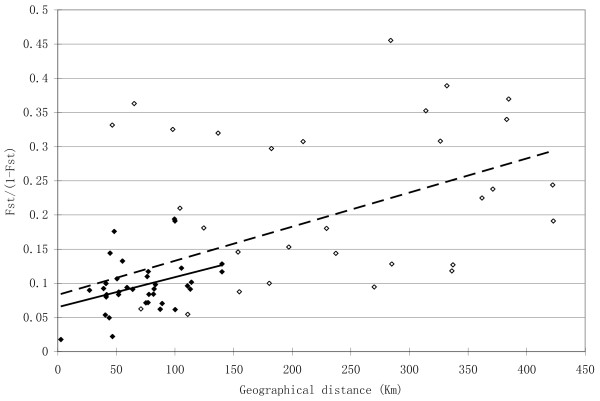
Using 13 polymorphic microsatellite DNA loci, 523 individuals from 12 breeding sites with geographical distances ranging from 2.6 to 422.8 kilometers were examined. Substantial genetic diversity was detected at all sites with an average of 25.5 alleles per locus and an expected heterozygosity ranging from 0.504 to 0.855, and two peripheral populations revealed significantly lower genetic diversity than the central populations. In addition, the genetic differentiation among the central populations was statistically significant, with pairwise FST values ranging from 0.0175 to 0.1625 with an average of 0.0878. Furthermore, hierarchical AMOVA analysis attributed most genetic variation to the within-population component, and the between-population variation can largely be explained by isolation-by-distance. None of the putative barriers detected from genetic data coincided with the location of the Tsinling Mountains.
The Tsinling and Daba Mountains revealed no significant impact on the population genetic structure of R. chensinensis. High population connectivity and extensive juvenile dispersal may account for the significant, but moderate differentiation between populations. Chinese wood frogs are able to use streams as breeding sites at high elevations, which may significantly contribute to the diminishing barrier effect of mountain ridges. Additionally, a significant decrease in genetic diversity in the peripheral populations supports Mayr's central-peripheral population hypothesis.
一般来说,两栖动物扩散能力较差且具有很强的恋巢性,景观特征往往对其种群遗传结构和扩散模式有重要影响。众多研究表明,对于被山脊分隔的两栖动物种群,其种群间的遗传分化尤为明显。中国北方的秦岭山脉是一条主要山脉,构成了东洋界和古北界动物地理区域的分界线。我们研究了中国林蛙(Rana chensinensis)的种群结构,以测试秦岭山脉和附近的大巴山是否对基因流构成主要障碍。
使用13个多态性微卫星DNA位点,对来自12个繁殖地点、地理距离在2.6至422.8公里之间的523个个体进行了检测。在所有地点均检测到丰富的遗传多样性,每个位点平均有25.5个等位基因,预期杂合度在0.504至0.855之间,两个边缘种群的遗传多样性显著低于中心种群。此外,中心种群之间的遗传分化具有统计学意义,成对FST值在0.0175至0.1625之间,平均为0.0878。此外,层次AMOVA分析表明,大部分遗传变异归因于种群内部分,种群间变异在很大程度上可以用距离隔离来解释。从遗传数据中检测到的假定障碍均与秦岭山脉的位置不重合。
秦岭和大巴山对中国林蛙的种群遗传结构没有显著影响。高种群连通性和广泛的幼体扩散可能是种群之间显著但适度分化的原因。中国林蛙能够利用高海拔溪流作为繁殖地点,这可能显著降低了山脊的屏障效应。此外,边缘种群遗传多样性的显著降低支持了迈尔的中心-边缘种群假说。