Geng Weidong, Hill Kathy, Zerwekh Joseph E, Kohler Thomas, Müller Ralph, Moe Orson W
Charles and Jane Pak Center for Mineral Metabolism and Clinical Research, University of Texas, Southwestern Medical Center at Dallas, Dallas, TX 75390-8885, USA.
J Cell Physiol. 2009 Aug;220(2):332-40. doi: 10.1002/jcp.21767.
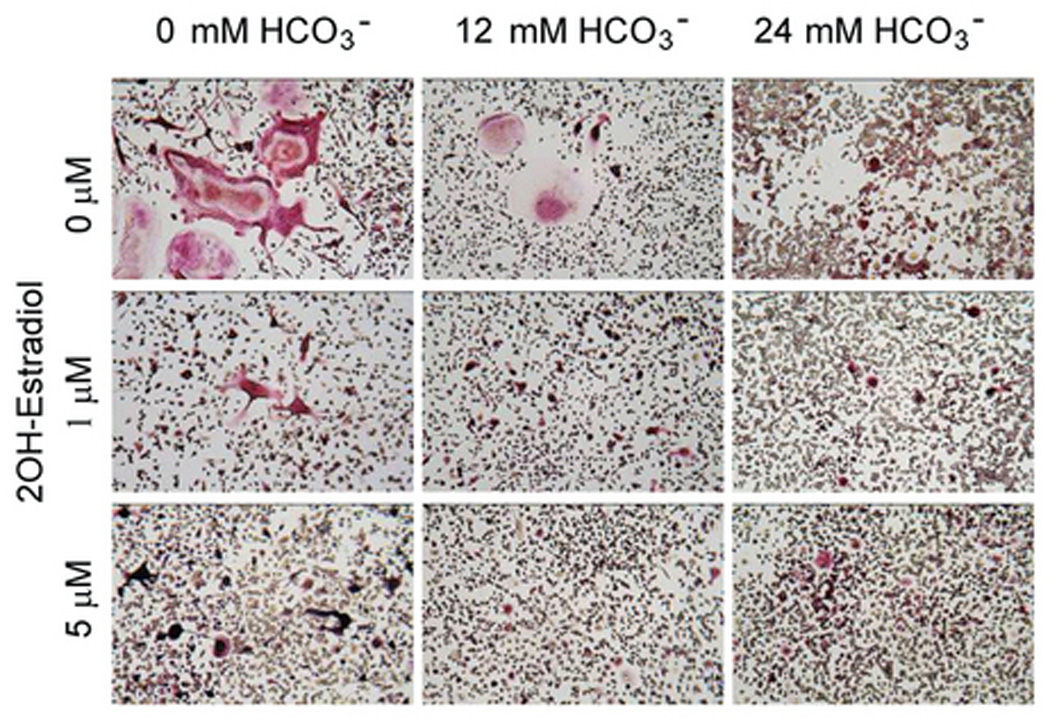
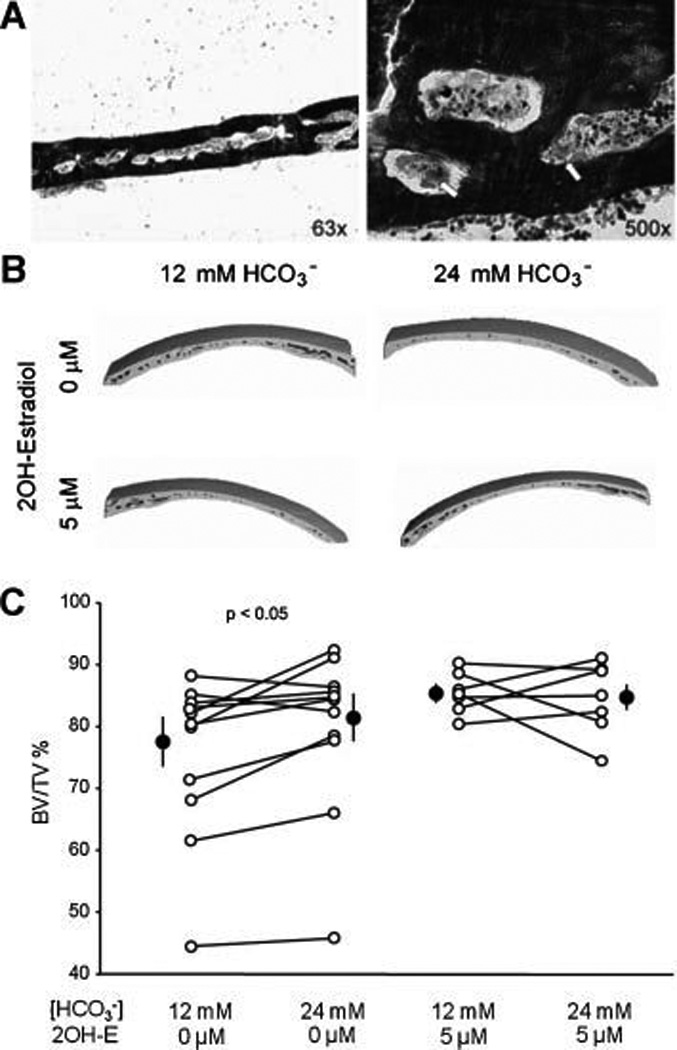
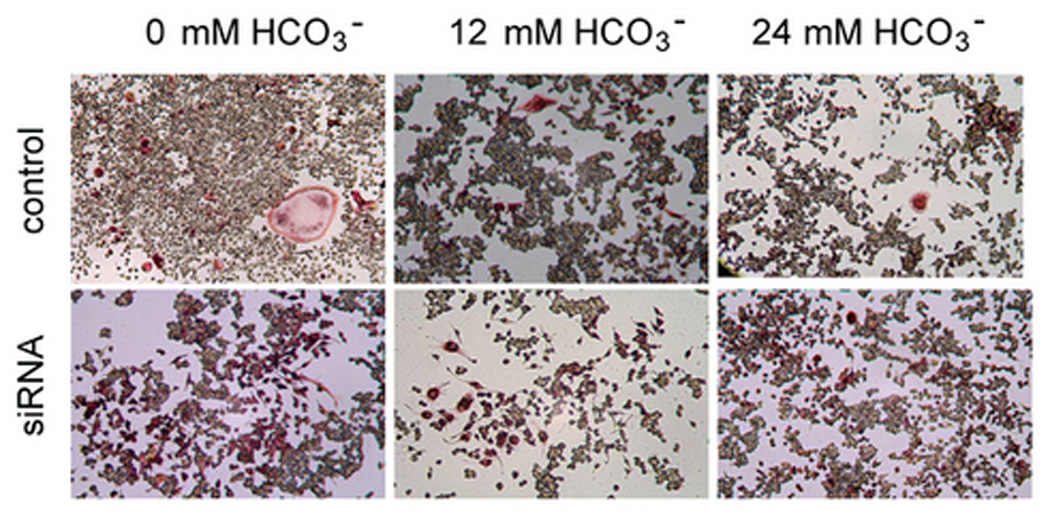
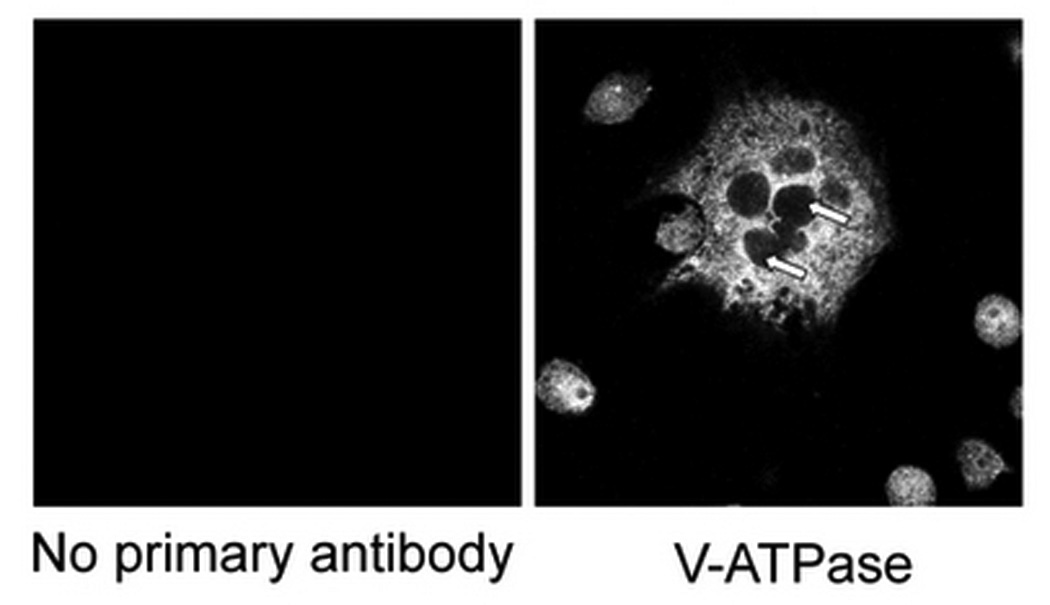
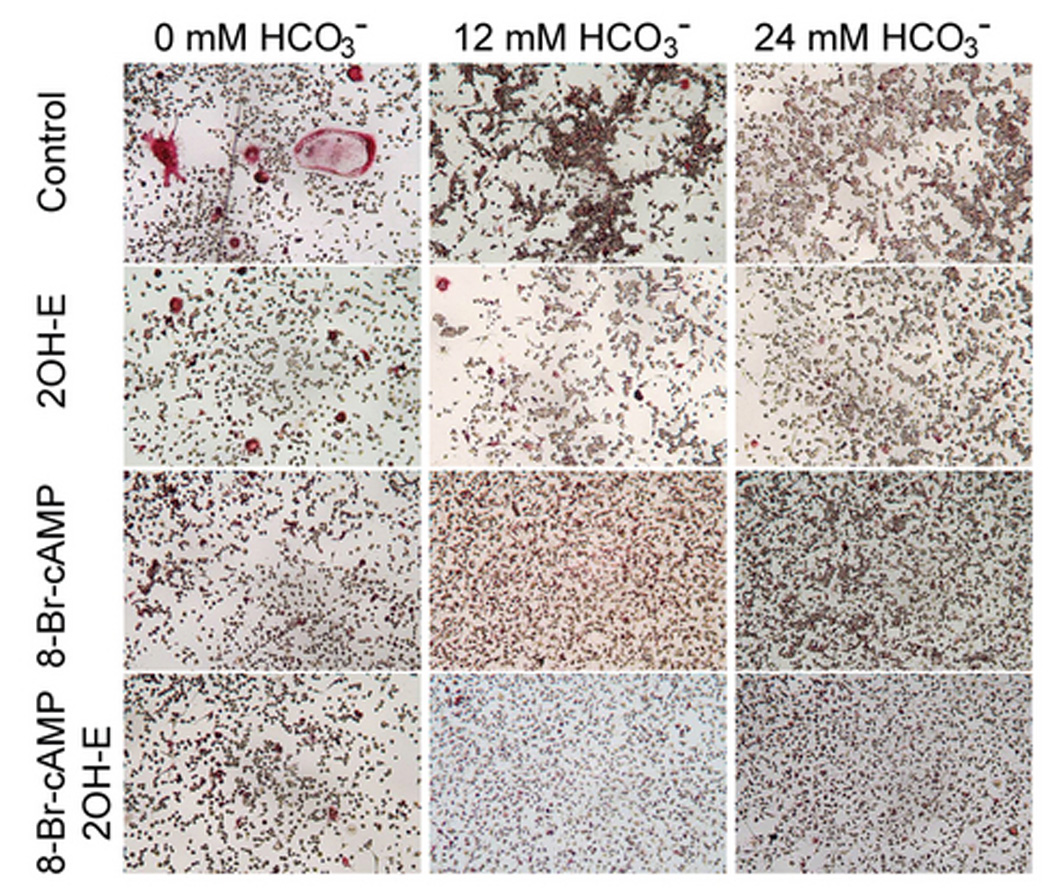
High [HCO(3)(-)] inhibits and low [HCO(3)(-)] stimulates bone resorption, which mediates part of the effect of chronic acidosis or acid feeding on bone. Soluble adenylyl cyclase (sAC) is a bicarbonate sensor that can potentially mediate the effect of bicarbonate on osteoclasts. Osteoclasts were incubated in 0, 12, and 24 mM HCO(3)(-) at pH 7.4 for 7-8 days and assayed for tartrate-resistant acid phosphatase (TRAP) and vacuolar-ATPase expression, and H+ accumulation. Total number and area of TRAP (+) multinucleated osteoclasts was decreased by HCO(3)(-) in a dose-dependent manner. V-ATPase expression and H+ accumulation normalized to cell cross-sectional area or protein were not significantly changed. The HCO(3)(-) -induced inhibition of osteoclast growth and differentiation was blocked by either 2-hydroxyestradiol, an inhibitor of sAC or sAC knockdown by sAC specific siRNA. The model of HCO(3)(-) inhibiting osteoclast via sAC was further supported by the fact that the HCO(3)(-) dose-response on osteoclasts is flat when cells were saturated with 8-bromo-cAMP, a permeant cAMP analog downstream from sAC thus simulating sAC activation. To confirm our in vitro findings in intact bone, we developed a 1-week mouse calvaria culture system where osteoclasts were shown to be viable. Bone volume density (BV/TV) determined by micro-computed tomography (microCT), was higher in 24 mM HCO(3)(-) compared to 12 mM HCO(3)(-) treated calvaria. This HCO(3)(-) effect on BV/TV was blocked by 2-hydroxyestradiol. In summary, sAC mediates the inhibition of osteoclast function by HCO(3)(-), by acting as a HCO(3)(-) sensor.
高[HCO₃⁻]抑制而低[HCO₃⁻]刺激骨吸收,这介导了慢性酸中毒或酸摄入对骨骼影响的部分作用。可溶性腺苷酸环化酶(sAC)是一种碳酸氢盐传感器,可能介导碳酸氢盐对破骨细胞的作用。将破骨细胞在pH 7.4的0、12和24 mM HCO₃⁻中孵育7 - 8天,并检测抗酒石酸酸性磷酸酶(TRAP)和液泡型ATP酶表达以及H⁺积累。TRAP(+)多核破骨细胞的总数和面积随HCO₃⁻呈剂量依赖性减少。以细胞横截面积或蛋白质标准化的V - ATP酶表达和H⁺积累没有显著变化。sAC抑制剂2 - 羟基雌二醇或sAC特异性siRNA敲低sAC可阻断HCO₃⁻诱导的破骨细胞生长和分化抑制。当细胞用8 - 溴 - cAMP(一种sAC下游的渗透性cAMP类似物,从而模拟sAC激活)饱和时,HCO₃⁻对破骨细胞的剂量反应呈平坦状态,这一事实进一步支持了HCO₃⁻通过sAC抑制破骨细胞的模型。为了在完整骨骼中证实我们的体外研究结果,我们建立了一个为期1周的小鼠颅骨培养系统,其中破骨细胞显示为存活状态。通过微计算机断层扫描(microCT)测定的骨体积密度(BV/TV),在24 mM HCO₃⁻处理的颅骨中高于12 mM HCO₃⁻处理的颅骨。2 - 羟基雌二醇可阻断HCO₃⁻对BV/TV的这种作用。总之,sAC作为一种HCO₃⁻传感器,介导了HCO₃⁻对破骨细胞功能的抑制。