Ferrucci Leah M, Sinha Rashmi, Graubard Barry I, Mayne Susan T, Ma Xiaomei, Schatzkin Arthur, Schoenfeld Philip S, Cash Brooks D, Flood Andrew, Cross Amanda J
Division of Cancer Epidemiology and Genetics, National Cancer Institute, National Institutes of Health, Department of Health and Human Services, Bethesda, Maryland, USA.
Am J Gastroenterol. 2009 May;104(5):1231-40. doi: 10.1038/ajg.2009.102. Epub 2009 Apr 14.
No previous study has concurrently assessed the associations between meat intake, meat-cooking methods and doneness levels, meat mutagens (heterocyclic amines (HCAs) and polycyclic aromatic hydrocarbons), heme iron, and nitrite from meat and colorectal adenoma in asymptomatic women undergoing colonoscopy.
Of the 807 eligible women in a cross-sectional multicenter colonoscopy screening study, 158 prevalent colorectal adenoma cases and 649 controls satisfactorily completed the validated food frequency and meat questionnaires. Using an established meat mutagen database and new heme iron and nitrite databases, we comprehensively investigated the components of meat that may be involved in carcinogenesis. Using logistic regression, we estimated odds ratios (ORs) and 95% confidence intervals (CIs) within quartiles of meat-related variables.
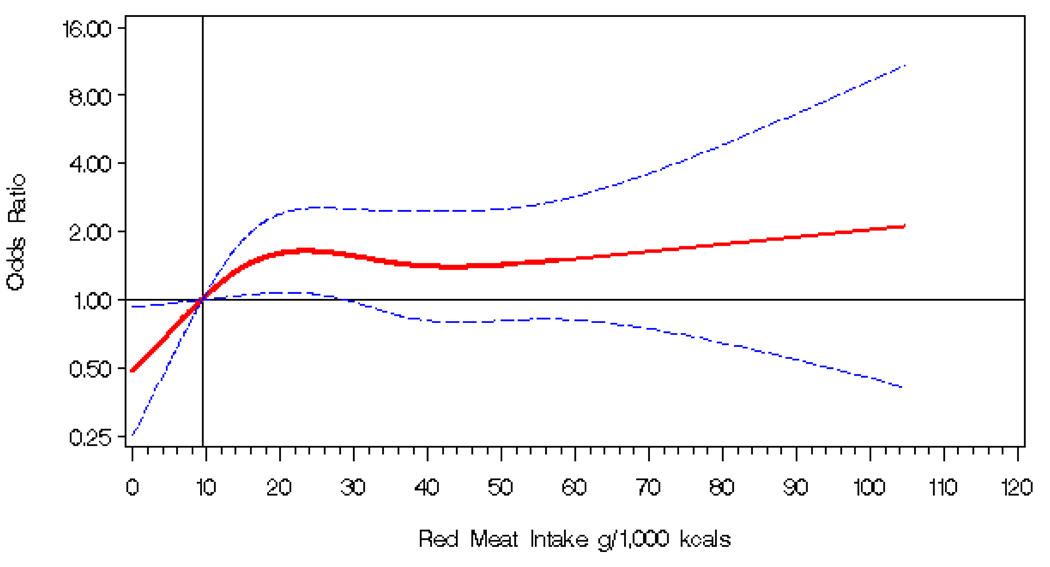
Red meat was associated positively with colorectal adenoma (OR fourth vs. first quartile = 2.02; 95% CI = 1.06-3.83; P trend = 0.38). Intake of pan-fried meat (OR = 1.72; 95% CI = 0.96-3.07; P trend = 0.01) and the HCA: 2-amino-3,8-dimethylimidazo[4,5-f]quinoxaline (MeIQx) (OR = 1.90; 95% CI = 1.05-3.42; P trend = 0.07) were also associated with an increased risk of colorectal adenoma. The new databases yielded lower estimates of heme iron and nitrite than previous assessment methods, although the two methods were highly correlated for both exposures. Although not statistically significant, there were positive associations between iron and heme iron from meat and colorectal adenoma.
In asymptomatic women undergoing colonoscopy, colorectal adenomas were associated with high intake of red meat, pan-fried meat, and the HCA MeIQx. Other meat-related exposures require further investigation.
既往尚无研究同时评估肉类摄入量、肉类烹饪方法及熟度水平、肉类诱变剂(杂环胺(HCAs)和多环芳烃)、血红素铁以及肉类中的亚硝酸盐与接受结肠镜检查的无症状女性患结直肠腺瘤之间的关联。
在一项横断面多中心结肠镜筛查研究的807名符合条件的女性中,158例结直肠腺瘤现患病例和649名对照者圆满完成了经过验证的食物频率和肉类问卷。利用一个已建立的肉类诱变剂数据库以及新的血红素铁和亚硝酸盐数据库,我们全面调查了可能参与致癌过程的肉类成分。采用逻辑回归分析,我们估计了肉类相关变量四分位数范围内的比值比(OR)和95%置信区间(CI)。
红肉与结直肠腺瘤呈正相关(第四四分位数与第一四分位数相比,OR = 2.02;95%CI = 1.06 - 3.83;P趋势 = 0.38)。煎肉摄入量(OR = 1.72;95%CI = 0.96 - 3.07;P趋势 = 0.01)以及HCA:2 - 氨基 - 3,8 - 二甲基咪唑并[4,5 - f]喹喔啉(MeIQx)(OR = 1.90;95%CI = 1.05 - 3.42;P趋势 = 0.07)也与结直肠腺瘤风险增加相关。尽管两种方法对两种暴露的相关性都很高,但新数据库得出的血红素铁和亚硝酸盐估计值低于先前的评估方法。虽然无统计学意义,但肉类中的铁和血红素铁与结直肠腺瘤之间存在正相关。
在接受结肠镜检查的无症状女性中,结直肠腺瘤与红肉、煎肉及HCA MeIQx的高摄入量相关。其他与肉类相关的暴露因素需要进一步研究。