de Groot Arjan, Dulermo Rémi, Ortet Philippe, Blanchard Laurence, Guérin Philippe, Fernandez Bernard, Vacherie Benoit, Dossat Carole, Jolivet Edmond, Siguier Patricia, Chandler Michael, Barakat Mohamed, Dedieu Alain, Barbe Valérie, Heulin Thierry, Sommer Suzanne, Achouak Wafa, Armengaud Jean
Laboratory of Microbial Ecology of the Rhizosphere and Extreme Environments (LEMiRE), Saint-Paul-lez-Durance, France.
PLoS Genet. 2009 Mar;5(3):e1000434. doi: 10.1371/journal.pgen.1000434. Epub 2009 Mar 27.
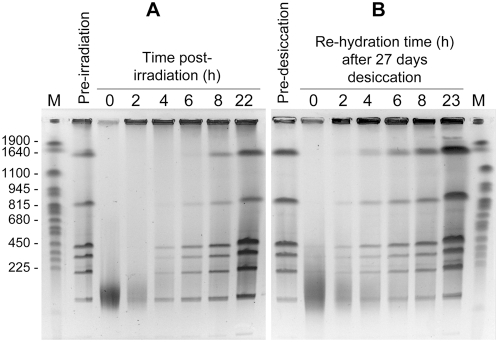
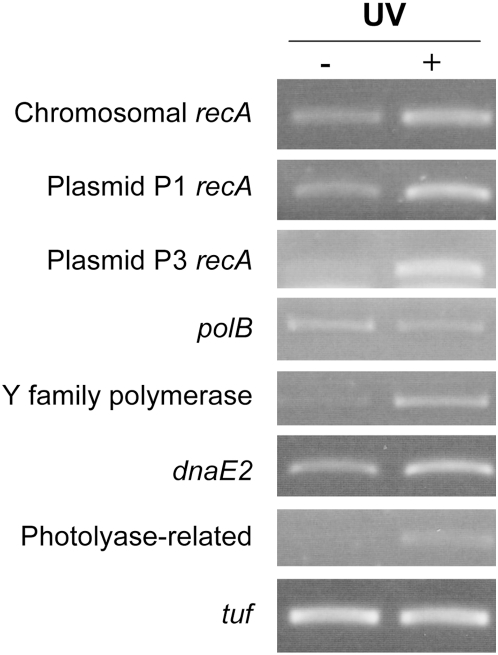
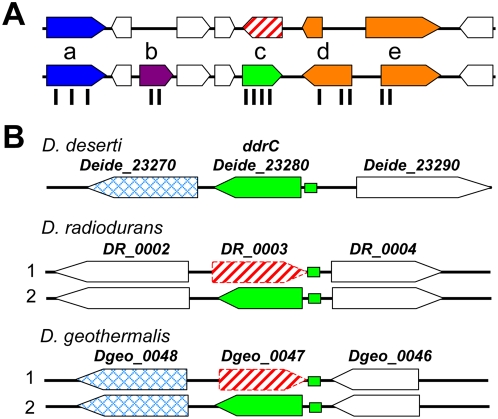
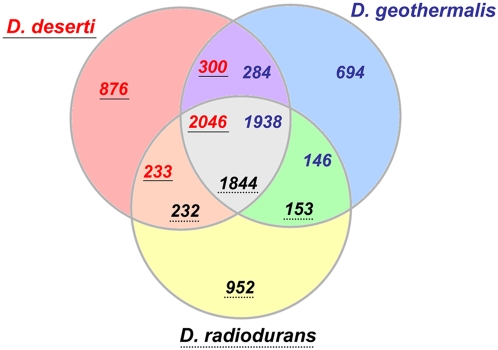
To better understand adaptation to harsh conditions encountered in hot arid deserts, we report the first complete genome sequence and proteome analysis of a bacterium, Deinococcus deserti VCD115, isolated from Sahara surface sand. Its genome consists of a 2.8-Mb chromosome and three large plasmids of 324 kb, 314 kb, and 396 kb. Accurate primary genome annotation of its 3,455 genes was guided by extensive proteome shotgun analysis. From the large corpus of MS/MS spectra recorded, 1,348 proteins were uncovered and semiquantified by spectral counting. Among the highly detected proteins are several orphans and Deinococcus-specific proteins of unknown function. The alliance of proteomics and genomics high-throughput techniques allowed identification of 15 unpredicted genes and, surprisingly, reversal of incorrectly predicted orientation of 11 genes. Reversal of orientation of two Deinococcus-specific radiation-induced genes, ddrC and ddrH, and identification in D. deserti of supplementary genes involved in manganese import extend our knowledge of the radiotolerance toolbox of Deinococcaceae. Additional genes involved in nutrient import and in DNA repair (i.e., two extra recA, three translesion DNA polymerases, a photolyase) were also identified and found to be expressed under standard growth conditions, and, for these DNA repair genes, after exposure of the cells to UV. The supplementary nutrient import and DNA repair genes are likely important for survival and adaptation of D. deserti to its nutrient-poor, dry, and UV-exposed extreme environment.
为了更好地理解生物对炎热干旱沙漠中恶劣条件的适应情况,我们报告了从撒哈拉沙漠表层沙子中分离出的一种细菌——沙漠嗜放射菌VCD115的首个完整基因组序列和蛋白质组分析结果。其基因组由一条2.8兆碱基的染色体和三个分别为324千碱基、314千碱基和396千碱基的大质粒组成。对其3455个基因进行准确的初步基因组注释是在广泛的蛋白质组鸟枪法分析的指导下完成的。从记录的大量串联质谱(MS/MS)谱图中,通过谱图计数发现并半定量了1348种蛋白质。在检测频率较高的蛋白质中,有几种孤儿蛋白和功能未知的嗜放射菌特异性蛋白质。蛋白质组学和基因组学高通量技术的结合使得鉴定出15个未预测到的基因,而且令人惊讶的是,纠正了11个基因错误预测的方向。两个嗜放射菌特异性辐射诱导基因ddrC和ddrH方向的逆转,以及在沙漠嗜放射菌中鉴定出参与锰摄取的补充基因,扩展了我们对嗜放射菌科辐射耐受性工具箱的认识。还鉴定出了参与营养物质摄取和DNA修复的其他基因(即两个额外的recA、三个跨损伤DNA聚合酶、一个光解酶),并发现它们在标准生长条件下表达,对于这些DNA修复基因,在细胞暴露于紫外线后也会表达。补充的营养物质摄取和DNA修复基因可能对沙漠嗜放射菌在其营养匮乏、干燥且暴露于紫外线的极端环境中的生存和适应很重要。