Suzuki Jun, Yamaguchi Katsumi, Kajikawa Masaki, Ichiyanagi Kenji, Adachi Noritaka, Koyama Hideki, Takeda Shunichi, Okada Norihiro
Graduate School of Bioscience and Biotechnology, Tokyo Institute of Technology, Midori-ku, Yokohama, Kanagawa, Japan.
PLoS Genet. 2009 Apr;5(4):e1000461. doi: 10.1371/journal.pgen.1000461. Epub 2009 Apr 24.
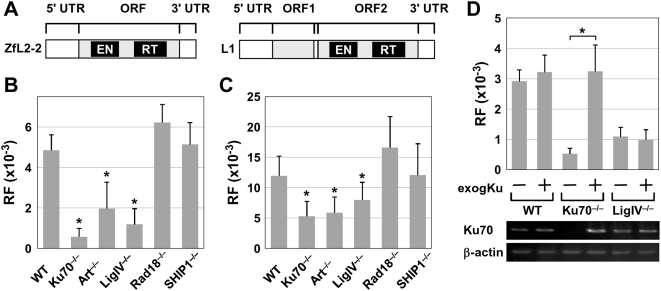
Long interspersed elements (LINEs) are transposable elements that proliferate within eukaryotic genomes, having a large impact on eukaryotic genome evolution. LINEs mobilize via a process called retrotransposition. Although the role of the LINE-encoded protein(s) in retrotransposition has been extensively investigated, the participation of host-encoded factors in retrotransposition remains unclear. To address this issue, we examined retrotransposition frequencies of two structurally different LINEs--zebrafish ZfL2-2 and human L1--in knockout chicken DT40 cell lines deficient in genes involved in the non-homologous end-joining (NHEJ) repair of DNA and in human HeLa cells treated with a drug that inhibits NHEJ. Deficiencies of NHEJ proteins decreased retrotransposition frequencies of both LINEs in these cells, suggesting that NHEJ is involved in LINE retrotransposition. More precise characterization of ZfL2-2 insertions in DT40 cells permitted us to consider the possibility of dual roles for NHEJ in LINE retrotransposition, namely to ensure efficient integration of LINEs and to restrict their full-length formation.
长散在元件(LINEs)是在真核生物基因组中增殖的转座元件,对真核生物基因组进化有重大影响。LINEs通过一种称为逆转座的过程进行移动。尽管LINE编码蛋白在逆转座中的作用已得到广泛研究,但宿主编码因子在逆转座中的参与情况仍不清楚。为了解决这个问题,我们检测了两种结构不同的LINEs——斑马鱼ZfL2-2和人类L1——在参与DNA非同源末端连接(NHEJ)修复的基因缺失的敲除鸡DT40细胞系中以及在用抑制NHEJ的药物处理的人类HeLa细胞中的逆转座频率。NHEJ蛋白的缺失降低了这些细胞中两种LINEs的逆转座频率,这表明NHEJ参与了LINE的逆转座。对DT40细胞中ZfL2-2插入的更精确表征使我们能够考虑NHEJ在LINE逆转座中的双重作用的可能性,即确保LINEs的有效整合并限制其全长形成。