Yamaguchi Katsumi, Kajikawa Masaki, Okada Norihiro
Graduate School of Bioscience and Biotechnology, Tokyo Institute of Technology, 4259-B-15 Nagatsuta-cho, Midori-ku, Yokohama, Kanagawa 226-8501, Japan.
Graduate School of Bioscience and Biotechnology, Tokyo Institute of Technology, 4259-B-15 Nagatsuta-cho, Midori-ku, Yokohama, Kanagawa 226-8501, Japan
Nucleic Acids Res. 2014 Dec 1;42(21):13269-79. doi: 10.1093/nar/gku1067. Epub 2014 Nov 6.
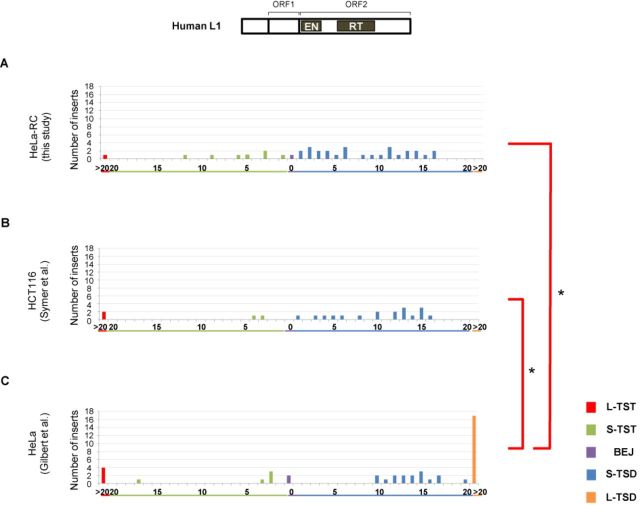
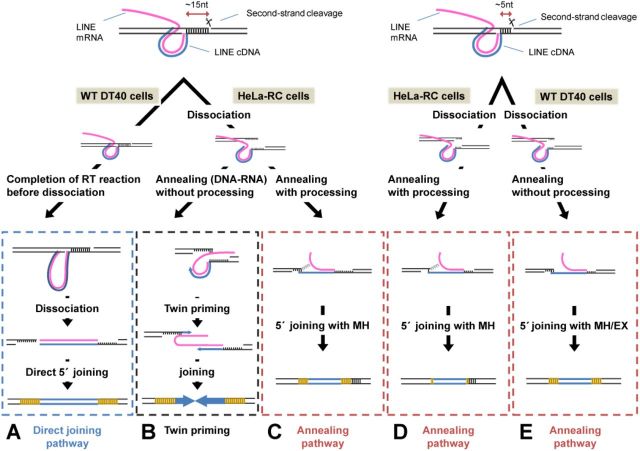
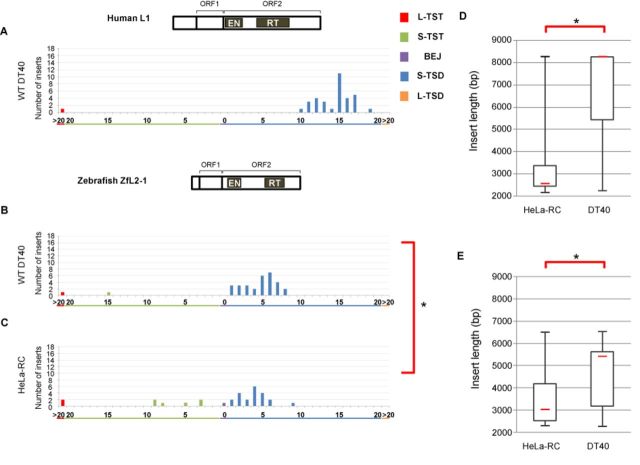
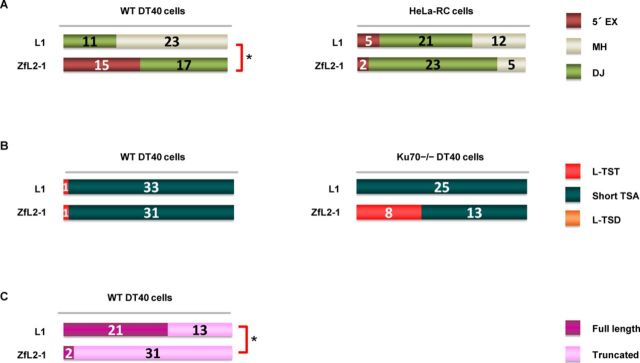
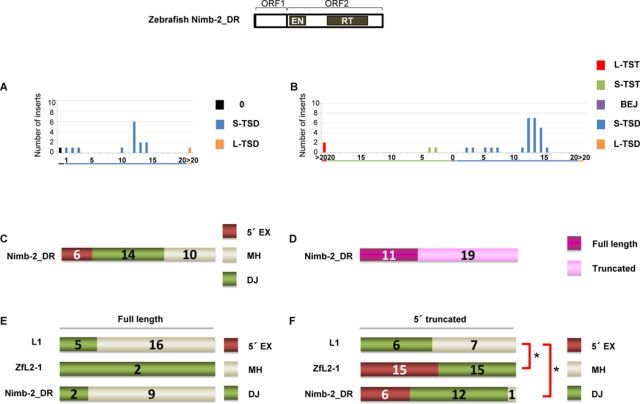
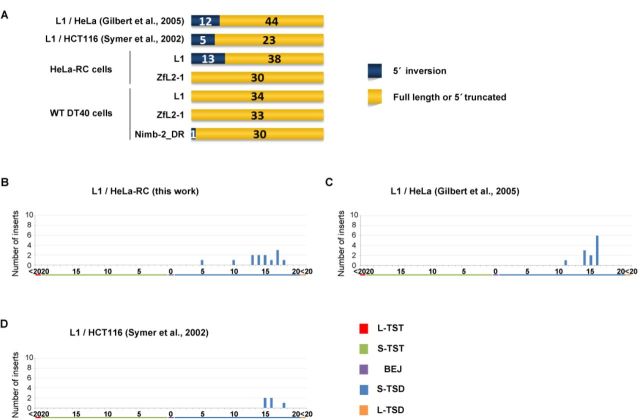
To elucidate the molecular mechanism of the integration of long interspersed elements (LINEs), we characterized the 5' ends of more than 200 LINE de novo retrotransposition events into chicken DT40 or human HeLa cells. Human L1 inserts produced 15-bp target-site duplications (TSDs) and zebrafish ZfL2-1 inserts produced 5-bp TSDs in DT40 cells, suggesting that TSD length depends on the LINE species. Further analysis of 5' junctions revealed that the 5'-end-joining pathways of LINEs can be divided into two fundamental types-annealing or direct. We also found that the generation of 5' inversions depends on host and LINE species. These results led us to propose a new model for 5'-end joining, the type of which is determined by the extent of exposure of 3' overhangs generated after the second-strand cleavage and by the involvement of host factors.
为阐明长散在元件(LINEs)整合的分子机制,我们对200多个LINEs从头逆转录转座事件插入鸡DT40细胞或人HeLa细胞的5'端进行了表征。人L1插入在DT40细胞中产生了15 bp的靶位点重复序列(TSDs),斑马鱼ZfL2 - 1插入产生了5 bp的TSDs,这表明TSD长度取决于LINEs种类。对5'连接的进一步分析表明,LINEs的5'末端连接途径可分为两种基本类型——退火型或直接型。我们还发现5'倒位的产生取决于宿主和LINEs种类。这些结果使我们提出了一种新的5'末端连接模型,其类型由第二条链切割后产生的3'突出端的暴露程度以及宿主因子的参与情况决定。