Uberti M Georgina, Ko Francis, Pierpont Yvonne N, Johnson Erika L, Wright Terry E, Smith Charlotte A, Robson Martin C, Payne Wyatt G
Institute for Tissue Regeneration, Repair, and Rehabilitation, Bay Pines VAHCS, Bay Pines, FL, USA.
Eplasty. 2009;9:e12. Epub 2009 Mar 25.
Meshed, split-thickness skin grafts, especially when required to be widely spread, do not obtain immediate biologic closure. In patients with burns that cover a large percentage of the body surface area, this leaves the patient at risk for metabolic problems and life-threatening infection.
The purpose of this study was to determine whether amnion-derived cellular cytokine solution could improve epithelialization kinetics and accelerate closure of meshed skin graft interstices.
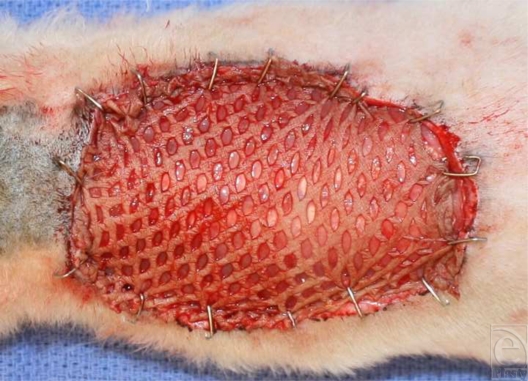
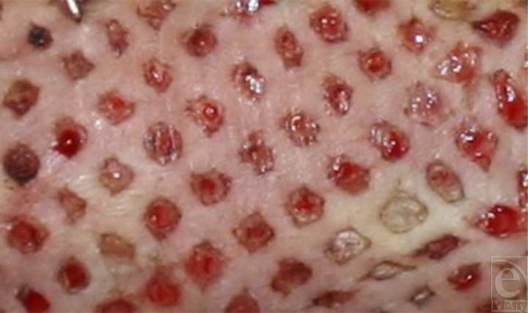
Human meshed, split-thickness skin grafts were explanted to athymic "nude" rats and treated with 3 different regimens of amnion-derived cellular cytokine solution (groups I, II, and III) or normal saline (group IV) as a control. Serial wound tracings of unepithelialized interstitial wound areas were compared over time. Two different preparations of amnion-derived cellular cytokine solution were also compared with one another, one containing animal components and the other free of animal components.
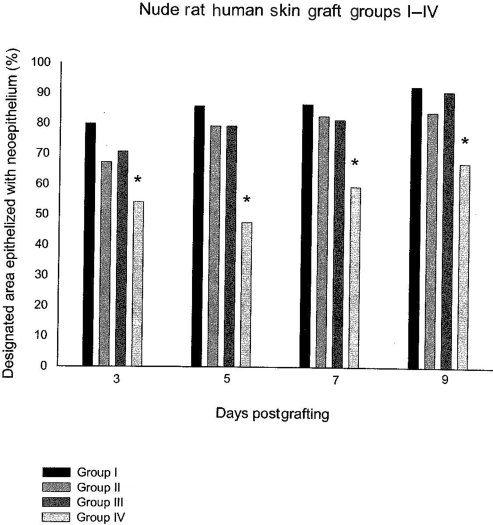
Only 67.03% of interstices in control animals closed by day 9. This compared with 92.2% closure for group I, 83.72% for group II, and 90.64% for group III. Interstices in all 3 groups treated with amnion-derived cellular cytokine solution (with or without animal-derived components) closed faster statistically than in the control animals (P < .05). There were no statistical differences among the 3 amnion-derived cellular cytokine solution-treated groups.
These data suggest that epithelialization kinetics and interstitial closure of meshed skin grafts can be accelerated with the use of amnion-derived cellular cytokine solution, a physiologic cocktail of cytokines, and provide support for a future clinical trial.
网状的、分层厚度的皮肤移植片,尤其是当需要大面积铺开时,无法实现即时生物闭合。在烧伤面积占体表面积很大比例的患者中,这会使患者面临代谢问题和危及生命的感染风险。
本研究的目的是确定羊膜来源的细胞因子溶液是否能改善上皮化动力学并加速网状皮肤移植片间隙的闭合。
将人网状分层厚度皮肤移植片移植到无胸腺“裸”鼠身上,并用3种不同方案的羊膜来源细胞因子溶液(I组、II组和III组)或生理盐水(IV组)作为对照进行处理。随时间比较未上皮化间隙伤口区域的连续伤口追踪情况。还对两种不同制备的羊膜来源细胞因子溶液进行了相互比较,一种含有动物成分,另一种不含动物成分。
到第9天时,对照动物中只有67.03%的间隙闭合。相比之下,I组的闭合率为92.2%,II组为83.72%,III组为90.64%。用羊膜来源细胞因子溶液(有或无动物来源成分)处理的所有3组间隙在统计学上比对照动物闭合得更快(P <.05)。3个羊膜来源细胞因子溶液处理组之间无统计学差异。
这些数据表明,使用羊膜来源细胞因子溶液(一种细胞因子的生理混合物)可以加速网状皮肤移植片的上皮化动力学和间隙闭合,并为未来的临床试验提供支持。