Cornelissen Piers L, Kringelbach Morten L, Ellis Andrew W, Whitney Carol, Holliday Ian E, Hansen Peter C
Department of Psychology, University of York, York, UK.
PLoS One. 2009;4(4):e5359. doi: 10.1371/journal.pone.0005359. Epub 2009 Apr 27.
It is well established that the left inferior frontal gyrus plays a key role in the cerebral cortical network that supports reading and visual word recognition. Less clear is when in time this contribution begins. We used magnetoencephalography (MEG), which has both good spatial and excellent temporal resolution, to address this question.
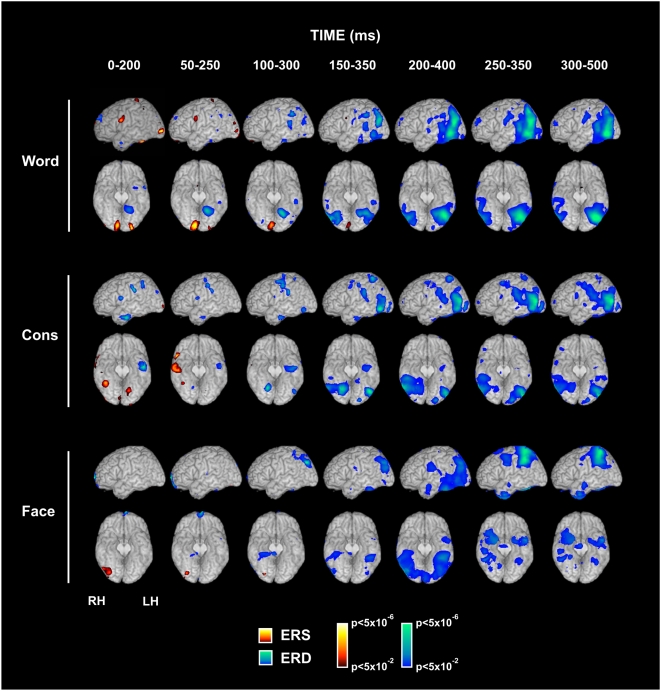
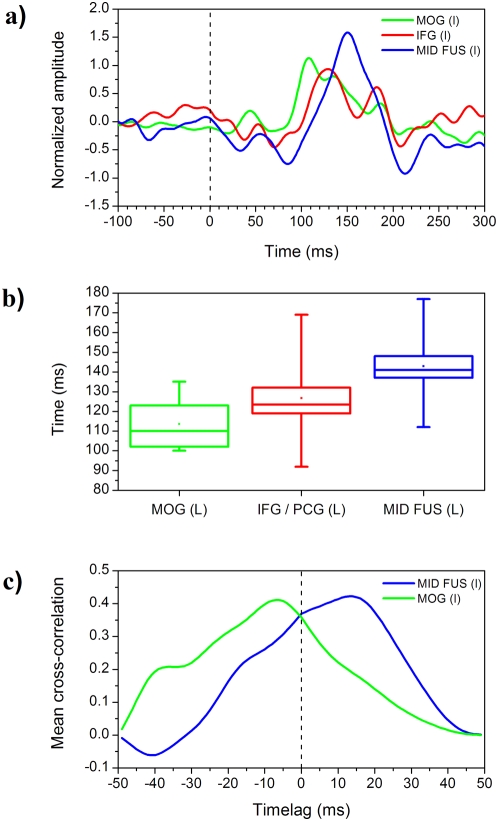
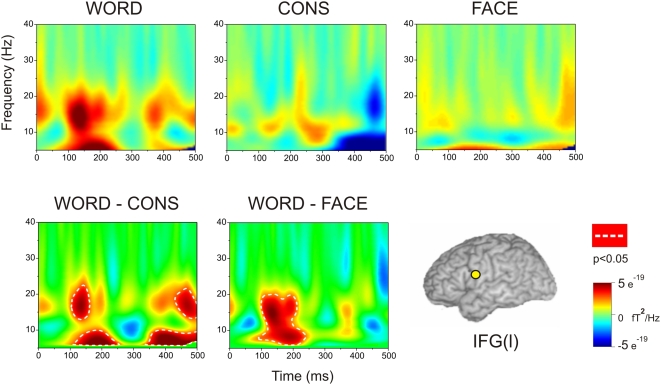
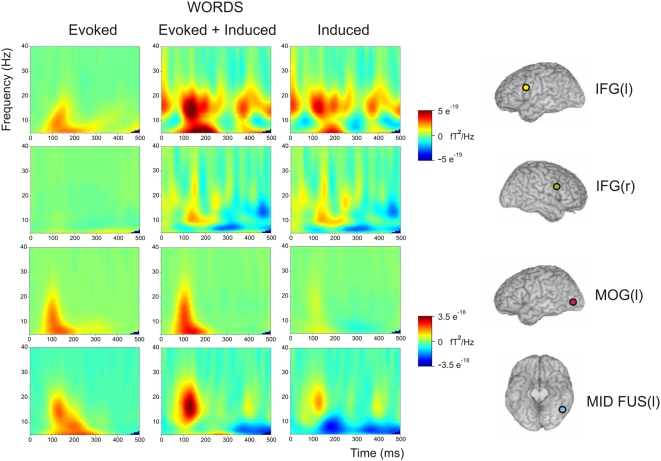
METHODOLOGY/PRINCIPAL FINDINGS: MEG data were recorded during a passive viewing paradigm, chosen to emphasize the stimulus-driven component of the cortical response, in which right-handed participants were presented words, consonant strings, and unfamiliar faces to central vision. Time-frequency analyses showed a left-lateralized inferior frontal gyrus (pars opercularis) response to words between 100-250 ms in the beta frequency band that was significantly stronger than the response to consonant strings or faces. The left inferior frontal gyrus response to words peaked at approximately 130 ms. This response was significantly later in time than the left middle occipital gyrus, which peaked at approximately 115 ms, but not significantly different from the peak response in the left mid fusiform gyrus, which peaked at approximately 140 ms, at a location coincident with the fMRI-defined visual word form area (VWFA). Significant responses were also detected to words in other parts of the reading network, including the anterior middle temporal gyrus, the left posterior middle temporal gyrus, the angular and supramarginal gyri, and the left superior temporal gyrus.
CONCLUSIONS/SIGNIFICANCE: These findings suggest very early interactions between the vision and language domains during visual word recognition, with speech motor areas being activated at the same time as the orthographic word-form is being resolved within the fusiform gyrus. This challenges the conventional view of a temporally serial processing sequence for visual word recognition in which letter forms are initially decoded, interact with their phonological and semantic representations, and only then gain access to a speech code.
众所周知,左下额回在支持阅读和视觉单词识别的大脑皮层网络中起关键作用。但这种作用在何时开始尚不清楚。我们使用了具有良好空间分辨率和出色时间分辨率的脑磁图(MEG)来解决这个问题。
方法/主要发现:在被动观看范式期间记录MEG数据,该范式旨在强调皮层反应的刺激驱动成分,在此范式中,右利手参与者的中央视觉中呈现单词、辅音串和不熟悉的面孔。时频分析显示,在100 - 250毫秒之间,左下额回( opercularis区)对单词的β频段反应在左侧更为明显,且显著强于对辅音串或面孔的反应。左下额回对单词的反应在约130毫秒时达到峰值。该反应在时间上明显晚于左枕中回,左枕中回在约115毫秒时达到峰值,但与左中梭状回的峰值反应无显著差异,左中梭状回在约140毫秒时达到峰值,其位置与功能磁共振成像(fMRI)定义的视觉单词形式区域(VWFA)一致。在阅读网络的其他部分,包括颞中前回、左颞中后回、角回和缘上回以及左颞上回,也检测到了对单词的显著反应。
结论/意义:这些发现表明,在视觉单词识别过程中,视觉和语言领域之间存在非常早期的相互作用,在梭状回中字形单词形式得到解析的同时,语音运动区域也被激活。这挑战了视觉单词识别的时间序列处理传统观点,即字母形式最初被解码,与它们的语音和语义表征相互作用,然后才获得语音代码。