R&D L'Oréal, Clark, NJ, USA,
J Cell Commun Signal. 2009 Jun;3(2):153-7. doi: 10.1007/s12079-009-0051-9. Epub 2009 Apr 28.
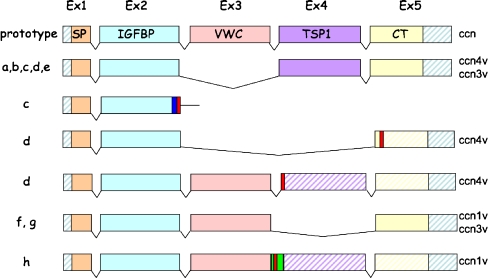
Variant CCN proteins have been identified over the past decade in several normal and pathological situations. The production of CCN truncated proteins have been reported in the case of CCN2(ctgf), CCN3(nov), CCN4(wisp-1) and CCN6(wisp-3). Furthermore, the natural CCN5 is known to miss the C-terminal domain that is present in all other members of the CCN family of proteins. In spite of compelling evidence that assign important biological activities to these truncated CCN variants, their potential regulatory functions have only recently begun to be widely accepted. The report of CCN1(cyr61) intron 3 retention in breast cancer cells now confirms that, in addition to well documented post-translational processing of full length CCN proteins, alternative splicing is to be regarded as another effective way to generate CCN variants. These observations add to a previous bulk of evidence that support the existence of alternative splicing for other CCN genes. It has become clearly evident that we need to recognize these mechanisms as a means to increase the biological diversity of CCN proteins.
在过去的十年中,已经在几种正常和病理情况下鉴定出了变体 CCN 蛋白。在 CCN2(ctgf)、CCN3(nov)、CCN4(wisp-1)和 CCN6(wisp-3)的情况下,已经报道了 CCN 截断蛋白的产生。此外,天然的 CCN5 被认为缺少存在于 CCN 蛋白家族所有其他成员中的 C 端结构域。尽管有令人信服的证据将重要的生物学活性分配给这些截断的 CCN 变体,但它们的潜在调节功能最近才开始被广泛接受。CCN1(cyr61)在乳腺癌细胞中保留内含子 3 的报告现在证实,除了众所周知的全长 CCN 蛋白的翻译后加工外,选择性剪接也被认为是产生 CCN 变体的另一种有效方法。这些观察结果增加了先前大量支持其他 CCN 基因存在选择性剪接的证据。显然,我们需要将这些机制视为增加 CCN 蛋白生物学多样性的一种手段。