Cencic Regina, Carrier Marilyn, Galicia-Vázquez Gabriela, Bordeleau Marie-Eve, Sukarieh Rami, Bourdeau Annie, Brem Brigitte, Teodoro Jose G, Greger Harald, Tremblay Michel L, Porco John A, Pelletier Jerry
Department of Biochemistry, McGill University, Montreal, Quebec, Canada.
PLoS One. 2009;4(4):e5223. doi: 10.1371/journal.pone.0005223. Epub 2009 Apr 29.
Flavaglines are a family of natural products from the genus Aglaia that exhibit anti-cancer activity in vitro and in vivo and inhibit translation initiation. They have been shown to modulate the activity of eIF4A, the DEAD-box RNA helicase subunit of the eukaryotic initiation factor (eIF) 4F complex, a complex that stimulates ribosome recruitment during translation initiation. One flavagline, silvestrol, is capable of modulating chemosensitivity in a mechanism-based mouse model.
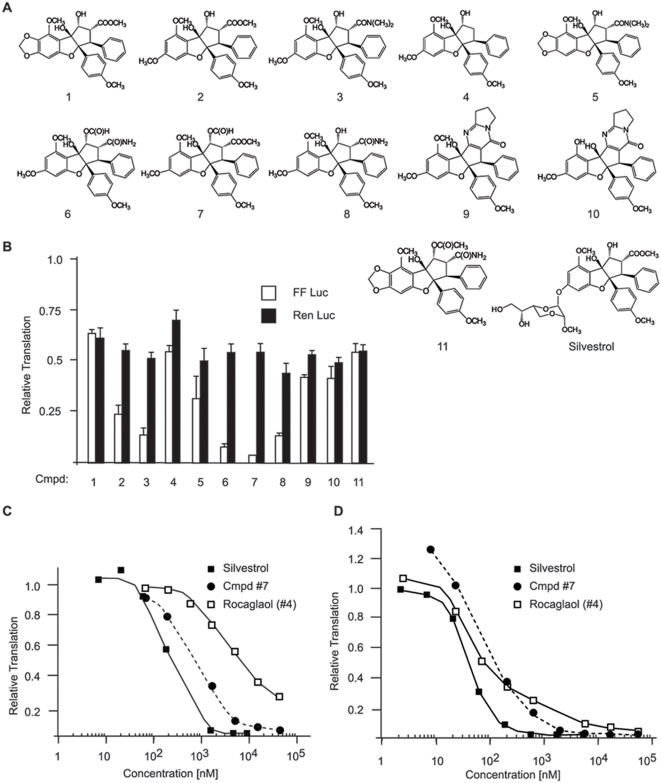
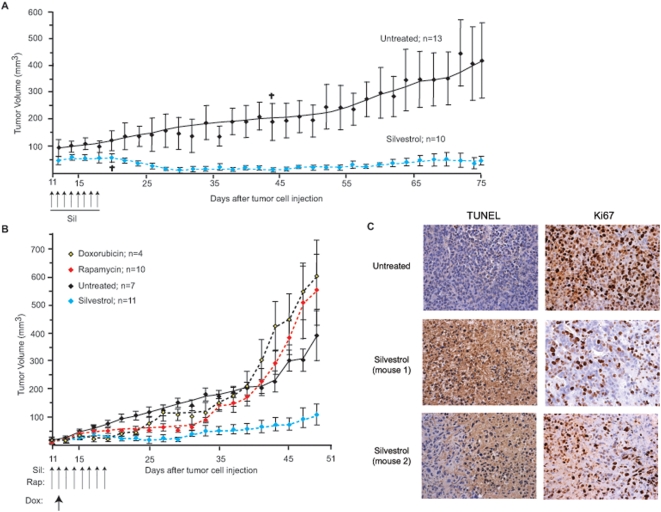
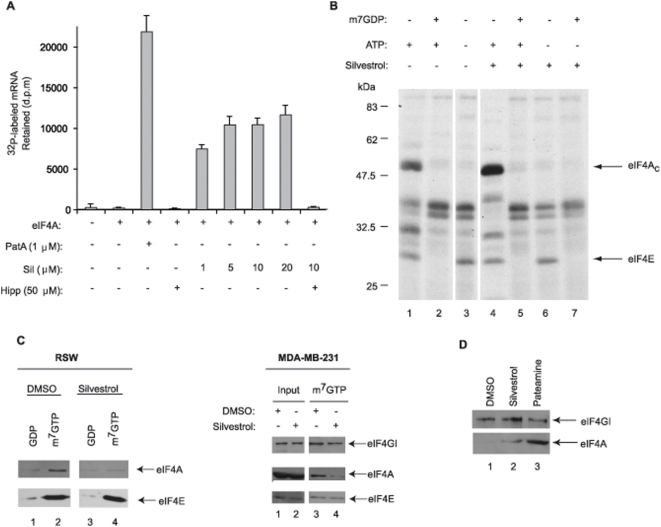
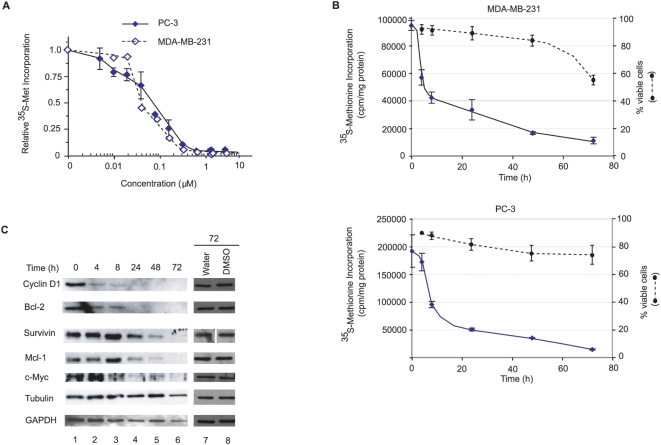
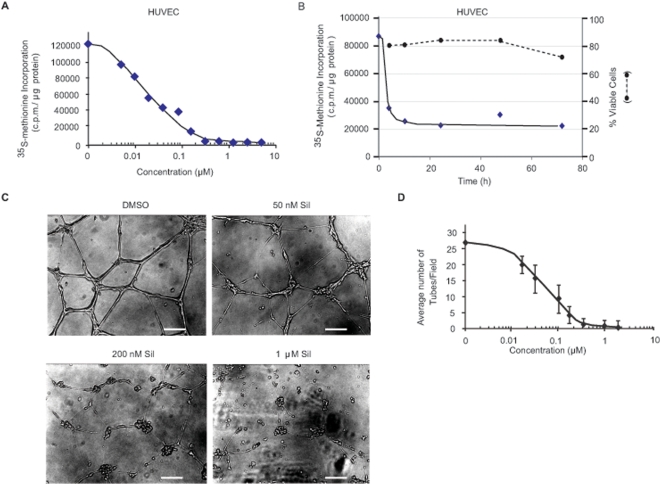
METHODOLOGY/PRINCIPAL FINDINGS: Among a number of flavagline family members tested herein, we find that silvestrol is the more potent translation inhibitor among these. We find that silvestrol impairs the ribosome recruitment step of translation initiation by affecting the composition of the eukaryotic initiation factor (eIF) 4F complex. We show that silvestrol exhibits significant anticancer activity in human breast and prostate cancer xenograft models, and that this is associated with increased apoptosis, decreased proliferation, and inhibition of angiogenesis. We demonstrate that targeting translation by silvestrol results in preferential inhibition of weakly initiating mRNAs.
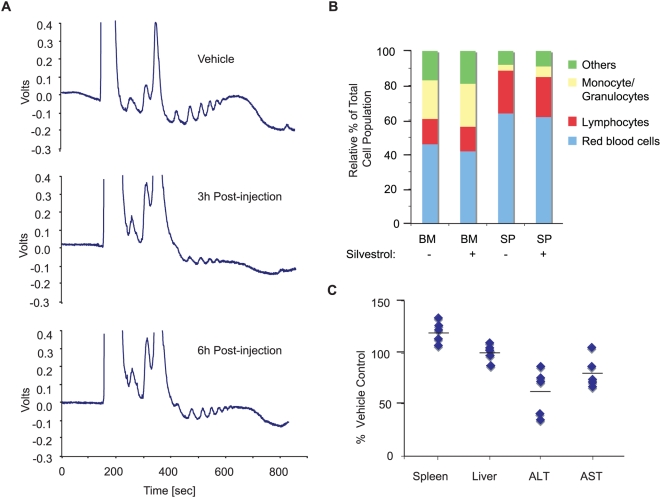
CONCLUSIONS/SIGNIFICANCE: Our results indicate that silvestrol is a potent anti-cancer compound in vivo that exerts its activity by affecting survival pathways as well as angiogenesis. We propose that silvestrol mediates its effects by preferentially inhibiting translation of malignancy-related mRNAs. Silvestrol appears to be well tolerated in animals.
黄皮酰胺是楝属植物中的一类天然产物,在体外和体内均表现出抗癌活性,并能抑制翻译起始。它们已被证明可调节真核起始因子(eIF)4F复合物的DEAD盒RNA解旋酶亚基eIF4A的活性,该复合物在翻译起始过程中刺激核糖体募集。一种黄皮酰胺,即silvestrol,能够在基于机制的小鼠模型中调节化学敏感性。
方法/主要发现:在本文测试的多种黄皮酰胺家族成员中,我们发现silvestrol是其中更有效的翻译抑制剂。我们发现silvestrol通过影响真核起始因子(eIF)4F复合物的组成来损害翻译起始的核糖体募集步骤。我们表明,silvestrol在人乳腺癌和前列腺癌异种移植模型中表现出显著的抗癌活性,这与细胞凋亡增加、增殖减少和血管生成抑制有关。我们证明,通过silvestrol靶向翻译会导致对弱起始mRNA的优先抑制。
结论/意义:我们的结果表明,silvestrol在体内是一种有效的抗癌化合物,通过影响生存途径以及血管生成发挥其活性。我们提出,silvestrol通过优先抑制恶性相关mRNA的翻译来介导其作用。Silvestrol在动物中似乎具有良好的耐受性。