Risonar Maria Grace D, Rayco-Solon Pura, Ribaya-Mercado Judy D, Solon Juan Antonio A, Cabalda Aegina B, Tengco Lorena W, Solon Florentino S
Nutrition Center of the Philippines, Taguig City, Philippines.
Nutr J. 2009 May 4;8:19. doi: 10.1186/1475-2891-8-19.
Aging is a process associated with physiological changes such as in body composition, energy expenditure and physical activity. Data on energy and nutrient intake adequacy among elderly is important for disease prevention, health maintenance and program development.
This descriptive cross-sectional study was designed to determine the energy requirements and adequacy of energy and nutrient intakes of older persons living in private households in a rural Filipino community. Study participants were generally-healthy, ambulatory, and community living elderly aged 60-100 y (n = 98), 88 of whom provided dietary information in three nonconsecutive 24-hour food-recall interviews.
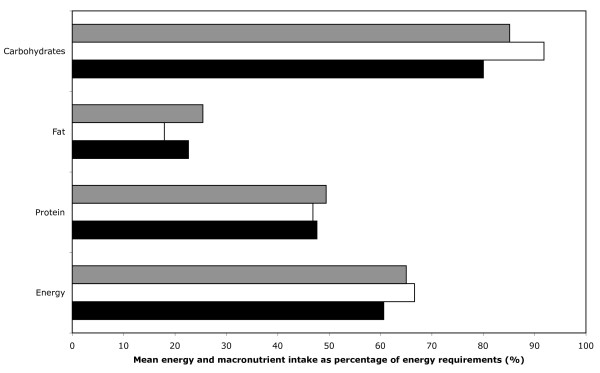
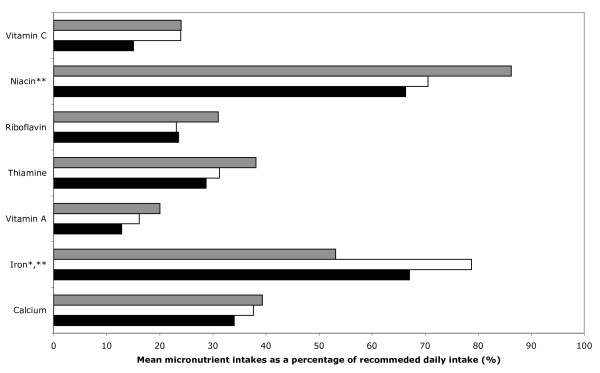
There was a decrease in both physical activity and food intake with increasing years. Based on total energy expenditure and controlling for age, gender and socio-economic status, the average energy requirement for near-old (>or= 60 to < 65 y) males was 2074 kcal/d, with lower requirements, 1919 and 1699 kcal/d for the young-old (>or= 65 to < 75 y) and the old-old (>or= 75 y), respectively. Among females, the average energy requirements for the 3 age categories were 1712, 1662, and 1398 kcal/d, respectively. Actual energy intakes, however, were only approximately 65% adequate for all subjects as compared to energy expenditure. Protein, fat, and micronutrients (vitamins A and C, thiamin, riboflavin, iron and calcium) intakes were only approximately 24-51% of the recommended daily intake. Among this population, there was a weight decrease of 100 g (p = 0.012) and a BMI decrease of 0.04 kg/m2 (p = 0.003) for every 1% decrease in total caloric intake as percentage of the total energy expenditure requirements.
These community living elderly suffer from lack of both macronutrient intake as compared with energy requirements, and micronutrient intake as compared with the standard dietary recommendations. Their energy intakes are ~65% of the amounts required based on their total energy expenditure. Though their intakes decrease with increasing age, so do their energy expenditure, making their relative insufficiency of food intake stable with age.
衰老过程伴随着身体成分、能量消耗和身体活动等生理变化。老年人能量和营养素摄入充足的数据对于疾病预防、健康维持和项目开发至关重要。
本描述性横断面研究旨在确定菲律宾农村社区私人家庭中老年人的能量需求以及能量和营养素摄入的充足程度。研究参与者为60至100岁的一般健康、能自主活动且居住在社区的老年人(n = 98),其中88人通过三次非连续的24小时食物回顾访谈提供了饮食信息。
随着年龄增长,身体活动和食物摄入量均有所下降。基于总能量消耗并控制年龄、性别和社会经济地位,接近老年(≥60至<65岁)男性的平均能量需求为2074千卡/天,年轻老年(≥65至<75岁)和高龄老年(≥75岁)的需求较低,分别为1919千卡/天和1699千卡/天。在女性中,这三个年龄组的平均能量需求分别为1712千卡/天、1662千卡/天和1398千卡/天。然而,与能量消耗相比,所有受试者的实际能量摄入量仅约为需求量的65%。蛋白质、脂肪和微量营养素(维生素A和C、硫胺素、核黄素、铁和钙)的摄入量仅约为推荐每日摄入量的24%至51%。在该人群中,总热量摄入量占总能量消耗需求的百分比每降低1%,体重下降100克(p = 0.012),体重指数下降0.04千克/平方米(p = 0.003)。
这些居住在社区的老年人,与能量需求相比,宏量营养素摄入不足,与标准饮食建议相比,微量营养素摄入不足。他们摄入的能量约为基于总能量消耗所需量的65%。尽管他们的摄入量随年龄增长而减少,但能量消耗也随之减少,使得他们食物摄入的相对不足随年龄保持稳定。