International Center for Insect Physiology and Ecology, ICIPE, Nairobi, Kenya.
PLoS Negl Trop Dis. 2009;3(5):e435. doi: 10.1371/journal.pntd.0000435. Epub 2009 May 12.
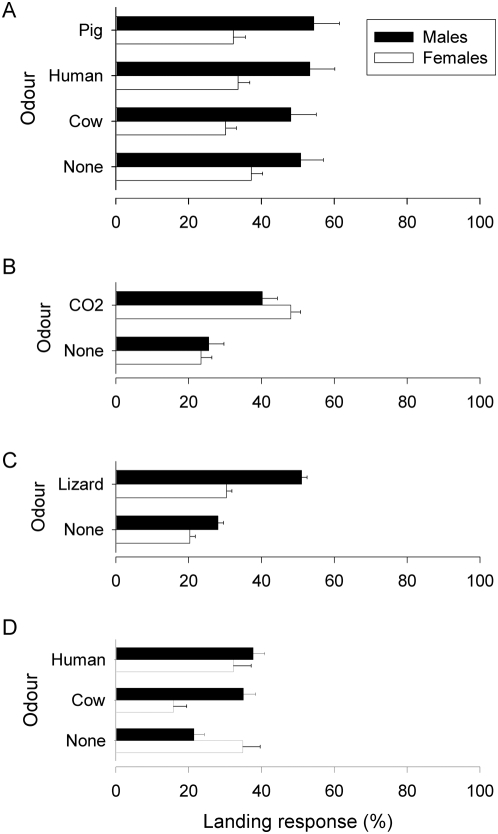
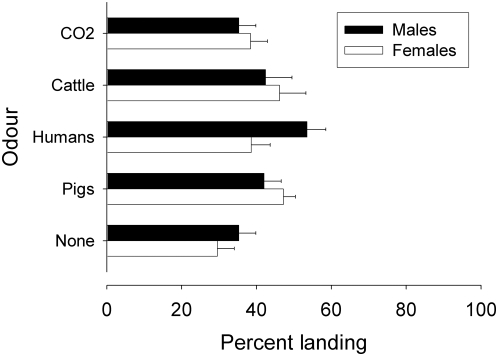
We are attempting to develop cost-effective control methods for the important vector of sleeping sickness, Glossina fuscipes spp. Responses of the tsetse flies Glossina fuscipes fuscipes (in Kenya) and G. f. quanzensis (in Democratic Republic of Congo) to natural host odours are reported. Arrangements of electric nets were used to assess the effect of cattle-, human- and pig-odour on (1) the numbers of tsetse attracted to the odour source and (2) the proportion of flies that landed on a black target (1x1 m). In addition responses to monitor lizard (Varanus niloticus) were assessed in Kenya. The effects of all four odours on the proportion of tsetse that entered a biconical trap were also determined. Sources of natural host odour were produced by placing live hosts in a tent or metal hut (volumes approximately 16 m(3)) from which the air was exhausted at approximately 2000 L/min. Odours from cattle, pigs and humans had no significant effect on attraction of G. f. fuscipes but lizard odour doubled the catch (P<0.05). Similarly, mammalian odours had no significant effect on landing or trap entry whereas lizard odour increased these responses significantly: landing responses increased significantly by 22% for males and 10% for females; the increase in trap efficiency was relatively slight (5-10%) and not always significant. For G. f. quanzensis, only pig odour had a consistent effect, doubling the catch of females attracted to the source and increasing the landing response for females by approximately 15%. Dispensing CO(2) at doses equivalent to natural hosts suggested that the response of G. f. fuscipes to lizard odour was not due to CO(2). For G. f. quanzensis, pig odour and CO(2) attracted similar numbers of tsetse, but CO(2) had no material effect on the landing response. The results suggest that identifying kairomones present in lizard odour for G. f. fuscipes and pig odour for G. f. quanzensis may improve the performance of targets for controlling these species.
我们正在尝试开发一种具有成本效益的控制昏睡病重要传播媒介——采采蝇的方法。本文报道了冈比亚采采蝇(肯尼亚)和 G. f. quanzensis(刚果民主共和国)对天然宿主气味的反应。我们使用电网装置来评估牛、人、猪气味对(1)吸引到气味源的采采蝇数量和(2)落在黑色目标(1x1 m)上的苍蝇比例的影响。此外,在肯尼亚还评估了对巨蜥(Varanus niloticus)的反应。还确定了这四种气味对进入双锥形陷阱的采采蝇比例的影响。通过将活宿主放置在帐篷或金属小屋里(体积约为 16 m(3)),从其中以大约 2000 L/min 的速度排出空气,产生天然宿主气味源。牛、猪和人的气味对 G. f. fuscipes 的吸引力没有显著影响,但蜥蜴气味使捕获量增加了一倍(P<0.05)。同样,哺乳动物气味对降落或进入陷阱没有显著影响,而蜥蜴气味则显著增加了这些反应:雄性降落反应增加了 22%,雌性增加了 10%;陷阱效率的增加相对较小(5-10%),并不总是显著的。对于 G. f. quanzensis,只有猪气味有一致的效果,使吸引到源的雌性采采蝇的捕获量增加了一倍,并使雌性的降落反应增加了约 15%。以相当于天然宿主的剂量释放 CO(2)表明,G. f. fuscipes 对蜥蜴气味的反应不是由于 CO(2)。对于 G. f. quanzensis,猪气味和 CO(2)吸引了相似数量的采采蝇,但 CO(2)对降落反应没有实质性影响。结果表明,为 G. f. fuscipes 确定蜥蜴气味中的信息素和 G. f. quanzensis 中的猪气味中的信息素可能会提高控制这些物种的靶标的性能。