Neurobiology and Pain Therapeutics Section, Laboratory of Sensory Biology, National Institute of Dental and Craniofacial Research, National Institutes of Health, Bethesda, Maryland, United States of America.
PLoS Negl Trop Dis. 2009;3(5):e438. doi: 10.1371/journal.pntd.0000438. Epub 2009 May 19.
Onchocerciasis, an infection caused by the filarial nematode Onchocerca volvulus, is a major public health concern. Given the debilitating symptoms associated with onchocerciasis and concerns about recrudescence in areas of previous onchocerciasis control, more efficient tools are needed for diagnosis and monitoring of control measures. We investigated whether luciferase immunoprecipitation systems (LIPS) may be used as a more rapid, specific, and standardized diagnostic assay for Onchocerca volvulus infection.
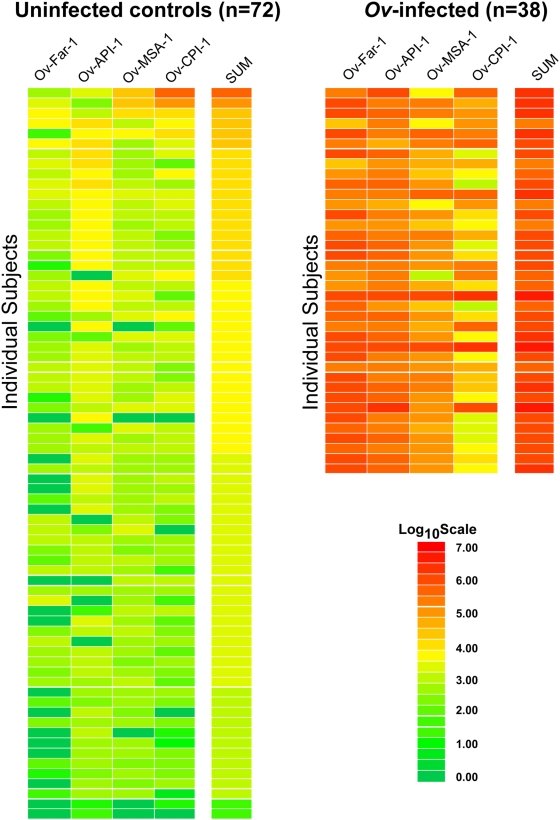
Four recombinantly produced Onchocerca volvulus antigens (Ov-FAR-1, Ov-API-1, Ov-MSA-1 and Ov-CPI-1) were tested by LIPS on a large cohort of blinded sera comprised of both uninfected controls and patients with a proven parasitic infection including Onchocerca volvulus (Ov), Wuchereria bancrofti (Wb), Loa loa (Ll), Strongyloides stercoralis (Ss), and with other potentially cross-reactive infections. In addition to testing all four Ov antigens separately, a mixture that tested all four antigens simultaneously was evaluated in the standard 2-hour incubation format as well as in a 15-minute rapid LIPS format.
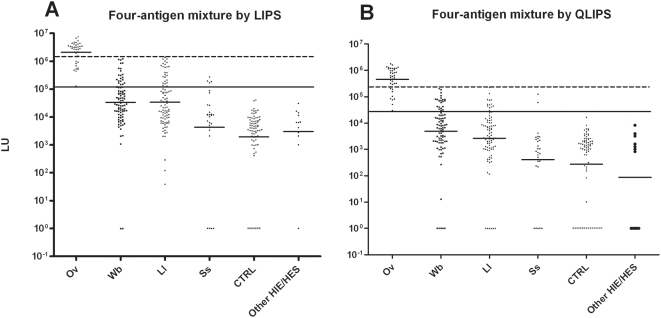
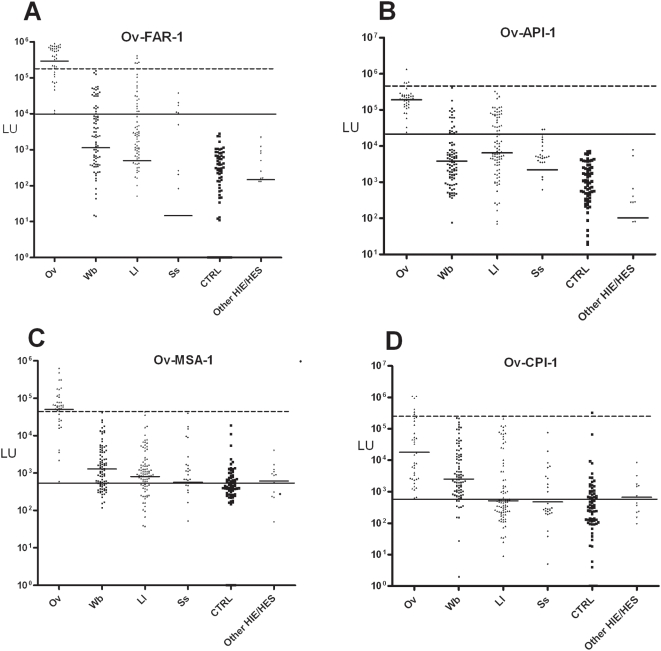
Antibody responses to the four different Ov antigens allowed for unequivocal differentiation between Ov-infected and uninfected control sera with 100% sensitivity and 100% specificity. Analysis of the antibody titers to each of these four antigens in individual Ov-infected sera revealed that they were markedly different and did not correlate (r(S) = -0.11 to 0.58; P = 0.001 to 0.89) to each other. Compared to Ov-infected sera, patients infected with Wb, Ll, Ss, and other conditions had markedly lower geometric mean antibody titers to each of the Ov 4 antigens (P<0.0002 for each antigen). The simplified method of using a mixture of the 4 Ov antigens simultaneously in the standard format or a quick 15-minute format (QLIPS) showed 100% sensitivity and 100% specificity in distinguishing the Ov-infected sera from the uninfected control sera. Finally, the QLIPS format had the best performance with 100% sensitivity and specificity values of 76%, 84% and 93% for distinguishing Ov from Wb, Ll and Ss-infected sera.
The multi-antigen LIPS assay can be used as a rapid, high throughput, and specific tool to not only to diagnose individual Ov infections but also as a sensitive and potentially point-of-care method for early detection of recrudescent infections in areas under control and for mapping new areas of transmission of Ov infection.
盘尾丝虫病是由旋尾丝虫属线虫引起的感染,是一个主要的公共卫生关注点。鉴于盘尾丝虫病相关的衰弱症状以及对既往盘尾丝虫病控制地区复发的担忧,我们需要更有效的工具来诊断和监测控制措施。我们研究了荧光素酶免疫沉淀系统(LIPS)是否可作为一种更快速、更特异和更标准化的旋尾丝虫属感染诊断检测方法。
我们用 LIPS 对包括未感染对照者和已证实寄生虫感染(包括盘尾丝虫属、班氏吴策线虫、罗阿丝虫、粪类圆线虫)患者在内的大量盲法血清样本中,四种重组盘尾丝虫属抗原(Ov-FAR-1、Ov-API-1、Ov-MSA-1 和 Ov-CPI-1)进行了检测。除了分别检测这四种 Ov 抗原外,还在标准的 2 小时孵育格式以及快速 15 分钟 LIPS 格式中评估了同时检测这四种抗原的混合物。
针对这四种不同 Ov 抗原的抗体反应能够明确地区分感染和未感染对照者的血清,敏感性为 100%,特异性为 100%。对每个单独的 Ov 感染血清中的这四种抗原的抗体滴度进行分析,结果显示它们明显不同,且彼此之间不相关(r(S) = -0.11 至 0.58;P = 0.001 至 0.89)。与 Ov 感染者的血清相比,感染班氏吴策线虫、罗阿丝虫、粪类圆线虫和其他疾病的患者的这四种 Ov 抗原的几何平均抗体滴度明显较低(每个抗原的 P<0.0002)。在标准格式中同时使用四种 Ov 抗原混合物的简化方法或快速 15 分钟格式(QLIPS),在区分 Ov 感染者的血清与未感染者的血清时,具有 100%的敏感性和特异性。最后,QLIPS 格式具有最佳性能,在区分 Ov 与感染班氏吴策线虫、罗阿丝虫和粪类圆线虫的血清时,其敏感性和特异性的最佳值分别为 76%、84%和 93%。
多抗原 LIPS 检测法不仅可以用于快速、高通量和特异性地诊断个体的 Ov 感染,还可以作为一种敏感的、潜在的即时护理方法,用于早期检测控制地区的复发感染,并用于绘制 Ov 感染传播的新区域。