Perales Celia, Agudo Rubén, Domingo Esteban
Centro de Biología Molecular "Severo Ochoa" (CSIC-UAM), Consejo Superior de Investigaciones Científicas (CSIC), Campus de Cantoblanco, Madrid, Spain.
PLoS One. 2009;4(5):e5554. doi: 10.1371/journal.pone.0005554. Epub 2009 May 14.
Lethal mutagenesis, or virus extinction promoted by mutagen-induced elevation of mutation rates of viruses, may meet with the problem of selection of mutagen-resistant variants, as extensively documented for standard, non-mutagenic antiviral inhibitors. Previously, we characterized a mutant of foot-and-mouth disease virus that included in its RNA-dependent RNA polymerase replacement M296I that decreased the sensitivity of the virus to the mutagenic nucleoside analogue ribavirin.
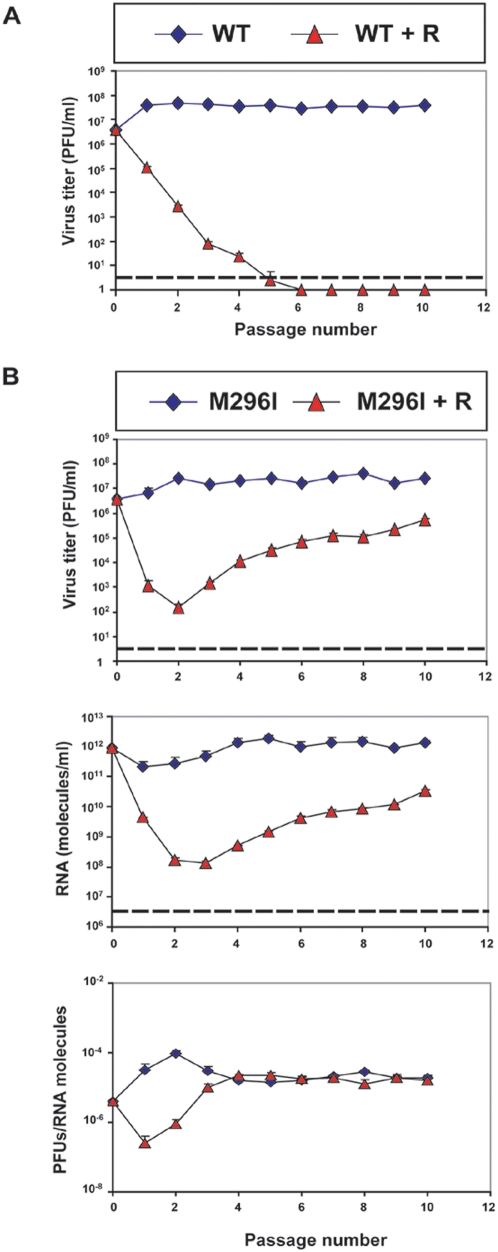
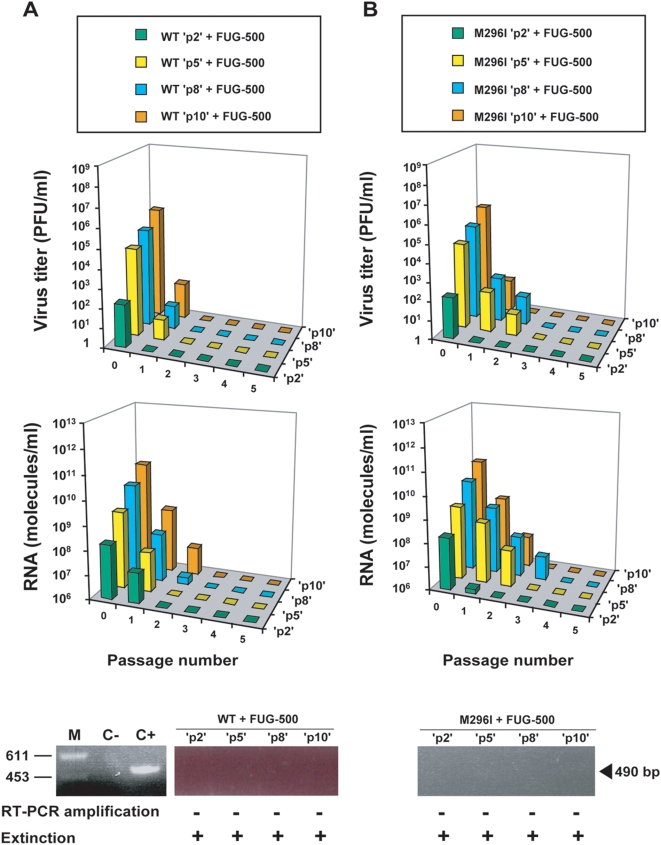
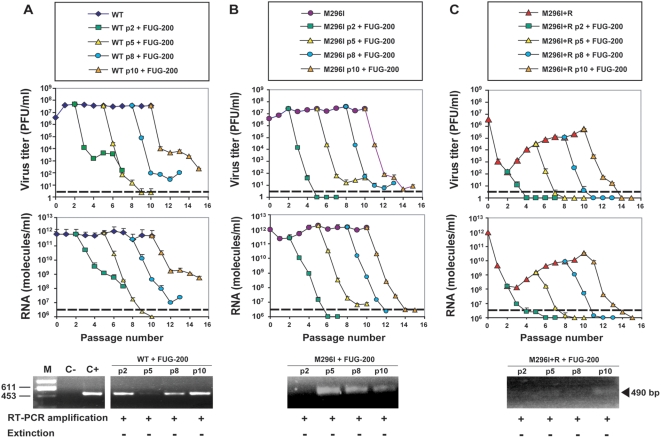
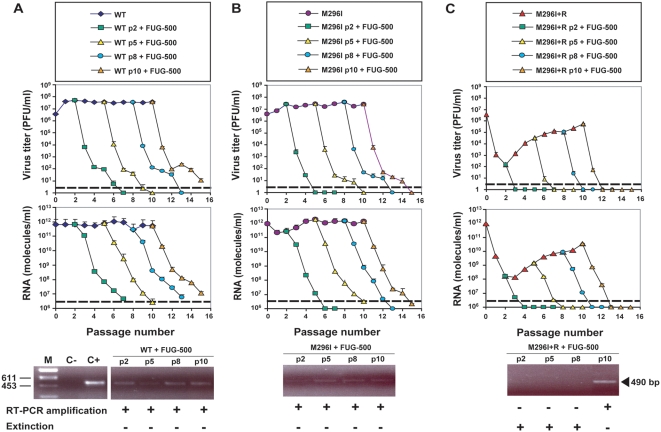
Replacement M296I in the viral polymerase impedes the extinction of the mutant foot-and-mouth disease virus by elevated concentrations of ribavirin. In contrast, wild type virus was extinguished by the same ribavirin treatment and, interestingly, no mutants resistant to ribavirin were selected from the wild type populations. Decreases of infectivity and viral load of the ribavirin-resistant M296I mutant were attained with a combination of the mutagen 5-fluorouracil and the non-mutagenic inhibitor guanidine hydrocloride. However, extinction was achieved with a sequential treatment, first with ribavirin, and then with a minimal dose of 5-fluorouracil in combination with guanidine hydrochloride. Both, wild type and ribavirin-resistant mutant M296I exhibited equal sensitivity to this combination, indicating that replacement M296I in the polymerase did not confer a significant cross-resistance to 5-fluorouracil. We discuss these results in relation to antiviral designs based on lethal mutagenesis.
(i) When dominant in the population, a mutation that confers partial resistance to a mutagenic agent can jeopardize virus extinction by elevated doses of the same mutagen. (ii) A wild type virus, subjected to identical high mutagenic treatment, need not select a mutagen-resistant variant, and the population can be extinguished. (iii) Extinction of the mutagen-resistant variant can be achieved by a sequential treatment of a high dose of the same mutagen, followed by a combination of another mutagen with an antiviral inhibitor.
致死性诱变,即通过诱变剂诱导病毒突变率升高来促使病毒灭绝,可能会遇到诱变抗性变异体的选择问题,这在标准的非诱变抗病毒抑制剂方面已有广泛记载。此前,我们鉴定了一种口蹄疫病毒突变体,其RNA依赖性RNA聚合酶中的M296I替换降低了病毒对诱变核苷类似物利巴韦林的敏感性。
病毒聚合酶中的M296I替换阻碍了高浓度利巴韦林对突变型口蹄疫病毒的灭绝作用。相比之下,野生型病毒在相同的利巴韦林处理下被灭绝,有趣的是,野生型群体中未筛选出对利巴韦林具有抗性的突变体。通过诱变剂5-氟尿嘧啶与非诱变抑制剂盐酸胍联合使用,可降低利巴韦林抗性M296I突变体的感染性和病毒载量。然而,通过先使用利巴韦林,然后使用最低剂量的5-氟尿嘧啶与盐酸胍联合的序贯治疗可实现病毒灭绝。野生型和利巴韦林抗性突变体M296I对此联合治疗均表现出同等敏感性,这表明聚合酶中的M296I替换并未赋予对5-氟尿嘧啶显著的交叉抗性。我们结合基于致死性诱变的抗病毒设计来讨论这些结果。
(i)当在群体中占主导时,赋予对诱变剂部分抗性的突变可能会因相同诱变剂剂量升高而危及病毒灭绝。(ii)经过相同高诱变处理的野生型病毒无需筛选出诱变抗性变异体,且该群体可被灭绝。(iii)通过先使用高剂量的相同诱变剂进行序贯治疗,然后再使用另一种诱变剂与抗病毒抑制剂联合使用,可实现诱变抗性变异体的灭绝。