Retamal Patricio, Castillo-Ruiz Mario, Mora Guido C
Departamento de Ciencias Biológicas, Universidad Andrés Bello, Santiago, Chile.
PLoS One. 2009;4(5):e5551. doi: 10.1371/journal.pone.0005551. Epub 2009 May 14.
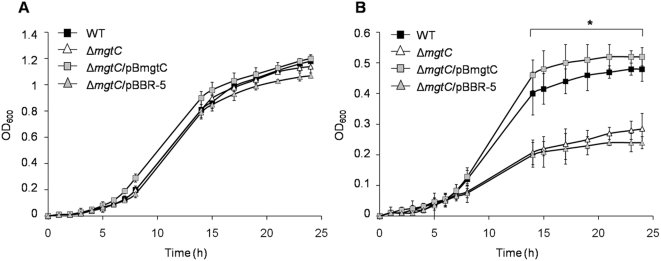
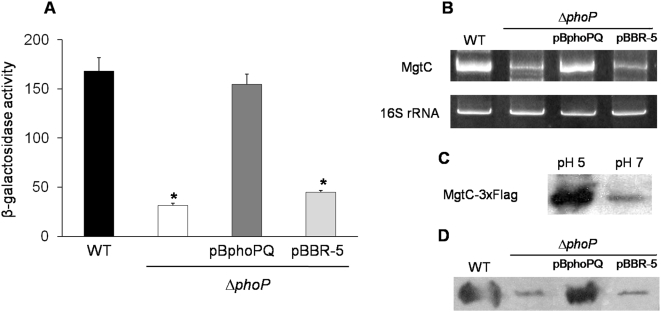
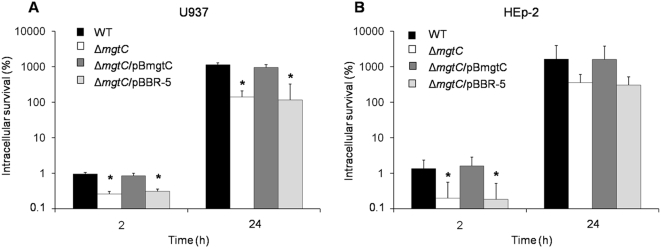
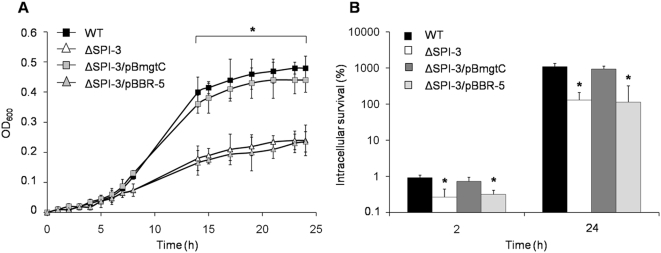
The MgtC is a virulence factor in Salmonella Typhimurium that is required for growth at low-Mg2+ concentrations and intramacrophage survival. This gene is codified in a conserved region of the Salmonella pathogenicity island 3 (SPI-3), and is also present in the chromosome of other Salmonella serovars. In this study we characterized the MgtC factor in S. Typhi, a human specific pathogen, by using mgtC and SPI-3 mutant strains. We found that MgtC is the most important factor codified in the SPI-3 of S. Typhi for growth in low-Mg2+ media and survival within human cells. In addition, by using reporter genes we determined that the low-Mg2+ concentration, acidic media and PhoP regulator induce mgtC expression in S. Typhi. We suggest that MgtC is the most important virulence factor codified in the SPI-3 of S. Typhi.
MgtC是鼠伤寒沙门氏菌中的一种毒力因子,在低镁离子浓度下生长及巨噬细胞内存活时是必需的。该基因编码于沙门氏菌致病岛3(SPI-3)的一个保守区域,也存在于其他沙门氏菌血清型的染色体中。在本研究中,我们通过使用mgtC和SPI-3突变株对人类特异性病原体伤寒沙门氏菌中的MgtC因子进行了表征。我们发现,MgtC是伤寒沙门氏菌SPI-3中编码的在低镁离子培养基中生长及在人类细胞内存活的最重要因子。此外,通过使用报告基因,我们确定低镁离子浓度、酸性培养基和PhoP调节因子可诱导伤寒沙门氏菌中mgtC的表达。我们认为MgtC是伤寒沙门氏菌SPI-3中编码的最重要的毒力因子。