Moser K L, Kelly J A, Lessard C J, Harley J B
Arthritis and Immunology Program, Oklahoma Medical Research Foundation, Oklahoma City, OK 73104, USA.
Genes Immun. 2009 Jul;10(5):373-9. doi: 10.1038/gene.2009.39. Epub 2009 May 14.
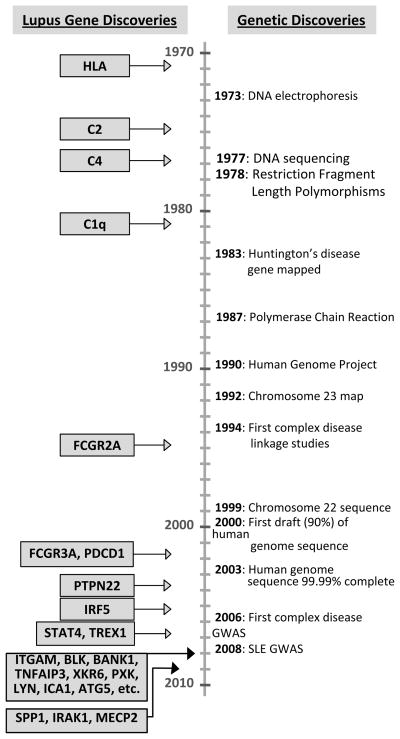
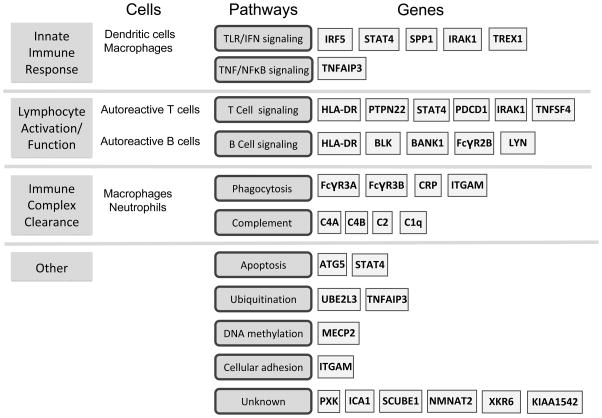
Genetic variation was first shown to be important in systemic lupus erythematosus (SLE or lupus) in the 1970s with associations in the human leukocyte antigen region. Almost four decades later, and with the help of increasingly powerful genetic approaches, more than 25 genes are now known to contribute to the mechanisms that predispose individuals to lupus. Over half of these loci have been discovered in the past 2 years, underscoring the extraordinary success of genome-wide association approaches in SLE. Well-established risk factors include alleles in the major histocompatibility complex region (multiple genes), IRF5, ITGAM, STAT4, BLK, BANK1, PDCD1, PTPN22, TNFSF4, TNFAIP3, SPP1, some of the Fcgamma receptors, and deficiencies in several complement components, including C1q, C4 and C2. As reviewed here, many susceptibility genes fall into key pathways that are consistent with previous studies implicating immune complexes, host immune signal transduction and interferon pathways in the pathogenesis of SLE. Other loci have no known function or apparent immunological role and have the potential to reveal novel disease mechanisms. Certainly, as our understanding of the genetic etiology of SLE continues to mature, important new opportunities will emerge for developing more effective diagnostic and clinical management tools for this complex autoimmune disease.
20世纪70年代,人类白细胞抗原区域的关联研究首次表明遗传变异在系统性红斑狼疮(SLE或狼疮)中具有重要意义。近四十年后,借助日益强大的遗传学方法,目前已知有超过25个基因参与了使个体易患狼疮的机制。其中超过一半的基因座是在过去两年中发现的,这突出了全基因组关联研究方法在SLE研究中的非凡成功。已明确的风险因素包括主要组织相容性复合体区域的等位基因(多个基因)、IRF5、ITGAM、STAT4、BLK、BANK1、PDCD1、PTPN22、TNFSF4、TNFAIP3、SPP1、一些Fcγ受体,以及几种补体成分的缺陷,包括C1q、C4和C2。如本文所述,许多易感基因属于关键通路,这与先前关于免疫复合物、宿主免疫信号转导和干扰素通路参与SLE发病机制的研究一致。其他基因座尚无已知功能或明显的免疫学作用,有可能揭示新的疾病机制。当然,随着我们对SLE遗传病因的理解不断成熟,为这种复杂的自身免疫性疾病开发更有效的诊断和临床管理工具将出现重要的新机遇。