Penetar David M, Kouri Elena M, McCarthy Elissa M, Lilly Michelle M, Peters Erica N, Juliano Trisha M, Lukas Scott E
Behavioral Psychopharmacology Research Laboratory, McLean Hospital/Harvard Medical School, 115 Mill Street, Belmont, MA 02478, USA.
Int J Environ Res Public Health. 2009 Feb;6(2):526-46. doi: 10.3390/ijerph6020526. Epub 2009 Feb 5.
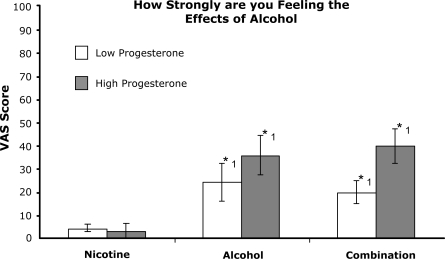
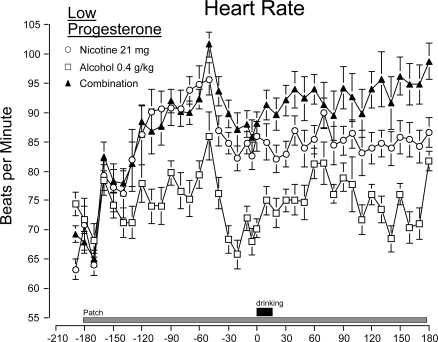
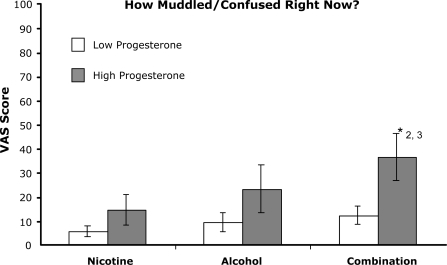
The present report shows that nicotine enhances some of alcohol's positive and negative effects in women and that these effects are most pronounced during the luteal phase of the menstrual cycle. Ten low progesterone and 10 high progesterone/luteal-phase women received nicotine patch pretreatments (placebo or 21 mg) 3 hours before an alcohol challenge (0.4 g/kg). Subjective effects were recorded on mood adjective scales and the Addiction Research Center Inventory (ARCI). Heart rate and skin temperature were recorded. Luteal-phase women reported peak positive (e.g. "stimulated") and peak negative effects (e.g. "clumsy", "dizzy") almost twice as great as low progesterone women.
本报告显示,尼古丁会增强酒精对女性的一些正面和负面影响,且这些影响在月经周期的黄体期最为明显。10名低孕酮水平女性和10名高孕酮水平/处于黄体期的女性在接受酒精激发试验(0.4 g/kg)前3小时接受尼古丁贴片预处理(安慰剂或21毫克)。通过情绪形容词量表和成瘾研究中心量表(ARCI)记录主观感受。记录心率和皮肤温度。处于黄体期的女性报告的积极峰值效应(如“兴奋”)和消极峰值效应(如“笨拙”“头晕”)几乎是低孕酮水平女性的两倍。