Marks P A, Xu W-S
Sloan-Kettering Institute, Memorial Sloan-Kettering Cancer Center, New York, New York 10065, USA.
J Cell Biochem. 2009 Jul 1;107(4):600-8. doi: 10.1002/jcb.22185.
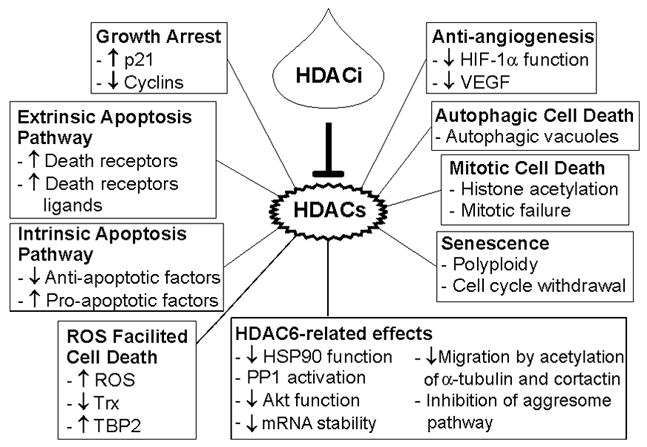
The role of histone deacetylases (HDAC) and the potential of these enzymes as therapeutic targets for cancer, neurodegenerative diseases and a number of other disorders is an area of rapidly expanding investigation. There are 18 HDACs in humans. These enzymes are not redundant in function. Eleven of the HDACs are zinc dependent, classified on the basis of homology to yeast HDACs: Class I includes HDACs 1, 2, 3, and 8; Class IIA includes HDACs 4, 5, 7, and 9; Class IIB, HDACs 6 and 10; and Class IV, HDAC 11. Class III HDACs, sirtuins 1-7, have an absolute requirement for NAD(+), are not zinc dependent and generally not inhibited by compounds that inhibit zinc dependent deacetylases. In addition to histones, HDACs have many nonhistone protein substrates which have a role in regulation of gene expression, cell proliferation, cell migration, cell death, and angiogenesis. HDAC inhibitors (HDACi) have been discovered of different chemical structure. HDACi cause accumulation of acetylated forms of proteins which can alter their structure and function. HDACi can induce different phenotypes in various transformed cells, including growth arrest, apoptosis, reactive oxygen species facilitated cell death and mitotic cell death. Normal cells are relatively resistant to HDACi induced cell death. Several HDACi are in various stages of development, including clinical trials as monotherapy and in combination with other anti-cancer drugs and radiation. The first HDACi approved by the FDA for cancer therapy is suberoylanilide hydroxamic acid (SAHA, vorinostat, Zolinza), approved for treatment of cutaneous T-cell lymphoma.
组蛋白脱乙酰酶(HDAC)的作用以及这些酶作为癌症、神经退行性疾病和许多其他疾病治疗靶点的潜力是一个研究迅速扩展的领域。人类有18种HDAC。这些酶在功能上并非冗余。其中11种HDAC依赖锌,根据与酵母HDAC的同源性分类:I类包括HDAC 1、2、3和8;IIA类包括HDAC 4、5、7和9;IIB类包括HDAC 6和10;IV类包括HDAC 11。III类HDAC,即沉默调节蛋白1 - 7,绝对需要NAD(+),不依赖锌,且通常不受抑制锌依赖性脱乙酰酶的化合物抑制。除组蛋白外,HDAC还有许多非组蛋白蛋白质底物,它们在基因表达、细胞增殖、细胞迁移、细胞死亡和血管生成的调节中发挥作用。已发现具有不同化学结构的HDAC抑制剂(HDACi)。HDACi会导致蛋白质乙酰化形式的积累,这可能改变其结构和功能。HDACi可在各种转化细胞中诱导不同的表型,包括生长停滞、凋亡、活性氧促进的细胞死亡和有丝分裂细胞死亡。正常细胞对HDACi诱导的细胞死亡相对耐药。几种HDACi正处于不同的开发阶段,包括作为单一疗法以及与其他抗癌药物和放疗联合使用的临床试验。美国食品药品监督管理局(FDA)批准的首个用于癌症治疗的HDACi是辛二酰苯胺异羟肟酸(SAHA,伏立诺他,Zolinza),被批准用于治疗皮肤T细胞淋巴瘤。