Patel A L, Engstrom J L, Meier P P, Jegier B J, Kimura R E
Pediatrics, Rush University Medical Center, Chicago, IL 60612, USA.
J Perinatol. 2009 Sep;29(9):618-22. doi: 10.1038/jp.2009.55. Epub 2009 May 21.
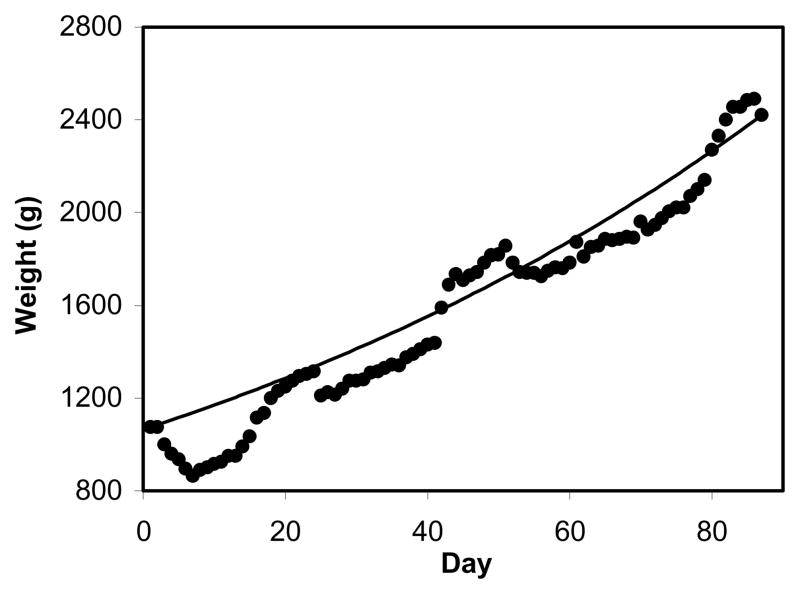
Currently, there is no standardized approach to the calculation of growth velocity (GV; g kg (-1) day(-1)) in hospitalized very low birth weight (VLBW) infants. Thus, differing methods are used to estimate GV, resulting in different medical centers and studies reporting growth results that are difficult to compare. The objective of this study was to compare actual GV calculated from infant daily weights during hospitalization in a Neonatal Intensive Care Unit (NICU) with estimated GV using two mathematical models that have been shown earlier to provide good estimated GVs in extremely low birth weight (ELBW) infants: an exponential model (EM) and a 2-Point model (2-PM).
Daily weights from 81 infants with birth weights (BWs) of 1000 to 1499 g were used to calculate actual GV in daily increments from two starting points: (1) birth and (2) day of life (DOL) of regaining BW. These daily GV values were then averaged over the NICU stay to yield overall NICU GV from the two starting points. We compared these actual GV with estimated GV calculated using the EM and 2-PM methods.
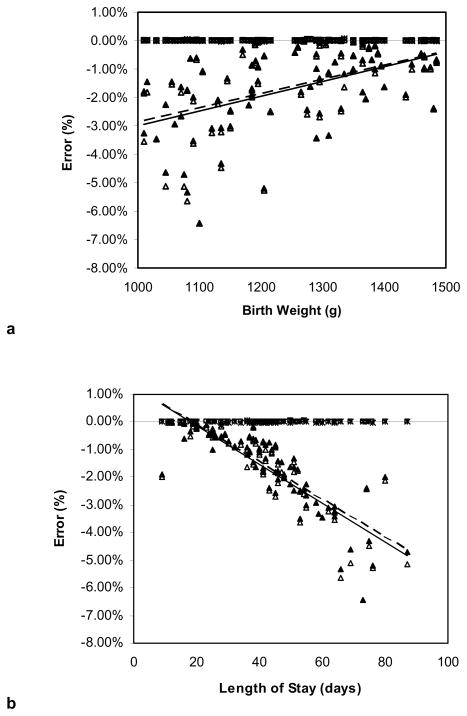
The mean absolute difference between actual and EM estimates of GV showed <1% error for 100% of infants from both starting points. The mean absolute difference between actual and 2-PM estimates showed <1% error for only 38 and 44% of infants from birth and regaining BW, respectively. The EM was unaffected by decreasing BW and increasing length of NICU stay, whereas the accuracy of the 2-PM was diminished significantly (P<0.001) by both factors.
In contrast to the 2-PM, the EM provides an extremely accurate estimate of GV in larger VLBW infants, and its accuracy is unaffected by common infant factors. The EM has now been validated for use in all VLBW infants to assess growth and provides a simple-to-use and consistent approach.
目前,对于住院的极低出生体重(VLBW)婴儿,尚无计算生长速度(GV;克/千克/天)的标准化方法。因此,人们使用不同的方法来估算GV,导致不同的医疗中心和研究报告的生长结果难以比较。本研究的目的是将新生儿重症监护病房(NICU)中根据婴儿住院期间每日体重计算出的实际GV与使用两种数学模型估算的GV进行比较,这两种模型先前已被证明能为极低出生体重(ELBW)婴儿提供良好的GV估算值:指数模型(EM)和两点模型(2-PM)。
选取81名出生体重(BW)为1000至1499克的婴儿的每日体重,从两个起始点以每日增量计算实际GV:(1)出生时;(2)恢复出生体重的生命日(DOL)。然后将这些每日GV值在NICU住院期间进行平均,以得出两个起始点的总体NICU GV。我们将这些实际GV与使用EM和2-PM方法计算出的估算GV进行比较。
对于两个起始点的所有婴儿,GV的实际值与EM估算值之间的平均绝对差异显示误差<1%。实际值与2-PM估算值之间的平均绝对差异显示,分别只有38%和44%出生时和恢复出生体重时的婴儿误差<1%。EM不受出生体重下降和NICU住院时间延长的影响,而这两个因素均会使2-PM的准确性显著降低(P<0.001)。
与2-PM相比,EM能极其准确地估算较大VLBW婴儿的GV,且其准确性不受常见婴儿因素的影响。EM现已被验证可用于所有VLBW婴儿以评估生长情况,并提供了一种简单易用且一致化的方法。