Chechko Natalya, Wehrle Renate, Erhardt Angelika, Holsboer Florian, Czisch Michael, Sämann Philipp G
Max Planck Institute of Psychiatry, Munich, Germany.
PLoS One. 2009 May 20;4(5):e5537. doi: 10.1371/journal.pone.0005537.
The neural mechanisms of panic disorder (PD) are only incompletely understood. Higher sensitivity of patients to unspecific fear cues and similarities to conditioned fear suggest involvement of lower limbic and brainstem structures. We investigated if emotion perception is altered in remitted PD as a trait feature.
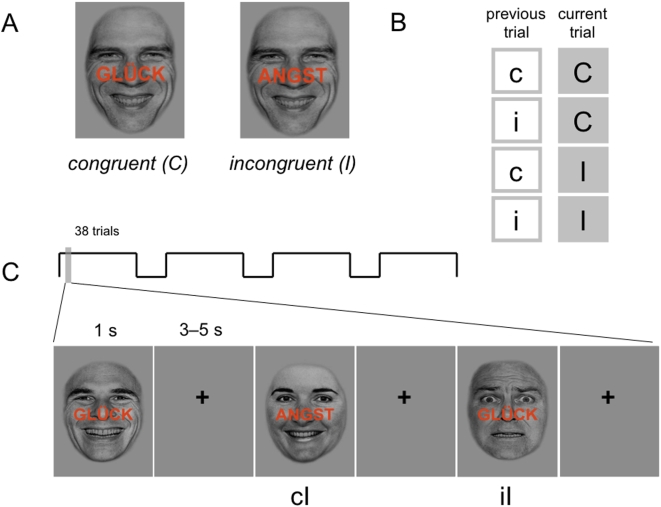
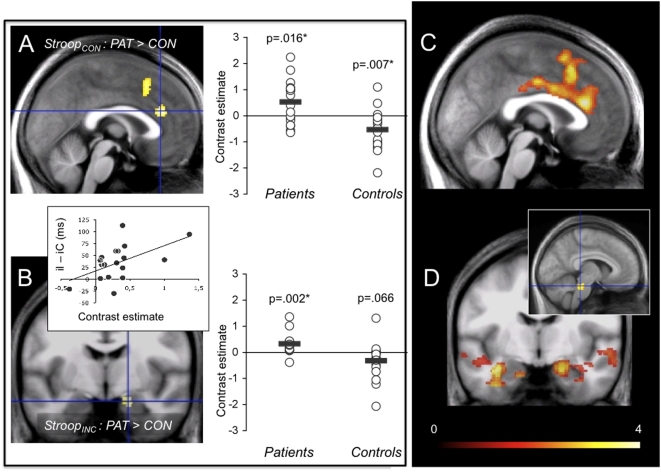
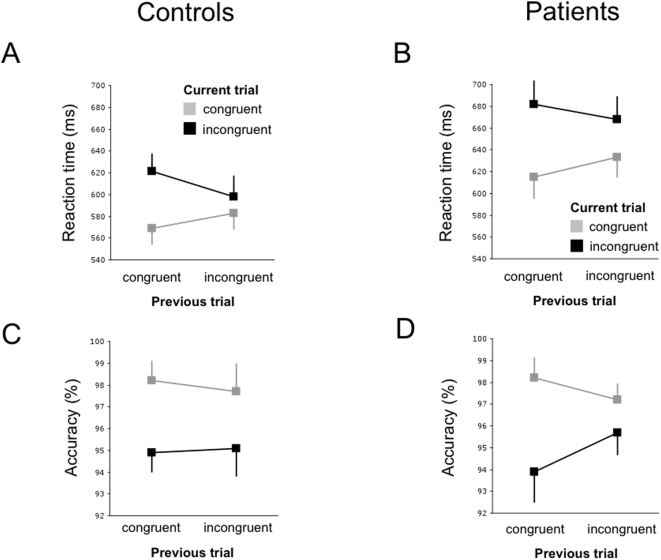
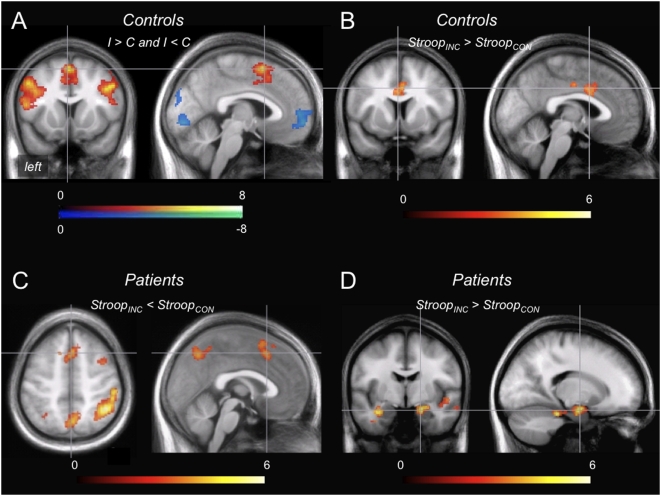
METHODOLOGY/PRINCIPAL FINDINGS: We used blood oxygenation level-dependent (BOLD) functional magnetic resonance imaging (fMRI) to study neural and behavioural responses of 18 remitted PD patients and 18 healthy subjects to the emotional conflict paradigm that is based on the presentation of emotionally congruent and incongruent face/word pairs. We observed that patients showed stronger behavioural interference and lower adaptation to interference conflict. Overall performance in patients was slower but not less accurate. In the context of preceding congruence, stronger dorsal anterior cingulate cortex (dACC) activation during conflict detection was found in patients. In the context of preceding incongruence, controls expanded dACC activity and succeeded in reducing behavioural interference. In contrast, patients demonstrated a dropout of dACC and dorsomedial prefrontal cortex (dmPFC) recruitment but activation of the lower limbic areas (including right amygdala) and brainstem.
CONCLUSIONS/SIGNIFICANCE: This study provides evidence that stimulus order in the presentation of emotional stimuli has a markedly larger influence on the brain's response in remitted PD than in controls, leading to abnormal responses of the dACC/dmPFC and lower limbic structures (including the amygdala) and brainstem. Processing of non-panic related emotional stimuli is disturbed in PD patients despite clinical remission.
惊恐障碍(PD)的神经机制尚未完全明了。患者对非特异性恐惧线索的更高敏感性以及与条件性恐惧的相似性提示边缘系统下部和脑干结构参与其中。我们研究了缓解期PD患者作为一种特质特征的情绪感知是否发生改变。
方法/主要发现:我们使用血氧水平依赖(BOLD)功能磁共振成像(fMRI)来研究18例缓解期PD患者和18名健康受试者对基于情绪一致和不一致的面部/单词对呈现的情绪冲突范式的神经和行为反应。我们观察到患者表现出更强的行为干扰以及对干扰冲突的较低适应性。患者的总体表现较慢,但准确性并不低。在先前一致的情况下,患者在冲突检测期间背侧前扣带回皮质(dACC)激活更强。在先前不一致的情况下,对照组扩大了dACC活动并成功减少了行为干扰。相比之下,患者表现出dACC和背内侧前额叶皮质(dmPFC)募集缺失,但边缘系统下部区域(包括右侧杏仁核)和脑干激活。
结论/意义:本研究提供的证据表明,与对照组相比,情绪刺激呈现的刺激顺序对缓解期PD患者大脑反应的影响明显更大,导致dACC/dmPFC以及边缘系统下部结构(包括杏仁核)和脑干出现异常反应。尽管临床已缓解,但PD患者对非惊恐相关情绪刺激的处理仍受到干扰。