Adijanto Jeffrey, Banzon Tina, Jalickee Stephen, Wang Nam S, Miller Sheldon S
Department of Chemical and Biomolecular Engineering, University of Maryland, College Park, MD 20742, USA.
J Gen Physiol. 2009 Jun;133(6):603-22. doi: 10.1085/jgp.200810169.
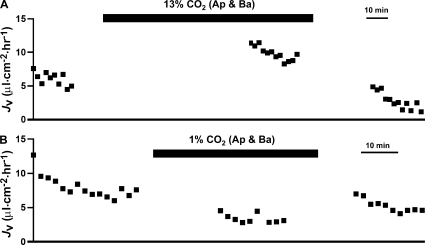
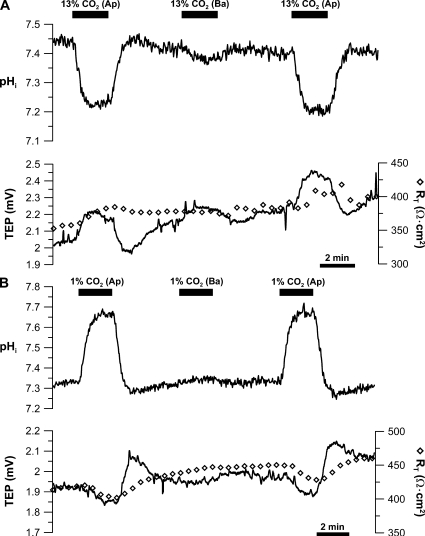
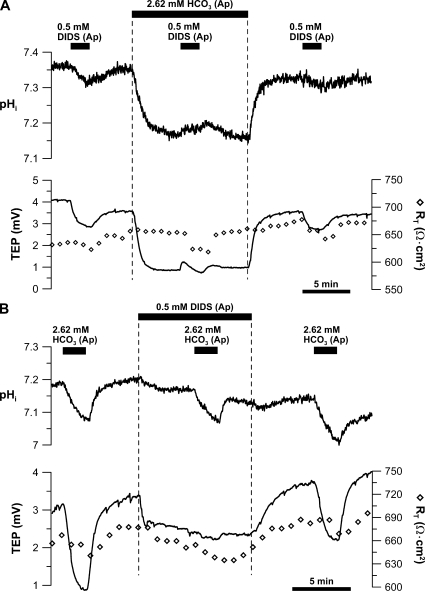
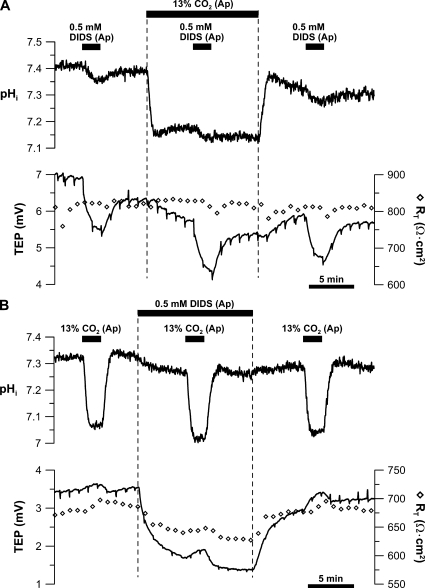
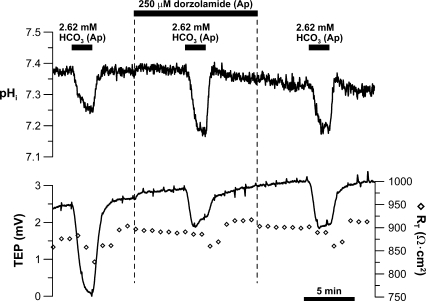
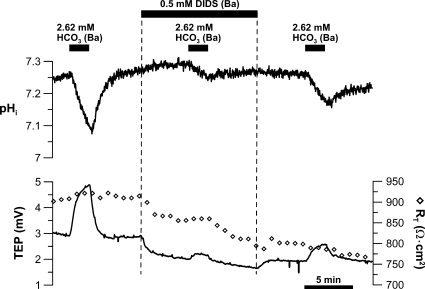
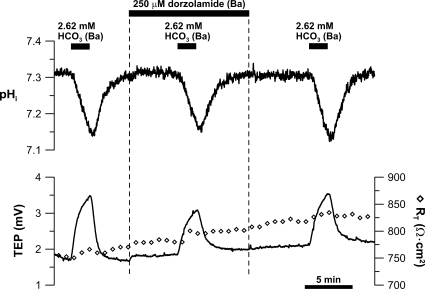
In the intact eye, the transition from light to dark alters pH, [Ca2+], and [K] in the subretinal space (SRS) separating the photoreceptor outer segments and the apical membrane of the retinal pigment epithelium (RPE). In addition to these changes, oxygen consumption in the retina increases with a concomitant release of CO2 and H2O into the SRS. The RPE maintains SRS pH and volume homeostasis by transporting these metabolic byproducts to the choroidal blood supply. In vitro, we mimicked the transition from light to dark by increasing apical bath CO2 from 5 to 13%; this maneuver decreased cell pH from 7.37 +/- 0.05 to 7.14 +/- 0.06 (n = 13). Our analysis of native and cultured fetal human RPE shows that the apical membrane is significantly more permeable (approximately 10-fold; n = 7) to CO2 than the basolateral membrane, perhaps due to its larger exposed surface area. The limited CO2 diffusion at the basolateral membrane promotes carbonic anhydrase-mediated HCO3 transport by a basolateral membrane Na/nHCO3 cotransporter. The activity of this transporter was increased by elevating apical bath CO2 and was reduced by dorzolamide. Increasing apical bath CO2 also increased intracellular Na from 15.7 +/- 3.3 to 24.0 +/- 5.3 mM (n = 6; P < 0.05) by increasing apical membrane Na uptake. The CO2-induced acidification also inhibited the basolateral membrane Cl/HCO3 exchanger and increased net steady-state fluid absorption from 2.8 +/- 1.6 to 6.7 +/- 2.3 microl x cm(-2) x hr(-1) (n = 5; P < 0.05). The present experiments show how the RPE can accommodate the increased retinal production of CO2 and H(2)O in the dark, thus preventing acidosis in the SRS. This homeostatic process would preserve the close anatomical relationship between photoreceptor outer segments and RPE in the dark and light, thus protecting the health of the photoreceptors.
在完整的眼睛中,从明到暗的转变会改变视网膜下间隙(SRS)中的pH值、[Ca2+]和[K],该间隙分隔着光感受器外段和视网膜色素上皮(RPE)的顶端膜。除了这些变化外,视网膜中的氧消耗增加,同时有CO2和H2O释放到SRS中。RPE通过将这些代谢副产物转运至脉络膜血液供应来维持SRS的pH值和体积稳态。在体外,我们通过将顶端浴液中的CO2从5%增加到13%来模拟从明到暗的转变;此操作使细胞pH值从7.37±0.05降至7.14±0.06(n = 13)。我们对天然和培养的胎儿人RPE的分析表明,顶端膜对CO2的通透性显著高于基底外侧膜(约10倍;n = 7),这可能是由于其暴露表面积更大。基底外侧膜处有限的CO2扩散通过基底外侧膜Na/nHCO3共转运体促进碳酸酐酶介导的HCO3转运。该转运体的活性通过提高顶端浴液中的CO2而增加,并被多佐胺降低。增加顶端浴液中的CO2还通过增加顶端膜对Na的摄取使细胞内Na从15.7±3.3 mM增加到24.0±5.3 mM(n = 6;P < 0.05)。CO2诱导的酸化还抑制了基底外侧膜Cl/HCO3交换体,并使净稳态液体吸收从2.8±1.6增加到6.7±2.3 μl×cm(-2)×hr(-1)(n = 5;P < 0.05)。本实验表明RPE如何在黑暗中适应视网膜产生的CO2和H2O增加,从而防止SRS中的酸中毒。这种稳态过程将在明和暗中维持光感受器外段与RPE之间紧密的解剖关系,从而保护光感受器的健康。