Mbarara University of Science and Technology, Uganda.
Confl Health. 2009 May 26;3:6. doi: 10.1186/1752-1505-3-6.
The aim of this study was to establish the prevalence of posttraumatic stress disorder (PTSD) and depression among Rwandese and Somali refugees resident in a Ugandan refugee settlement, as a measure of the mental health consequences of armed conflict, as well as to inform a subsequent mental health outreach program. The study population comprised a sample from 14400 (n = 519 Somali and n = 906 Rwandese) refugees resident in Nakivale refugee settlement in South Western Uganda during the year 2003.
The Posttraumatic Diagnostic Scale (PDS) and the Hopkins Symptom Checklist 25 were used to screen for posttraumatic stress disorder and depression.
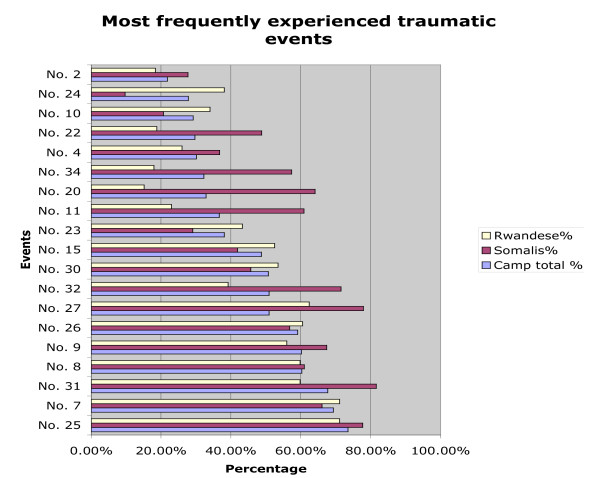
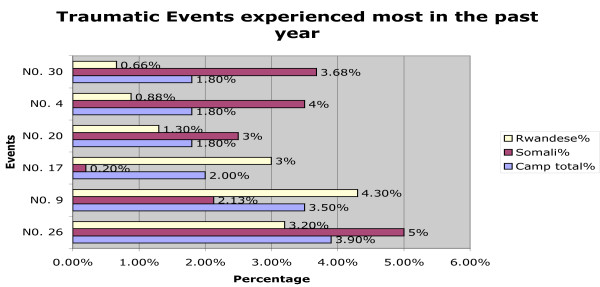
Thirty two percent of the Rwandese and 48.1% of the Somali refugees were found to suffer from PTSD. The Somalis refugees had a mean of 11.95 (SD = 6.17) separate traumatic event types while the Rwandese had 8.86 (SD = 5.05). The Somalis scored a mean sum score of 21.17 (SD = 16.19) on the PDS while the Rwandese had a mean sum score of 10.05 (SD = 9.7).
Mental health consequences of conflict remain long after the events are over, and therefore mental health intervention is as urgent for post-conflict migrant populations as physical health and other emergency interventions. A mental health outreach program was initiated based on this study.
本研究旨在确定居住在乌干达难民营的卢旺达和索马里难民中创伤后应激障碍(PTSD)和抑郁症的患病率,以此衡量武装冲突对心理健康的影响,并为随后的心理健康外展计划提供信息。研究人群包括 2003 年居住在乌干达西南部纳基瓦莱难民营的 14400 名难民中的一个样本(n = 519 名索马里人和 n = 906 名卢旺达人)。
使用创伤后诊断量表(PDS)和霍普金斯症状清单 25 来筛查 PTSD 和抑郁症。
32%的卢旺达难民和 48.1%的索马里难民被发现患有 PTSD。索马里难民经历了 11.95 种(SD = 6.17)不同的创伤性事件类型,而卢旺达难民经历了 8.86 种(SD = 5.05)。索马里难民的 PDS 总分平均为 21.17(SD = 16.19),而卢旺达难民的总分平均为 10.05(SD = 9.7)。
冲突的心理健康后果在事件结束后仍会长期存在,因此对于冲突后移民群体来说,心理健康干预与身体健康和其他紧急干预一样紧迫。基于这项研究,启动了一项心理健康外展计划。