Friedland Ari E, Lu Timothy K, Wang Xiao, Shi David, Church George, Collins James J
Howard Hughes Medical Institute, Department of Biomedical Engineering, Center for BioDynamics and Center for Advanced Biotechnology, Boston University, Boston, MA 02215, USA.
Science. 2009 May 29;324(5931):1199-202. doi: 10.1126/science.1172005.
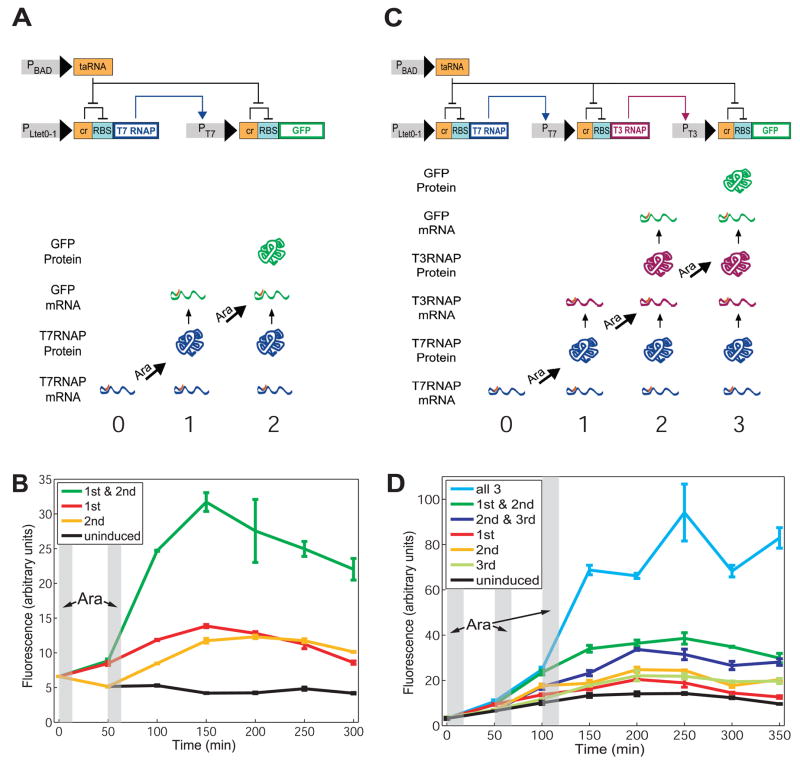
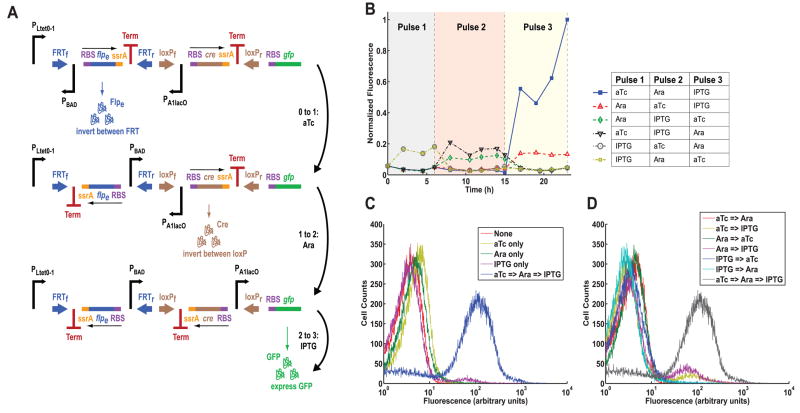
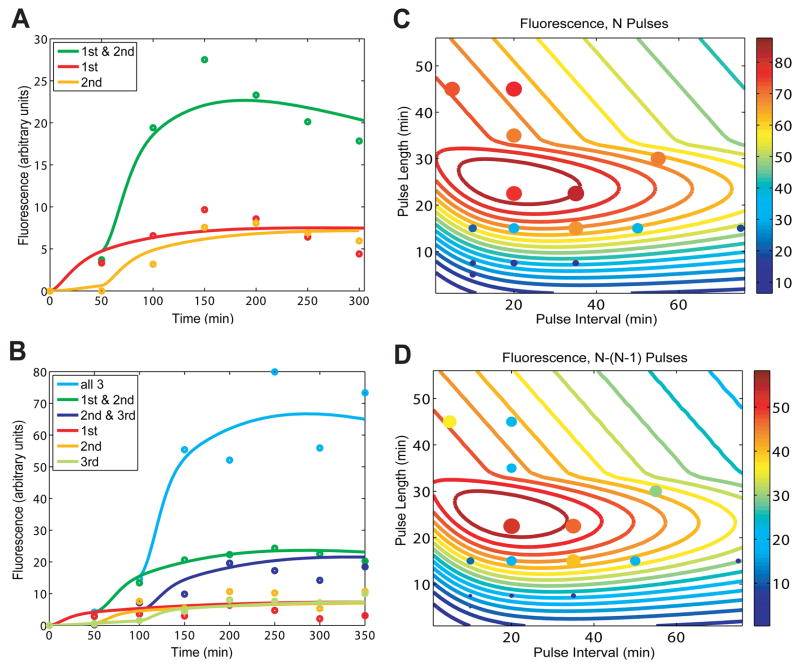
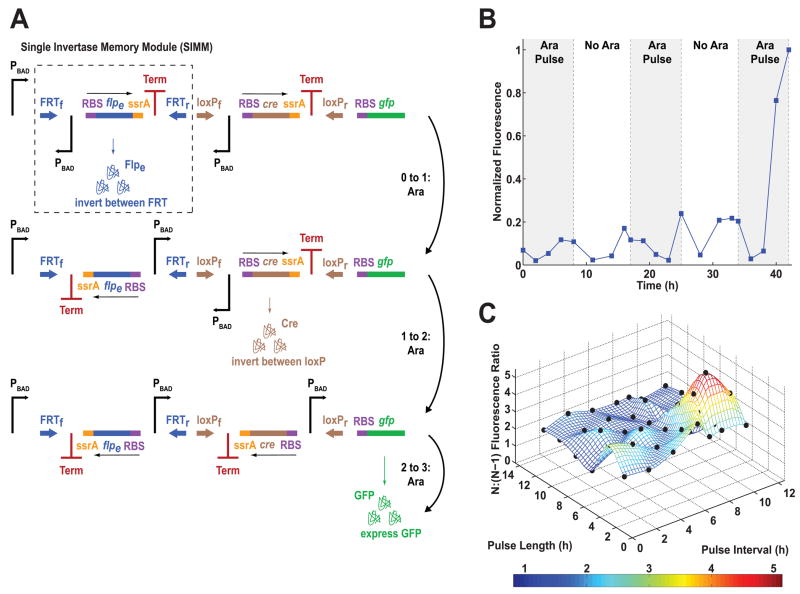
Synthetic gene networks can be constructed to emulate digital circuits and devices, giving one the ability to program and design cells with some of the principles of modern computing, such as counting. A cellular counter would enable complex synthetic programming and a variety of biotechnology applications. Here, we report two complementary synthetic genetic counters in Escherichia coli that can count up to three induction events: the first, a riboregulated transcriptional cascade, and the second, a recombinase-based cascade of memory units. These modular devices permit counting of varied user-defined inputs over a range of frequencies and can be expanded to count higher numbers.
可以构建合成基因网络来模拟数字电路和设备,使人们能够运用现代计算的一些原理(如计数)对细胞进行编程和设计。细胞计数器将实现复杂的合成编程以及各种生物技术应用。在此,我们报告了在大肠杆菌中构建的两个互补的合成遗传计数器,它们能够对多达三次诱导事件进行计数:第一个是核糖核酸调节的转录级联反应,第二个是基于重组酶的记忆单元级联反应。这些模块化装置能够在一系列频率上对各种用户定义的输入进行计数,并且可以扩展以进行更高次数的计数。