Anderson J Christopher, Voigt Christopher A, Arkin Adam P
Department of Pharmaceutical Chemistry, QB3: California Institute for Quantitative Biological Research, The University of California San Francisco, San Francisco, CA 94158-2330, USA.
Mol Syst Biol. 2007;3:133. doi: 10.1038/msb4100173. Epub 2007 Aug 14.
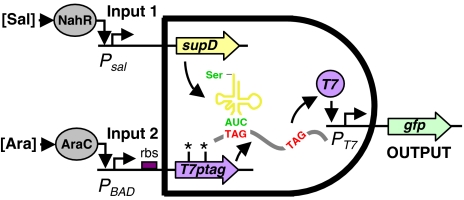
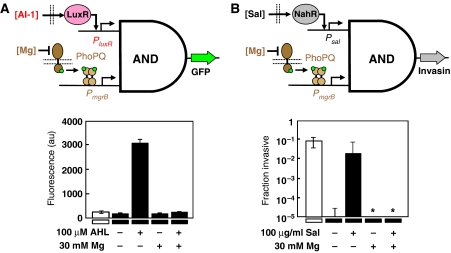
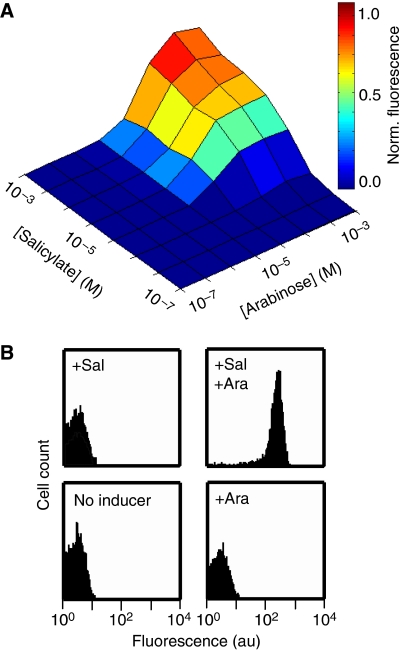
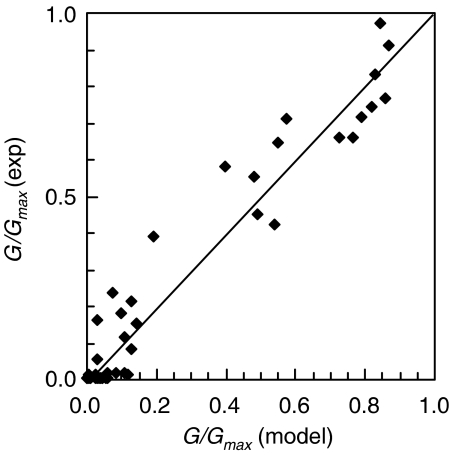
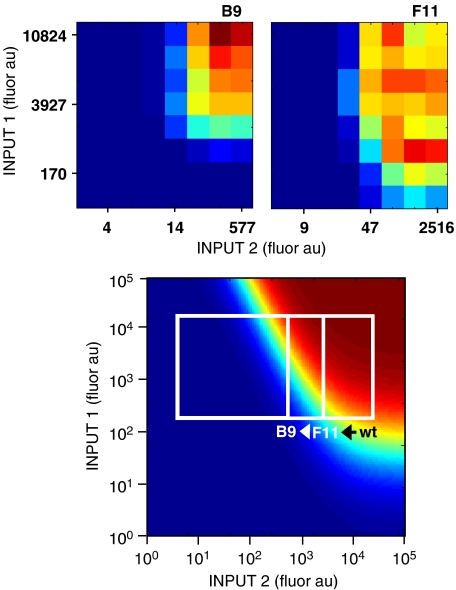
Microorganisms use genetic circuits to integrate environmental information. We have constructed a synthetic AND gate in the bacterium Escherichia coli that integrates information from two promoters as inputs and activates a promoter output only when both input promoters are transcriptionally active. The integration occurs via an interaction between an mRNA and tRNA. The first promoter controls the transcription of a T7 RNA polymerase gene with two internal amber stop codons blocking translation. The second promoter controls the amber suppressor tRNA supD. When both components are transcribed, T7 RNA polymerase is synthesized and this in turn activates a T7 promoter. Because inputs and outputs are promoters, the design is modular; that is, it can be reconnected to integrate different input signals and the output can be used to drive different cellular responses. We demonstrate this modularity by wiring the gate to integrate natural promoters (responding to Mg(2+) and AI-1) and using it to implement a phenotypic output (invasion of mammalian cells). A mathematical model of the transfer function is derived and parameterized using experimental data.
微生物利用遗传回路整合环境信息。我们在大肠杆菌中构建了一个合成“与”门,它将来自两个启动子的信息作为输入进行整合,并且仅当两个输入启动子都具有转录活性时才激活一个启动子输出。这种整合是通过mRNA与tRNA之间的相互作用发生的。第一个启动子控制带有两个内部琥珀色终止密码子的T7 RNA聚合酶基因的转录,这两个密码子会阻止翻译。第二个启动子控制琥珀色抑制tRNA supD。当这两个元件都被转录时,就会合成T7 RNA聚合酶,进而激活一个T7启动子。由于输入和输出都是启动子,所以该设计是模块化的;也就是说,它可以重新连接以整合不同的输入信号,并且输出可用于驱动不同的细胞反应。我们通过连接该门以整合天然启动子(响应Mg(2+)和AI-1)并利用它来实现一种表型输出(侵袭哺乳动物细胞)来证明这种模块化。利用实验数据推导并参数化了传递函数的数学模型。