Nandi Arijit, Beard John R, Galea Sandro
Center for Urban Epidemiologic Studies, New York Academy of Medicine, New York, USA.
BMC Psychiatry. 2009 Jun 1;9:31. doi: 10.1186/1471-244X-9-31.
Clinical evidence has long suggested there may be heterogeneity in the patterns and predictors of common mood and anxiety disorders; however, epidemiologic studies have generally treated these outcomes as homogenous entities. The objective of this study was to systematically review the epidemiologic evidence for potential patterns of heterogeneity of common mood and anxiety disorders over the lifecourse in the general population.
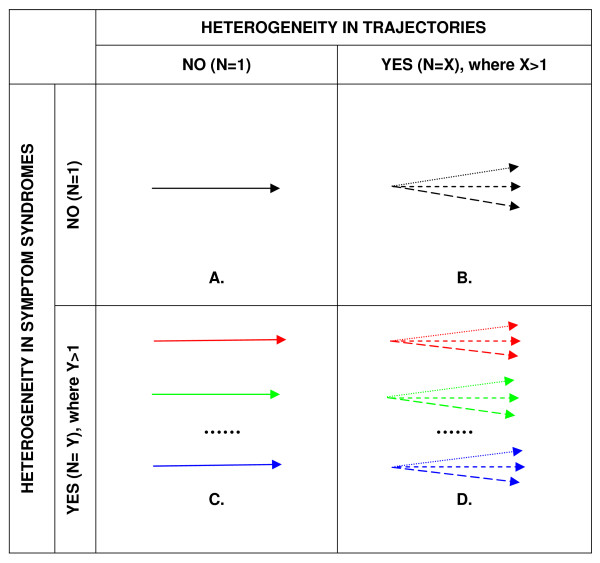
We reviewed epidemiologic studies examining heterogeneity in either the nature of symptoms experienced ("symptom syndromes") or in patterns of symptoms over time ("symptom trajectories"). To be included, studies of syndromes were required to identify distinct symptom subtypes, and studies of trajectories were required to identify distinct longitudinal patterns of symptoms in at least three waves of follow-up. Studies based on clinical or patient populations were excluded.
While research in this field is in its infancy, we found growing evidence that, not only can mood and anxiety disorders be differentiated by symptom syndromes and trajectories, but that the factors associated with these disorders may vary between these subtypes. Whether this reflects a causal pathway, where genetic or environmental factors influence the nature of the symptom or trajectory subtype experienced by an individual, or whether individuals with different subtypes differed in their susceptibility to different environmental factors, could not be determined. Few studies addressed issues of comorbidity or transitions in symptoms between common disorders.
Understanding the diversity of these conditions may help us identify preventable factors that are only associated with some subtypes of these common disorders.
长期以来,临床证据表明常见情绪和焦虑障碍的模式及预测因素可能存在异质性;然而,流行病学研究通常将这些结果视为同质的实体。本研究的目的是系统回顾一般人群中常见情绪和焦虑障碍在生命历程中潜在异质性模式的流行病学证据。
我们回顾了研究症状体验性质(“症状综合征”)或症状随时间变化模式(“症状轨迹”)异质性的流行病学研究。对于综合征研究,要纳入研究需识别出不同的症状亚型;对于轨迹研究,要纳入研究需在至少三轮随访中识别出不同的症状纵向模式。排除基于临床或患者人群的研究。
虽然该领域的研究尚处于起步阶段,但我们发现越来越多的证据表明,情绪和焦虑障碍不仅可通过症状综合征和轨迹加以区分,而且与这些障碍相关的因素在这些亚型之间可能有所不同。这是否反映了一种因果途径,即遗传或环境因素影响个体经历的症状或轨迹亚型的性质,或者不同亚型的个体对不同环境因素的易感性是否存在差异,尚无法确定。很少有研究涉及常见障碍之间的共病问题或症状转变。
了解这些病症的多样性可能有助于我们识别仅与这些常见障碍某些亚型相关的可预防因素。