Bessho Hiroaki, Kondo Naoshi, Honda Shigeru, Kuno Shin-ichi, Negi Akira
Department of Surgery, Division of Ophthalmology, Kobe University Graduate School of Medicine, Chuo-ku, Kobe, Japan.
Mol Vis. 2009 Jun 2;15:1107-14.
Using a candidate-gene approach, a recent case-control study identified a previously unknown association between neovascular age-related macular degeneration (AMD) and the coding Met72Thr variant in the pigment epithelium-derived factor (PEDF) gene in a Taiwan Chinese population. However, a subsequent replication study failed to see this association in a white European population. We noted an important difference in the sample ascertainment scheme between these two studies. The original study did not consider findings of indocyanine green (ICG) angiography for disease classification, which is the only way to obtain a clear image of polypoidal choroidal vasculopathy (PCV) lesions. This suggests that their cohort might include a considerable amount of PCV, given its high prevalence in the Chinese population. In contrast, the replication study intentionally excluded PCV from the case cohort on the basis of ICG angiograms. Therefore, the inconsistent finding might be caused by potential sample heterogeneity between these two studies. In this respect, this association needed to be examined in a case series of clearly defined individuals with neovascular AMD and PCV. The aim of this study was to validate the previously reported association of the PEDF Met72Thr variant in a well characterized Japanese population with neovascular AMD and PCV.
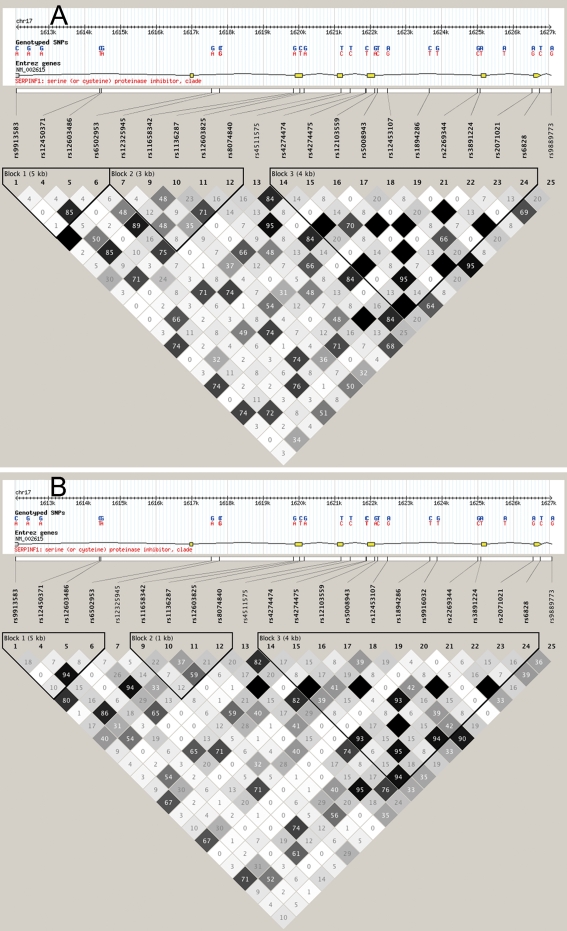
We genotyped the Met72Thr variant (rs1136287) in 116 patients with neovascular AMD, 140 patients with PCV, and 189 control participants in a Japanese population. Genotyping was performed using TaqMan technology. We tested for an association of this variant with neovascular AMD and PCV separately. We also evaluated population stratification in our study cohort.
We found no statistically significant evidence for association between rs1136287 and either neovascular AMD or PCV under any genetic models (trend, genotypic, dominant, and recessive genetic models; p>0.05). Population structure analyses excluded stratification artifact in our study population.
We report a lack of association between the PEDF Met72Thr variant and either neovascular AMD or PCV in a Japanese population. We conclude that the Met72Thr variant does not play a significant role in the risk of developing neovascular AMD or PCV.
通过候选基因方法,最近一项病例对照研究在台湾汉族人群中发现了新生血管性年龄相关性黄斑变性(AMD)与色素上皮衍生因子(PEDF)基因编码区的Met72Thr变异之间存在一种此前未知的关联。然而,随后的一项重复研究在欧洲白人人群中未发现这种关联。我们注意到这两项研究在样本确定方案上存在一个重要差异。原始研究在疾病分类时未考虑吲哚菁绿(ICG)血管造影的结果,而ICG血管造影是获得息肉状脉络膜血管病变(PCV)病变清晰图像的唯一方法。鉴于PCV在中国人群中的高患病率,这表明他们的队列中可能包含相当数量的PCV患者。相比之下,重复研究根据ICG血管造影有意将PCV排除在病例队列之外。因此,结果不一致可能是由这两项研究之间潜在的样本异质性导致的。在这方面,需要在一组明确诊断的新生血管性AMD和PCV患者中检验这种关联。本研究的目的是在一个特征明确的日本人群中验证先前报道的PEDF Met72Thr变异与新生血管性AMD和PCV之间的关联。
我们对116例新生血管性AMD患者、140例PCV患者和189名日本对照参与者的Met72Thr变异(rs1136287)进行了基因分型。基因分型采用TaqMan技术。我们分别检测了该变异与新生血管性AMD和PCV的关联。我们还评估了研究队列中的人群分层情况。
在任何遗传模型(趋势、基因型、显性和隐性遗传模型;p>0.05)下,我们均未发现rs1136287与新生血管性AMD或PCV之间存在统计学上显著的关联证据。人群结构分析排除了我们研究人群中的分层假象。
我们报道在日本人群中,PEDF Met72Thr变异与新生血管性AMD或PCV之间不存在关联。我们得出结论,Met72Thr变异在新生血管性AMD或PCV的发病风险中不发挥重要作用。