Li Zhigang, Reighard Gregory Lynn, Abbott Albert Glenn, Bielenberg Douglas Gary
Department of Horticulture, 152 Poole Agricultural Center, Clemson University, Clemson, SC 29634-0319, USA.
J Exp Bot. 2009;60(12):3521-30. doi: 10.1093/jxb/erp195. Epub 2009 Jun 24.
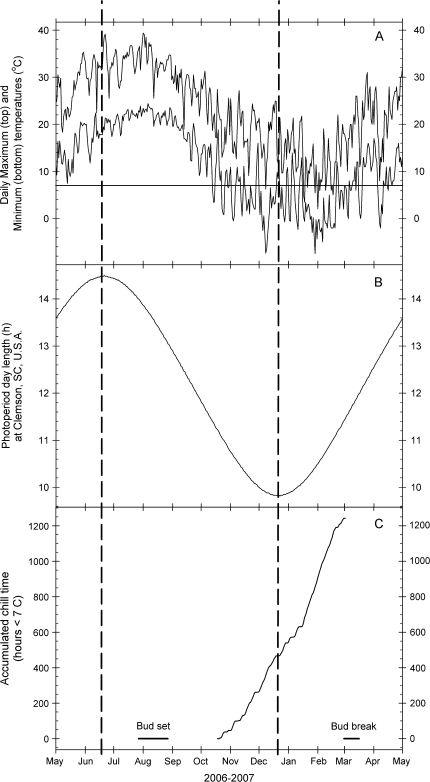
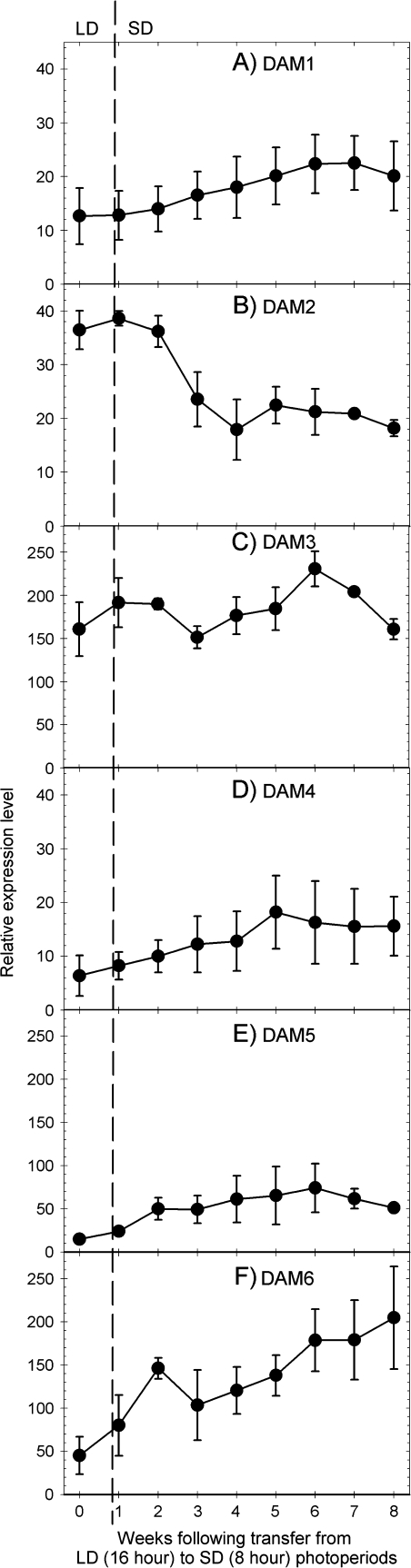
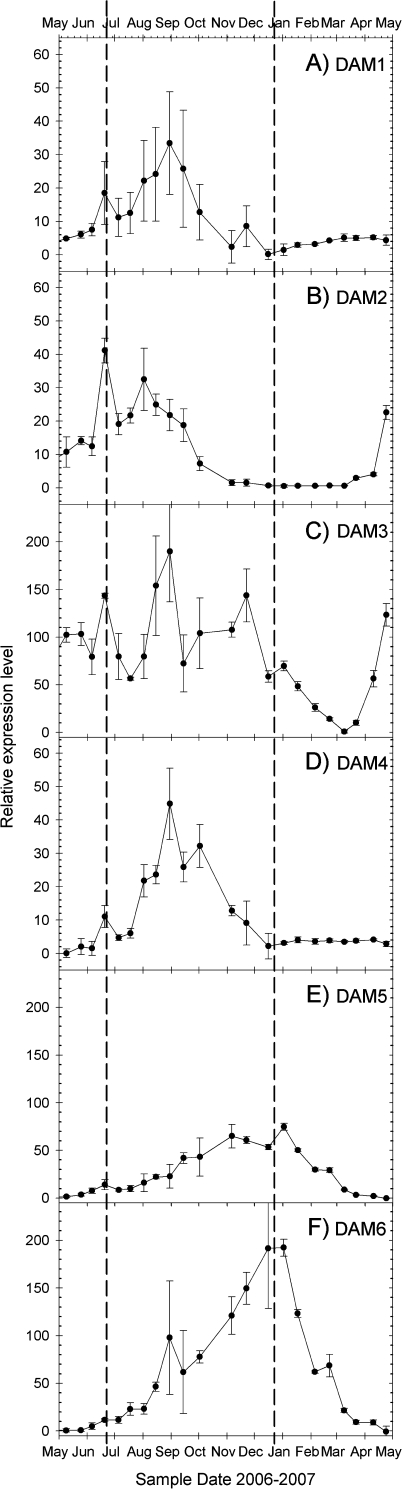
Mapping and sequencing of the non-dormant evg mutant in peach [Prunus persica (L.) Batsch] identified six tandem-arrayed DAM (dormancy-associated MADS-box) genes as candidates for regulating growth cessation and terminal bud formation. To narrow the list of candidate genes, an attempt was made to associate bud phenology with the seasonal and environmental patterns of expression of the candidates in wild-type trees. The expression of the six peach DAM genes at the EVG locus of peach was characterized throughout an annual growing cycle in the field, and under controlled conditions in response to a long day-short day photoperiod transition. DAM1, 2, 4, 5, and 6 were responsive to a reduction in photoperiod in controlled conditions and the direction of response correlated with the seasonal timing of expression in field-grown trees. DAM3 did not respond to photoperiod and may be regulated by chilling temperatures. The DAM genes in peach appear to have at least four distinct patterns of expression. DAM1, 2, and 4 are temporally associated with seasonal elongation cessation and bud formation and are the most likely candidates for control of the evg phenotype.
对桃[Prunus persica (L.) Batsch]中不进入休眠的evg突变体进行图谱绘制和测序,鉴定出6个串联排列的DAM(休眠相关MADS盒)基因,它们是调控生长停止和顶芽形成的候选基因。为了缩小候选基因的范围,研究人员尝试将芽物候与野生型树中候选基因的季节性和环境表达模式联系起来。在田间的一个年度生长周期内,以及在可控条件下响应长日照-短日照光周期转变时,对桃EVG位点处的6个桃DAM基因的表达进行了表征。DAM1、2、4、5和6在可控条件下对光周期缩短有响应,且响应方向与田间生长树木中表达的季节性时间相关。DAM3对光周期无响应,可能受低温调控。桃中的DAM基因似乎至少有4种不同的表达模式。DAM1、2和4在时间上与季节性伸长停止和芽形成相关,是控制evg表型的最有可能的候选基因。