Chin Mark H, Mason Mike J, Xie Wei, Volinia Stefano, Singer Mike, Peterson Cory, Ambartsumyan Gayane, Aimiuwu Otaren, Richter Laura, Zhang Jin, Khvorostov Ivan, Ott Vanessa, Grunstein Michael, Lavon Neta, Benvenisty Nissim, Croce Carlo M, Clark Amander T, Baxter Tim, Pyle April D, Teitell Mike A, Pelegrini Matteo, Plath Kathrin, Lowry William E
Department of Biological Chemistry, David Geffen School of Medicine, University of California, Los Angeles, CA 90095, USA.
Cell Stem Cell. 2009 Jul 2;5(1):111-23. doi: 10.1016/j.stem.2009.06.008.
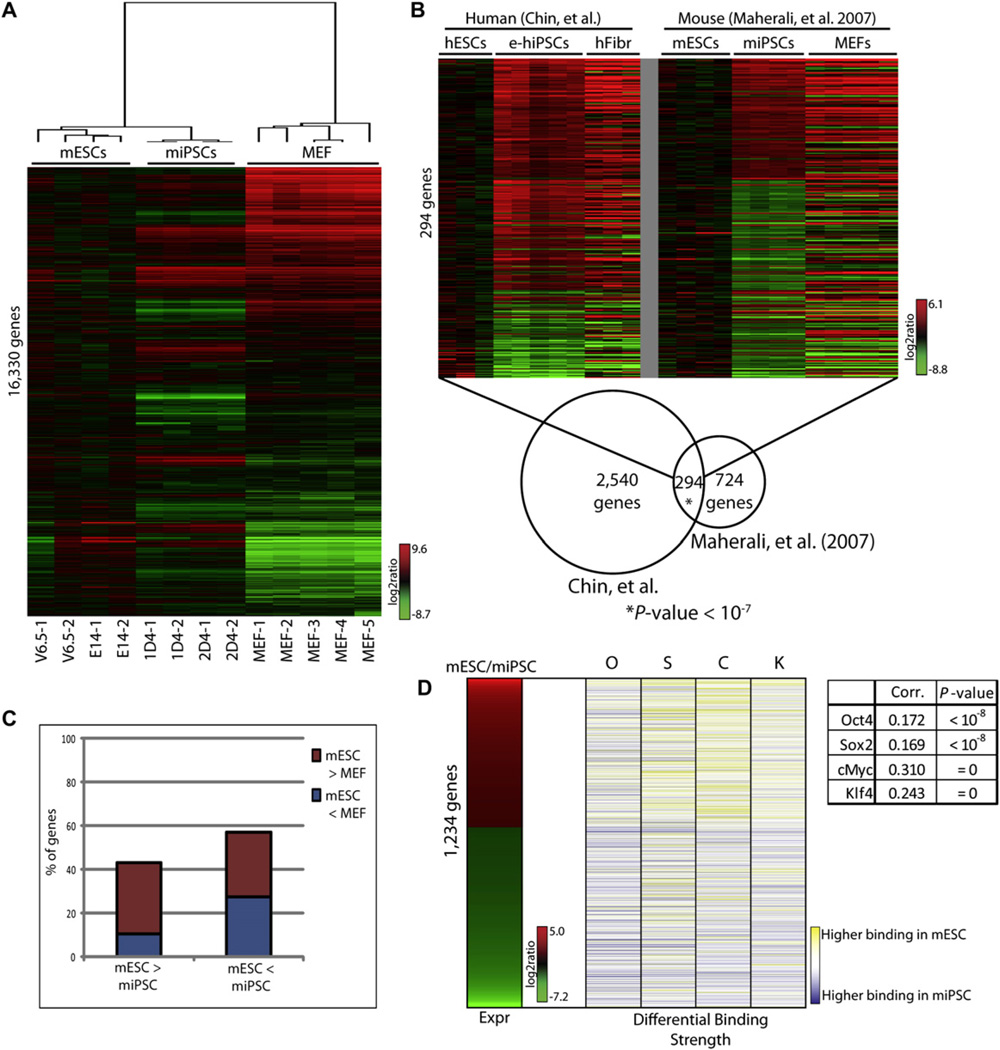
Induced pluripotent stem cells (iPSCs) outwardly appear to be indistinguishable from embryonic stem cells (ESCs). A study of gene expression profiles of mouse and human ESCs and iPSCs suggests that, while iPSCs are quite similar to their embryonic counterparts, a recurrent gene expression signature appears in iPSCs regardless of their origin or the method by which they were generated. Upon extended culture, hiPSCs adopt a gene expression profile more similar to hESCs; however, they still retain a gene expression signature unique from hESCs that extends to miRNA expression. Genome-wide data suggested that the iPSC signature gene expression differences are due to differential promoter binding by the reprogramming factors. High-resolution array profiling demonstrated that there is no common specific subkaryotypic alteration that is required for reprogramming and that reprogramming does not lead to genomic instability. Together, these data suggest that iPSCs should be considered a unique subtype of pluripotent cell.
诱导多能干细胞(iPSC)在外观上似乎与胚胎干细胞(ESC)没有区别。一项对小鼠和人类ESC及iPSC基因表达谱的研究表明,虽然iPSC与它们的胚胎对应物非常相似,但无论其来源或产生方法如何,iPSC中都会出现一种反复出现的基因表达特征。经过长时间培养后,人iPSC会采用更类似于人ESC的基因表达谱;然而,它们仍然保留着与人ESC不同的独特基因表达特征,这种特征延伸到了miRNA表达。全基因组数据表明,iPSC特征性基因表达差异是由于重编程因子与启动子的结合不同所致。高分辨率阵列分析表明,重编程不需要共同的特定亚核型改变,并且重编程不会导致基因组不稳定。总之,这些数据表明iPSC应被视为一种独特的多能细胞亚型。