
使用平均巴甫洛夫比率预测颈椎后路减压术后上肢麻痹的风险。
The use of average Pavlov ratio to predict the risk of post operative upper limb palsy after posterior cervical decompression.
作者信息
Sieh Koon-Man, Leung Siu-Man, Lam Judy Suk Yee, Cheung Kai Yin, Fung Kwai Yau
机构信息
Department of Orthopaedics and Traumatology, Alice Ho Mui Ling Nethersole Hospital, Tai Po, NT, Hong Kong SAR, PR China.
出版信息
J Orthop Surg Res. 2009 Jul 7;4:24. doi: 10.1186/1749-799X-4-24.
STUDY DESIGN
A retrospective study was conducted to study the post operative upper limb palsy after laminoplasty for cervical myelopathy.
OBJECTIVE
To identify a reliable and simple preoperative radiological parameter in predicting the risk of post operative upper limb palsy.
BACKGROUND
Post operative upper limb palsy is one of the causes of patient dissatisfaction after surgery. There had been no simple, standard preoperative radiological parameters reliably predict the occurrence of this problem.
MATERIALS AND METHODS
Seventy-four patients received posterior cervical decompression from 1998 to 2008. Medical record and preoperative radiological information were evaluated. Clinical presentations of the palsy were described. The relationship between the occurrence of palsy and different preoperative radiological information is analyzed.
RESULTS
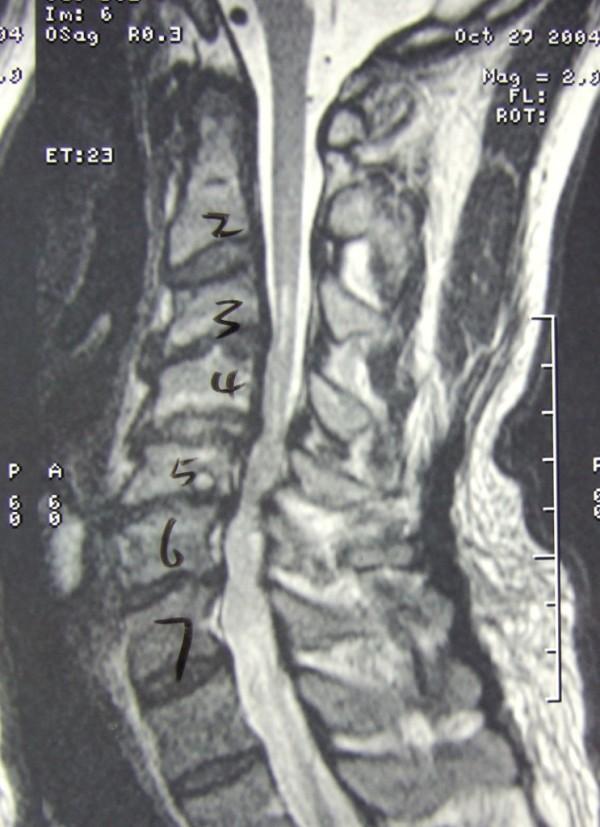
Eighteen patients (24.3%) presented with post operative upper limb palsy. Majority of patients presented with dysesthesia (17/18) and with deficit of the C5 segment (17/18). Ten patients presented with pure dysesthesia and 8 patients presented with mixed motor-sensory deficit and dysesthesia. Multilevel involvement was exclusively presented in patients with motor weakness. A longer duration of symptom (16.7 Vs 57.2 days) was noticed in patients in the motor deficit group. Average Pavlov ratio less then 0.65 (P = 0.027, Odds Ratio = 3.68) and compression at the C3/4 in preoperative MRI image (P = 0.025, Odds Ratio = 6) were significant risk factors for development of this problem.
CONCLUSION
Post operative upper limb palsy is not uncommon and thorough preoperative explanation is important. There is a spectrum of clinical presentation and patients with multi-level involvement and motor deficit are associated with poorer prognosis. Average Pavlov ratio < 0.65 and compression at C3/4 segment on preoperative MRI image are simple and reliable preoperative predictor for the development of this problem.
研究设计
进行一项回顾性研究,以探讨颈椎脊髓病椎板成形术后上肢麻痹情况。
目的
确定一个可靠且简单的术前影像学参数,用于预测术后上肢麻痹风险。
背景
术后上肢麻痹是患者术后不满意的原因之一。此前尚无简单、标准的术前影像学参数能可靠预测该问题的发生。
材料与方法
1998年至2008年间,74例患者接受了颈椎后路减压术。评估病历及术前影像学信息。描述麻痹的临床表现。分析麻痹发生与不同术前影像学信息之间的关系。
结果
18例患者(24.3%)出现术后上肢麻痹。大多数患者表现为感觉异常(17/18)及C5节段功能障碍(17/18)。10例患者表现为单纯感觉异常,8例患者表现为运动 - 感觉混合功能障碍及感觉异常。多节段受累仅见于有运动无力的患者。运动功能障碍组患者的症状持续时间更长(16.7天对57.2天)。术前MRI图像中平均Pavlov比值小于0.65(P = 0.027,优势比 = 3.68)及C3/4节段受压(P = 0.025,优势比 = 6)是该问题发生的显著危险因素。
结论
术后上肢麻痹并不少见,术前充分解释很重要。临床表现具有多样性,多节段受累及运动功能障碍的患者预后较差。术前MRI图像中平均Pavlov比值<0.65及C3/4节段受压是该问题发生的简单可靠的术前预测指标。



 Zotero 插件