Shah Chirayu, Miller Todd W, Wyatt Shelby K, McKinley Eliot T, Olivares Maria Graciela, Sanchez Violeta, Nolting Donald D, Buck Jason R, Zhao Ping, Ansari M Sib, Baldwin Ronald M, Gore John C, Schiff Rachel, Arteaga Carlos L, Manning H Charles
Vanderbilt University Institute of Imaging Science, Department of Radiology and Radiological Sciences, Vanderbilt University Medical Center, Nashville, Tennessee 37232, USA
Clin Cancer Res. 2009 Jul 15;15(14):4712-21. doi: 10.1158/1078-0432.CCR-08-2635. Epub 2009 Jul 7.
To evaluate noninvasive imaging methods as predictive biomarkers of response to trastuzumab in mouse models of HER2-overexpressing breast cancer. The correlation between tumor regression and molecular imaging of apoptosis, glucose metabolism, and cellular proliferation was evaluated longitudinally in responding and nonresponding tumor-bearing cohorts.
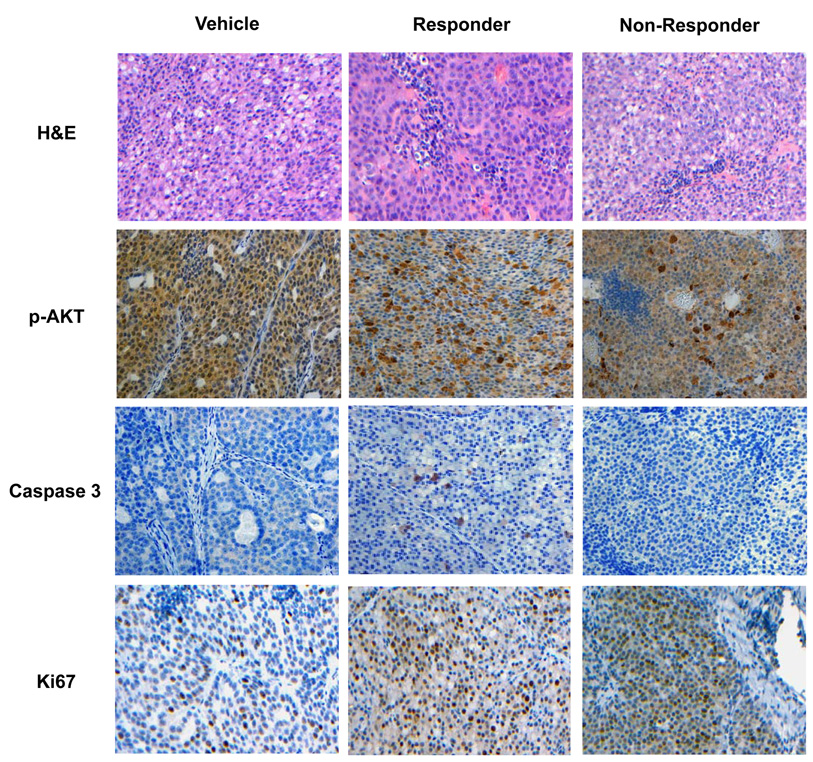
Mammary tumors from MMTV/HER2 transgenic female mice were transplanted into syngeneic female mice. BT474 human breast carcinoma cell line xenografts were grown in athymic nude mice. Tumor cell apoptosis (NIR700-Annexin V accumulation), glucose metabolism [2-deoxy-2-[18F]fluoro-d-glucose positron emission tomography ([18F]FDG-PET)], and proliferation [3'-[18F]fluoro-3'-deoxythymidine-PET ([18F]FLT-PET)] were evaluated throughout a biweekly trastuzumab regimen. Imaging metrics were validated by direct measurement of tumor size and immunohistochemical analysis of cleaved caspase-3, phosphorylated AKT, and Ki67.
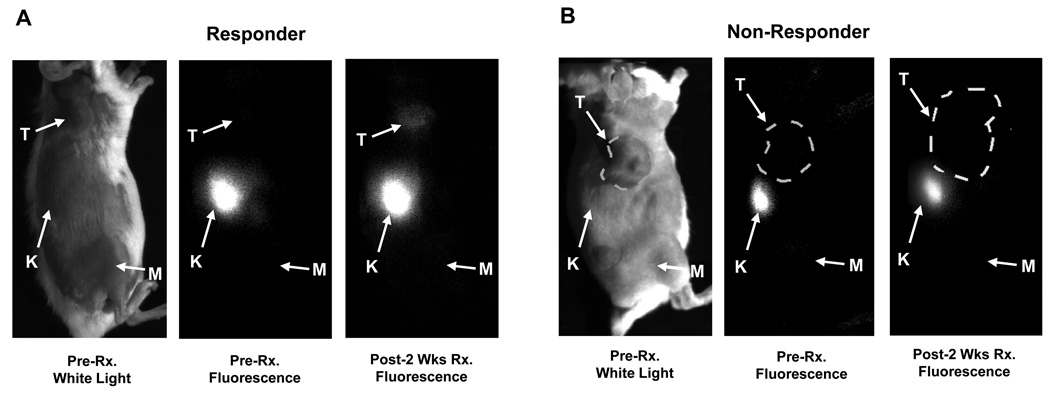
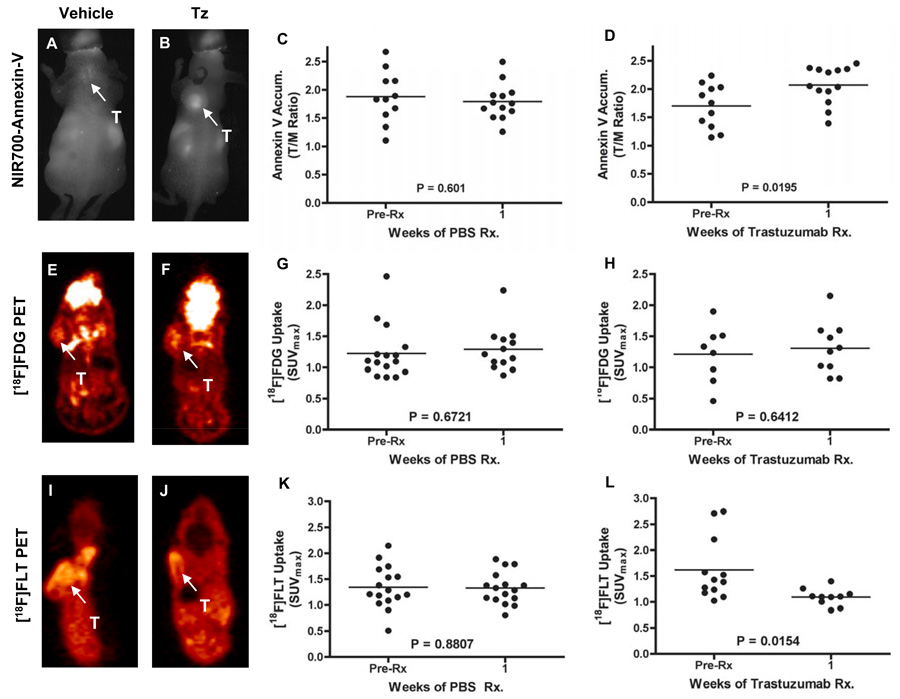
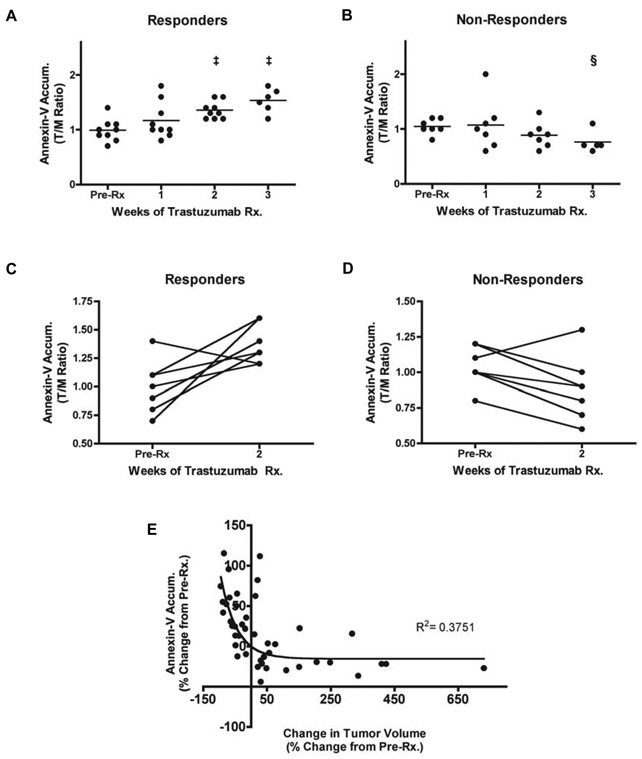
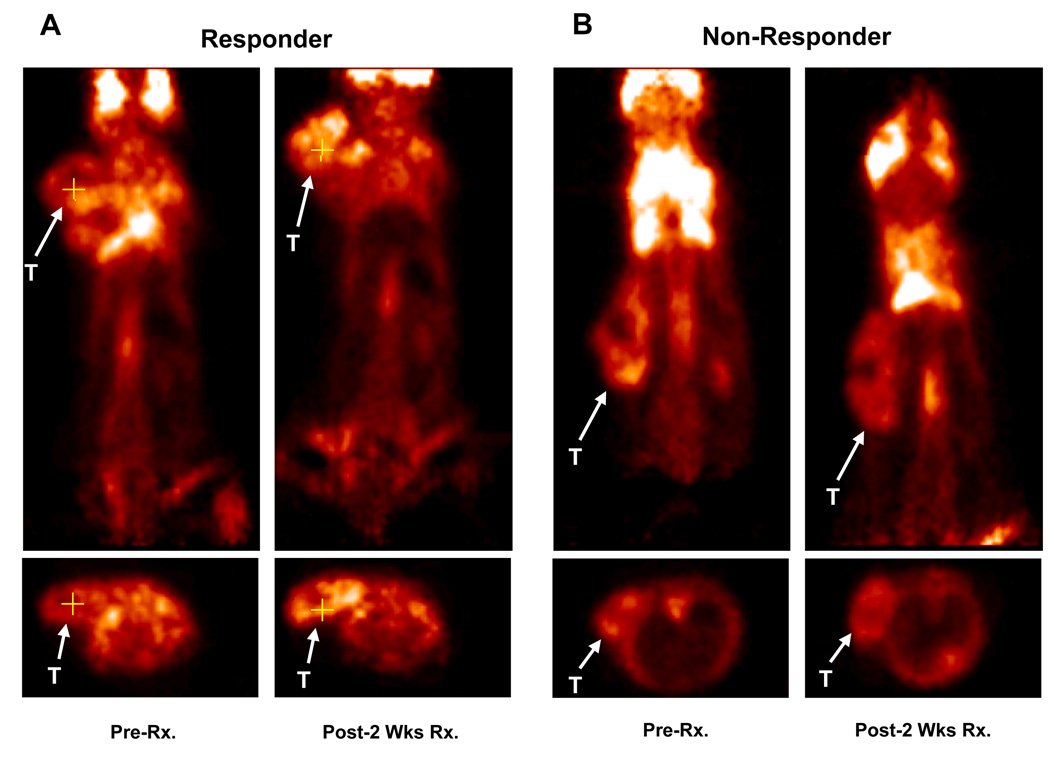
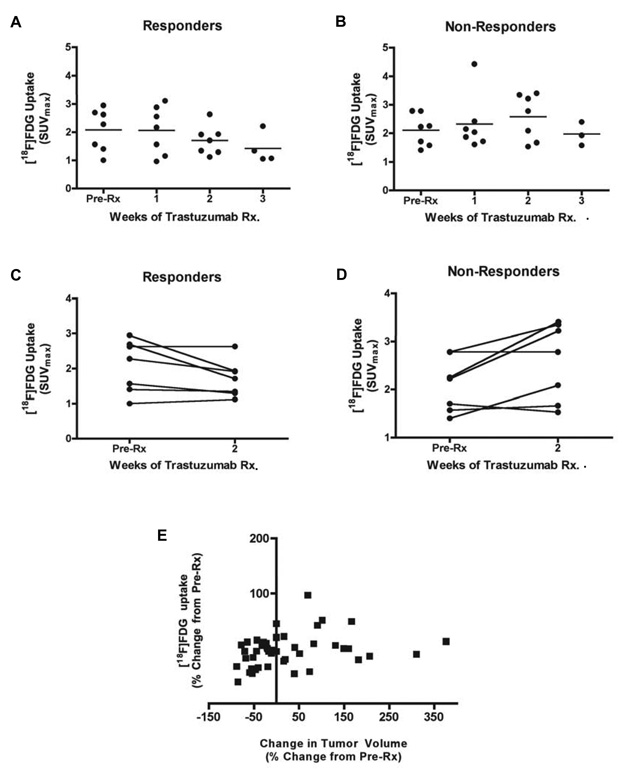
NIR700-Annexin V accumulated significantly in trastuzumab-treated MMTV/HER2 and BT474 tumors that ultimately regressed but not in nonresponding or vehicle-treated tumors. Uptake of [18F]FDG was not affected by trastuzumab treatment in MMTV/HER2 or BT474 tumors. [18F]FLT-PET imaging predicted trastuzumab response in BT474 tumors but not in MMTV/HER2 tumors, which exhibited modest uptake of [18F]FLT. Close agreement was observed between imaging metrics and immunohistochemical analysis.
Molecular imaging of apoptosis accurately predicts trastuzumab-induced regression of HER2+ tumors and may warrant clinical exploration to predict early response to neoadjuvant trastuzumab. Trastuzumab does not seem to alter glucose metabolism substantially enough to afford [18F]FDG-PET significant predictive value in this setting. Although promising in one preclinical model, further studies are required to determine the overall value of [18F]FLT-PET as a biomarker of response to trastuzumab in HER2+ breast cancer.
在HER2过表达乳腺癌小鼠模型中评估非侵入性成像方法作为曲妥珠单抗反应预测生物标志物的作用。在有反应和无反应的荷瘤队列中纵向评估肿瘤消退与细胞凋亡、葡萄糖代谢及细胞增殖分子成像之间的相关性。
将MMTV/HER2转基因雌性小鼠的乳腺肿瘤移植到同基因雌性小鼠体内。将BT474人乳腺癌细胞系异种移植物接种到无胸腺裸鼠体内。在每两周一次的曲妥珠单抗治疗方案期间,评估肿瘤细胞凋亡(NIR700-Annexin V聚集)、葡萄糖代谢[2-脱氧-2-[18F]氟-D-葡萄糖正电子发射断层扫描([18F]FDG-PET)]和增殖[3'-[18F]氟-3'-脱氧胸苷-PET([18F]FLT-PET)]。通过直接测量肿瘤大小以及对裂解的半胱天冬酶-3、磷酸化AKT和Ki67进行免疫组织化学分析来验证成像指标。
NIR700-Annexin V在最终消退的曲妥珠单抗治疗的MMTV/HER2和BT474肿瘤中显著聚集,但在无反应或载体治疗的肿瘤中未聚集。在MMTV/HER2或BT474肿瘤中,曲妥珠单抗治疗不影响[18F]FDG的摄取。[18F]FLT-PET成像预测了BT474肿瘤对曲妥珠单抗的反应,但在MMTV/HER2肿瘤中未预测到,MMTV/HER2肿瘤对[18F]FLT的摄取适中。成像指标与免疫组织化学分析之间观察到密切一致性。
细胞凋亡分子成像准确预测曲妥珠单抗诱导的HER2+肿瘤消退,可能值得进行临床探索以预测对新辅助曲妥珠单抗的早期反应。在这种情况下,曲妥珠单抗似乎未对葡萄糖代谢产生足够大的改变,从而使[18F]FDG-PET具有显著的预测价值。尽管在一个临床前模型中有前景,但需要进一步研究以确定[18F]FLT-PET作为HER2+乳腺癌中曲妥珠单抗反应生物标志物的总体价值。