Bennett Ian M, Coco Andrew, Anderson Janice, Horst Michael, Gambler Angela S, Barr Wendy Brooks, Ratcliffe Stephen
Department of Family Medicine and Community Health and the Leonard Davis Institute of Health Economics, University of Pennsylvania School of Medicine, Philadelphia, PA 19104-4283, USA.
J Am Board Fam Med. 2009 Jul-Aug;22(4):380-6. doi: 10.3122/jabfm.2009.04.090111.
Maternal medical care (prenatal and postpartum) involves a set of clinical interventions addressing risk factors associated with important maternal and infant outcomes. Programs to increase the rate of delivery of these interventions in clinical practice have not been widely implemented.
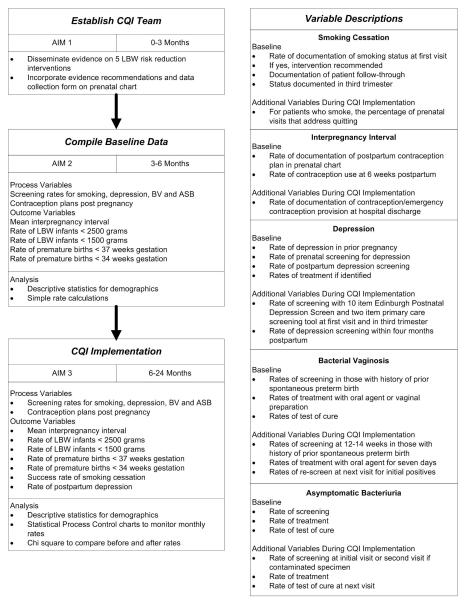
A practice-based research network focused on developing continuous quality improvement (CQI) processes for maternal care among 10 family medicine residency training sites in the northeastern United States (the IMPLICIT Network) from January 2003 through September 2007. Documented delivery of 5 standard maternal care interventions was assessed before and after initiating a program to increase their frequency. Proportion chart analyses were conducted comparing the period before and after implementation of the CQI interventions.
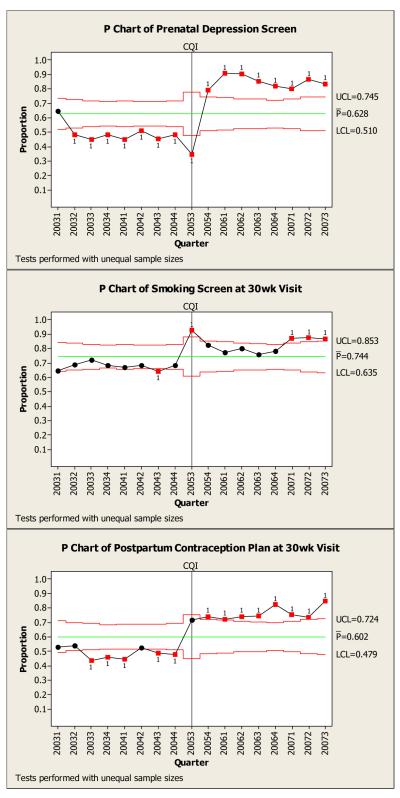
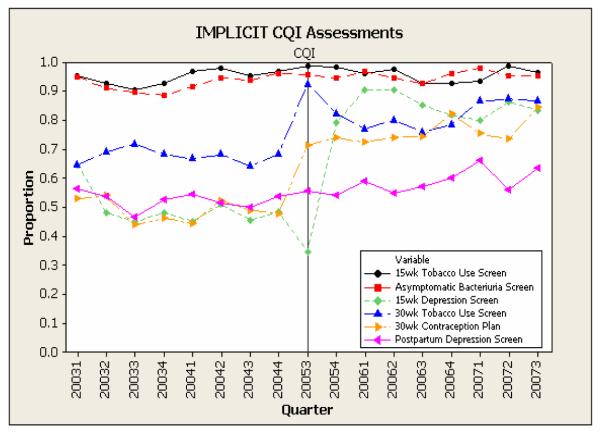
Data were available for 3936 pregnancies during the course of the study period. Results varied across the clinical interventions. Significant improvement in care processes was seen for 3 screening activities: (1) prenatal depression symptomatology (by 15 weeks' gestation); (2) screening for smoking at 30 weeks' gestation; (3) and postpartum contraception planning. Screening for smoking by 15 weeks' gestation and testing for asymptomatic bacteriuria were already conducted >90% of the time during the baseline period and did not increase significantly after initiating the CQI program. Screening for postpartum depression symptomatology was recorded in 50% to 60% of women before the CQI program and did not increase significantly.
A practice-based research network of family medicine residency practices focused on CQI outcomes was successful in increasing the delivery of some maternal care interventions.
孕产妇医疗保健(产前和产后)涉及一系列针对与重要母婴结局相关风险因素的临床干预措施。提高这些干预措施在临床实践中实施率的项目尚未得到广泛实施。
2003年1月至2007年9月期间,一个基于实践的研究网络专注于为美国东北部10个家庭医学住院医师培训地点(IMPLICIT网络)的孕产妇护理开发持续质量改进(CQI)流程。在启动一项提高5项标准孕产妇护理干预措施实施频率的项目前后,对这些干预措施的实施记录进行了评估。进行了比例图分析,比较了CQI干预措施实施前后的时间段。
在研究期间,共有3936例妊娠的数据可用。不同临床干预措施的结果有所不同。3项筛查活动的护理流程有显著改善:(1)孕15周时的产前抑郁症状筛查;(2)孕30周时的吸烟筛查;(3)产后避孕计划。在基线期,孕15周时的吸烟筛查和无症状菌尿检测的实施率已超过90%,在启动CQI项目后没有显著增加。在CQI项目实施前,50%至60%的女性记录了产后抑郁症状筛查,且没有显著增加。
一个专注于CQI结果的基于实践的家庭医学住院医师实践研究网络成功提高了一些孕产妇护理干预措施的实施率。