Grunnet Louise G, Nilsson Emma, Ling Charlotte, Hansen Torben, Pedersen Oluf, Groop Leif, Vaag Allan, Poulsen Pernille
Steno Diabetes Center, Gentofte, Denmark.
Diabetes. 2009 Oct;58(10):2402-8. doi: 10.2337/db09-0205. Epub 2009 Jul 8.
Common variants in FTO (the fat mass- and obesity-associated gene) associate with obesity and type 2 diabetes. The regulation and biological function of FTO mRNA expression in target tissue is unknown. We investigated the genetic and nongenetic regulation of FTO mRNA in skeletal muscle and adipose tissue and their influence on in vivo glucose and fat metabolism.
The FTO rs9939609 polymorphism was genotyped in two twin cohorts: 1) 298 elderly twins aged 62-83 years with glucose tolerance ranging from normal to type 2 diabetes and 2) 196 young (25-32 years) and elderly (58-66 years) nondiabetic twins examined by a hyperinsulinemic-euglycemic clamp including indirect calorimetry. FTO mRNA expression was determined in subcutaneous adipose tissue (n = 226) and skeletal muscle biopsies (n = 158).
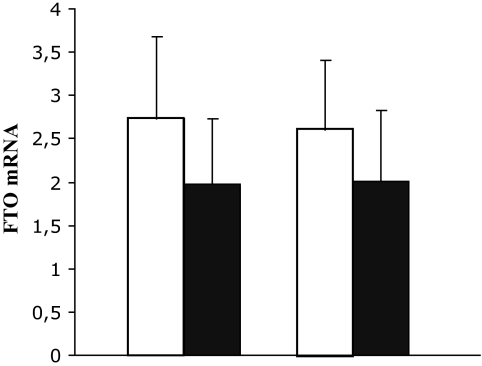
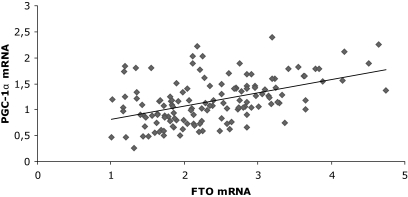
Heritability of FTO expression in both tissues was low, and FTO expression was not influenced by FTO rs9939609 genotype. FTO mRNA expression in skeletal muscle was regulated by age and sex, whereas age and BMI were predictors of adipose tissue FTO mRNA expression. FTO mRNA expression in adipose tissue was associated with an atherogenic lipid profile. In skeletal muscle, FTO mRNA expression was negatively associated to fat and positively to glucose oxidation rates as well as positively correlated with expression of genes involved in oxidative phosphorylation including PGC1alpha.
The heritability of FTO expression in adipose tissue and skeletal muscle is low and not influenced by obesity-associated FTO genotype. The age-dependent decline in FTO expression is associated with peripheral defects of glucose and fat metabolism.
FTO(脂肪量和肥胖相关基因)中的常见变异与肥胖症和2型糖尿病相关。FTO mRNA在靶组织中的调控及生物学功能尚不清楚。我们研究了骨骼肌和脂肪组织中FTO mRNA的遗传和非遗传调控及其对体内葡萄糖和脂肪代谢的影响。
在两个双胞胎队列中对FTO rs9939609多态性进行基因分型:1)298名年龄在62 - 83岁的老年双胞胎,其糖耐量范围从正常到2型糖尿病;2)196名年轻(25 - 32岁)和老年(58 - 66岁)非糖尿病双胞胎,通过高胰岛素 - 正常血糖钳夹试验(包括间接测热法)进行检查。在皮下脂肪组织(n = 226)和骨骼肌活检样本(n = 158)中测定FTO mRNA表达。
两种组织中FTO表达的遗传度较低,且FTO表达不受FTO rs9939609基因型影响。骨骼肌中FTO mRNA表达受年龄和性别的调控,而年龄和BMI是脂肪组织FTO mRNA表达的预测因子。脂肪组织中FTO mRNA表达与致动脉粥样硬化的脂质谱相关。在骨骼肌中,FTO mRNA表达与脂肪呈负相关,与葡萄糖氧化率呈正相关,并且与包括PGC1α在内的参与氧化磷酸化的基因表达呈正相关。
脂肪组织和骨骼肌中FTO表达的遗传度较低,且不受与肥胖相关的FTO基因型影响。FTO表达随年龄下降与葡萄糖和脂肪代谢的外周缺陷有关。