Hill Robin Cook, Haag Eric S
Department of Biology, University of Maryland, College Park, MD 20742, USA.
Evol Dev. 2009 Jul-Aug;11(4):333-42. doi: 10.1111/j.1525-142X.2009.00340.x.
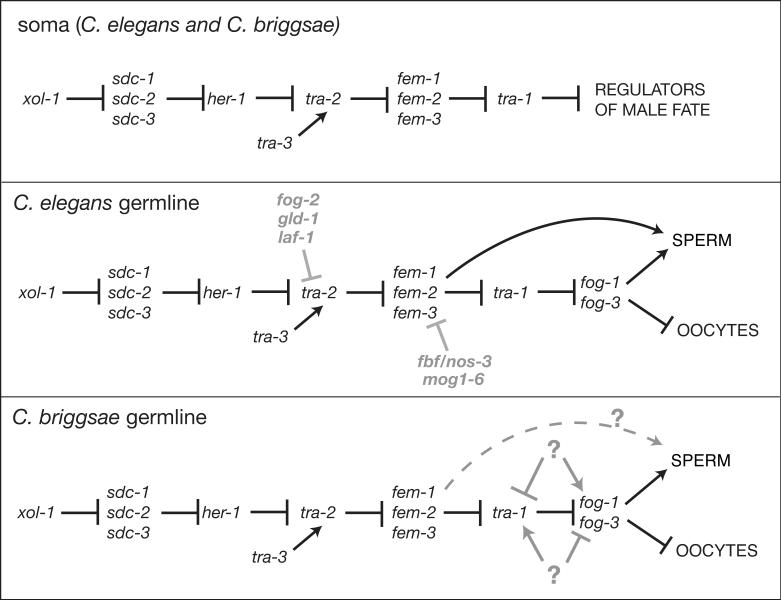
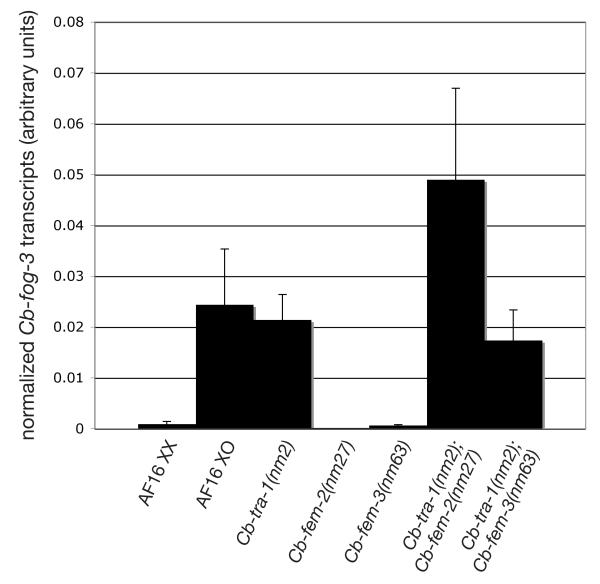
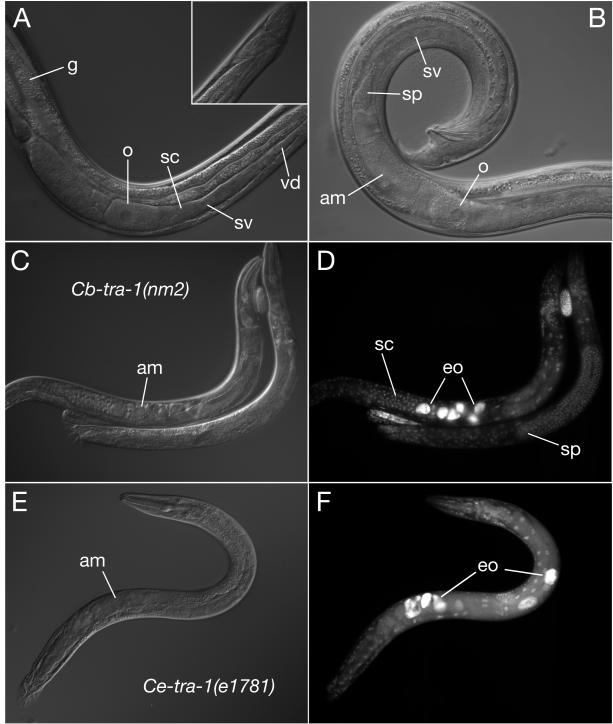
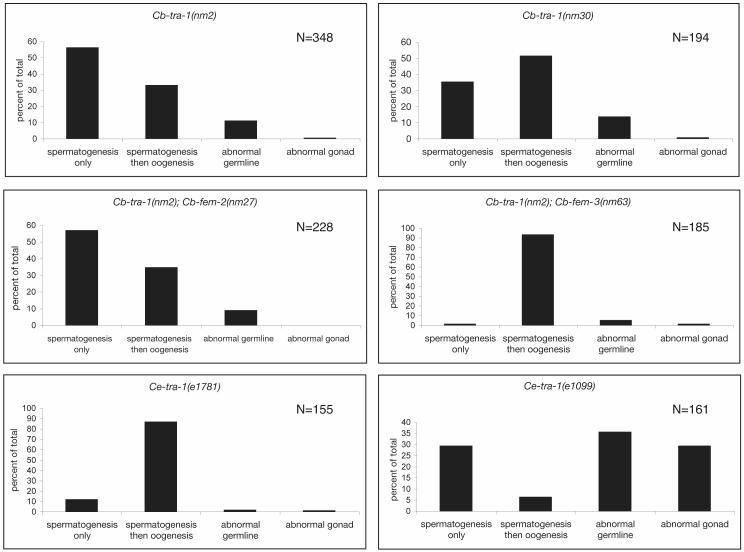
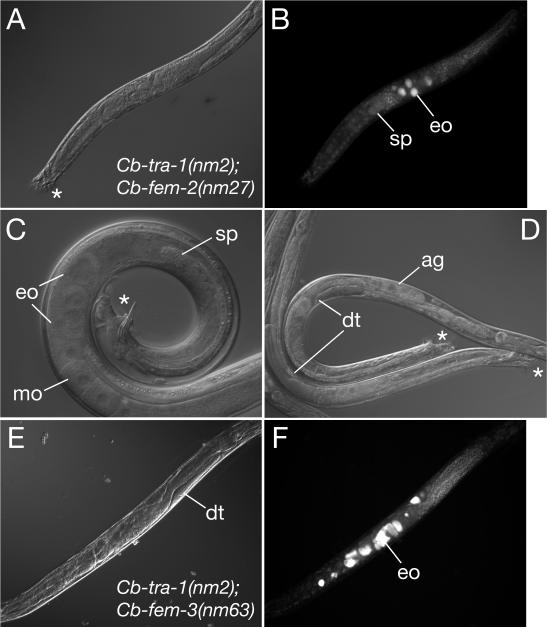
Caenorhabditis elegans and Caenorhabditis briggsae are both self-fertile hermaphroditic nematodes that evolved independently from male/female ancestors. In C. elegans, FEM-1, FEM-2, and FEM-3 specify male fates by promoting proteolysis of the male-repressing transcription factor, TRA-1. Phenotypes of tra-1 and fem mutants are consistent with this simple linear model in the soma, but not in the germline. While both XX and XO tra-1(lf) mutants have functional male somas, they produce both sperm and oocytes. Further, all three tra-1; fem double mutants retain the expected male soma, but make only oocytes (the germline fem phenotype). Thus, a poorly characterized tra-1 activity is important for sustained male spermatogenesis, and the fem genes affect germline sexual fate independently of their role in regulating TRA-1. C. briggsae tra-1 mutants are phenotypically identical to their C. elegans counterparts, while the fem mutants differ in the germline: XX and XO C. elegans fem mutants are true females, but in C. briggsae they are self-fertile hermaphrodites. To further explore how C. briggsae hermaphrodites regulate germline sex, we analyzed Cb-tra-1/Cb-fem interactions. Cb-tra-1 is fully epistatic to Cb-fem-2 in the germline, unlike the orthologous C. elegans combination. In contrast, Cb-fem-3 shifts the Cb-tra-1(lf) germline phenotype to that of a nearly normal hermaphrodite in the context of a male somatic gonad. This suggests that Cb-fem-3 is epistatic to Cb-tra-1(lf) (as in C. elegans), and that the normal control of C. briggsae XX spermatogenesis targets Cb-tra-1-independent factors downstream of Cb-fem-3. The effect of Cb-fem-3(lf) on Cb-tra-1(lf) is not mediated by change in the expression of Cb-fog-3, a likely direct germline target of Cb-tra-1. As Cb-fem-2 and Cb-fem-3 have identical single mutant phenotypes, Cb-tra-1 provides a sensitized background that reveals differences in how they promote male germline development. These results represent another way in which C. briggsae germline sex determination is incongruent with that of the outwardly similar C. elegans.
秀丽隐杆线虫和briggsae隐杆线虫都是自体受精的雌雄同体线虫,它们从雄性/雌性祖先独立进化而来。在秀丽隐杆线虫中,FEM - 1、FEM - 2和FEM - 3通过促进雄性抑制转录因子TRA - 1的蛋白水解来确定雄性命运。tra - 1和fem突变体的表型在体细胞中与这个简单的线性模型一致,但在生殖系中并非如此。虽然XX和XO tra - 1(lf)突变体都有功能性的雄性体细胞,但它们同时产生精子和卵子。此外,所有三种tra - 1; fem双突变体都保留了预期的雄性体细胞,但只产生卵子(生殖系fem表型)。因此,一种特征不明的tra - 1活性对于持续的雄性精子发生很重要,并且fem基因独立于其在调节TRA - 1中的作用而影响生殖系的性别命运。briggsae隐杆线虫的tra - 1突变体表型与其秀丽隐杆线虫对应物相同,而fem突变体在生殖系方面有所不同:XX和XO秀丽隐杆线虫fem突变体是真正的雌性,但在briggsae隐杆线虫中它们是自体受精的雌雄同体。为了进一步探索briggsae隐杆线虫雌雄同体如何调节生殖系性别,我们分析了Cb - tra - 1/Cb - fem的相互作用。在生殖系中,Cb - tra - 1对Cb - fem - 2完全上位,这与直系同源的秀丽隐杆线虫组合不同。相比之下,在雄性体细胞性腺的背景下,Cb - fem - 3将Cb - tra - 1(lf)生殖系表型转变为近乎正常的雌雄同体表型。这表明Cb - fem - 3对Cb - tra - 1(lf)上位(如在秀丽隐杆线虫中),并且briggsae隐杆线虫XX精子发生的正常调控靶向Cb - fem - 3下游不依赖Cb - tra - 1的因子。Cb - fem - 3(lf)对Cb - tra - 1(lf)的影响不是由Cb - fog - 3表达的变化介导的,Cb - fog - 3可能是Cb - tra - 1在生殖系中的直接靶点。由于Cb - fem - 2和Cb - fem - 3具有相同的单突变体表型,Cb - tra - 1提供了一个敏感背景,揭示了它们在促进雄性生殖系发育方面的差异。这些结果代表了briggsae隐杆线虫生殖系性别决定与外观相似的秀丽隐杆线虫不同的另一种方式。