Harkins Gordon W, Delport Wayne, Duffy Siobain, Wood Natasha, Monjane Adérito L, Owor Betty E, Donaldson Lara, Saumtally Salem, Triton Guy, Briddon Rob W, Shepherd Dionne N, Rybicki Edward P, Martin Darren P, Varsani Arvind
South African National Bioinformatics Institute, University of the Western Cape, Cape Town, South Africa.
Virol J. 2009 Jul 16;6:104. doi: 10.1186/1743-422X-6-104.
Despite the demonstration that geminiviruses, like many other single stranded DNA viruses, are evolving at rates similar to those of RNA viruses, a recent study has suggested that grass-infecting species in the genus Mastrevirus may have co-diverged with their hosts over millions of years. This "co-divergence hypothesis" requires that long-term mastrevirus substitution rates be at least 100,000-fold lower than their basal mutation rates and 10,000-fold lower than their observable short-term substitution rates. The credibility of this hypothesis, therefore, hinges on the testable claim that negative selection during mastrevirus evolution is so potent that it effectively purges 99.999% of all mutations that occur.
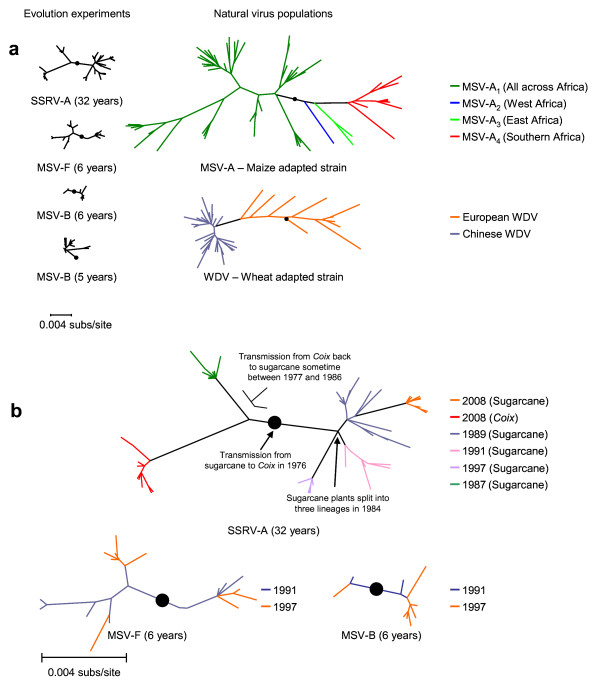
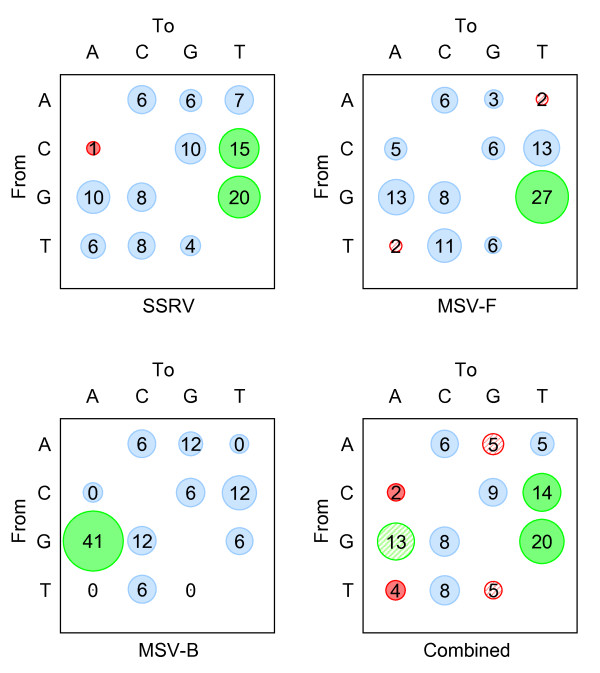
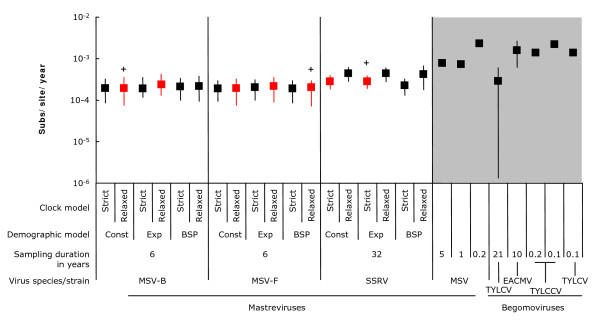
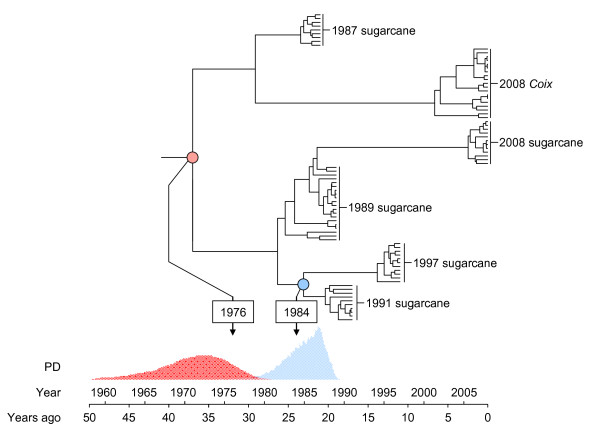
We have conducted long-term evolution experiments lasting between 6 and 32 years, where we have determined substitution rates of between 2 and 3 x 10(-4) substitutions/site/year for the mastreviruses Maize streak virus (MSV) and Sugarcane streak Réunion virus (SSRV). We further show that mutation biases are similar for different geminivirus genera, suggesting that mutational processes that drive high basal mutation rates are conserved across the family. Rather than displaying signs of extremely severe negative selection as implied by the co-divergence hypothesis, our evolution experiments indicate that MSV and SSRV are predominantly evolving under neutral genetic drift.
The absence of strong negative selection signals within our evolution experiments and the uniformly high geminivirus substitution rates that we and others have reported suggest that mastreviruses cannot have co-diverged with their hosts.
尽管有证据表明双生病毒与许多其他单链DNA病毒一样,其进化速率与RNA病毒相似,但最近一项研究表明,玉米线条病毒属中感染禾本科植物的病毒可能在数百万年的时间里与其宿主共同分化。这种“共同分化假说”要求玉米线条病毒的长期替代率比其基础突变率至少低10万倍,比其可观察到的短期替代率低1万倍。因此,这一假说的可信度取决于一个可检验的论断,即玉米线条病毒进化过程中的负选择作用非常强大,以至于能有效清除所有发生突变的99.999%。
我们进行了为期6至32年的长期进化实验,确定了玉米线条病毒(MSV)和甘蔗线条留尼汪病毒(SSRV)的替代率为2至3×10⁻⁴个替代/位点/年。我们进一步表明,不同双生病毒属的突变偏向相似,这表明驱动高基础突变率的突变过程在整个科中是保守的。我们的进化实验并未显示出如共同分化假说所暗示的极其严重的负选择迹象,而是表明MSV和SSRV主要是在中性遗传漂变下进化。
我们的进化实验中缺乏强烈的负选择信号,以及我们和其他人报告的双生病毒替代率一直很高,这表明玉米线条病毒不可能与其宿主共同分化。