Williamson Thomas, Schwartz Jean-Marc, Kell Douglas B, Stateva Lubomira
Faculty of Life Sciences, The University of Manchester, Manchester, M13 9PT, UK.
BMC Syst Biol. 2009 Jul 16;3:70. doi: 10.1186/1752-0509-3-70.
Cyclic adenosine monophosphate (cAMP) has a key signaling role in all eukaryotic organisms. In Saccharomyces cerevisiae, it is the second messenger in the Ras/PKA pathway which regulates nutrient sensing, stress responses, growth, cell cycle progression, morphogenesis, and cell wall biosynthesis. A stochastic model of the pathway has been reported.
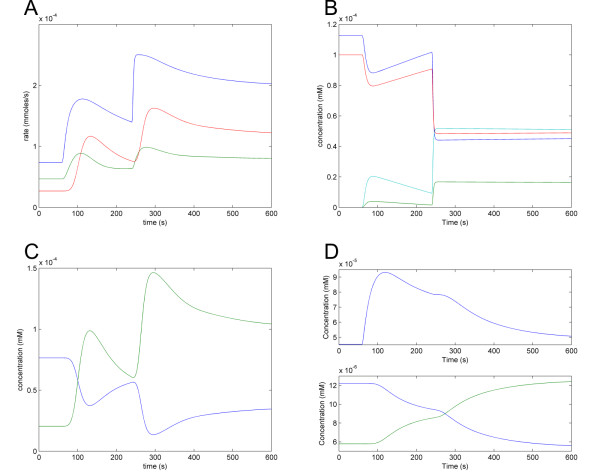
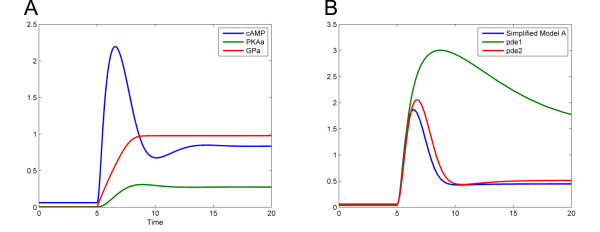
We have created deterministic mathematical models of the PKA module of the pathway, as well as the complete cAMP pathway. First, a simplified conceptual model was created which reproduced the dynamics of changes in cAMP levels in response to glucose addition in wild-type as well as cAMP phosphodiesterase deletion mutants. This model was used to investigate the role of the regulatory Krh proteins that had not been included previously. The Krh-containing conceptual model reproduced very well the experimental evidence supporting the role of Krh as a direct inhibitor of PKA. These results were used to develop the Complete cAMP Model. Upon simulation it illustrated several important features of the yeast cAMP pathway: Pde1p is more important than is Pde2p for controlling the cAMP levels following glucose pulses; the proportion of active PKA is not directly proportional to the cAMP level, allowing PKA to exert negative feedback; negative feedback mechanisms include activating Pde1p and deactivating Ras2 via phosphorylation of Cdc25. The Complete cAMP model is easier to simulate, and although significantly simpler than the existing stochastic one, it recreates cAMP levels and patterns of changes in cAMP levels observed experimentally in vivo in response to glucose addition in wild-type as well as representative mutant strains such as pde1Delta, pde2Delta, cyr1Delta, and others. The complete model is made available in SBML format.
We suggest that the lower number of reactions and parameters makes these models suitable for integrating them with models of metabolism or of the cell cycle in S. cerevisiae. Similar models could be also useful for studies in the human pathogen Candida albicans as well as other less well-characterized fungal species.
环磷酸腺苷(cAMP)在所有真核生物中具有关键的信号传导作用。在酿酒酵母中,它是Ras/PKA途径中的第二信使,该途径调节营养感知、应激反应、生长、细胞周期进程、形态发生和细胞壁生物合成。已报道了该途径的一个随机模型。
我们创建了该途径的PKA模块以及完整cAMP途径的确定性数学模型。首先,创建了一个简化的概念模型,该模型再现了野生型以及cAMP磷酸二酯酶缺失突变体中添加葡萄糖后cAMP水平变化的动态。该模型用于研究先前未包含的调节性Krh蛋白的作用。包含Krh的概念模型很好地再现了支持Krh作为PKA直接抑制剂作用的实验证据。这些结果被用于开发完整的cAMP模型。模拟结果显示了酵母cAMP途径的几个重要特征:对于控制葡萄糖脉冲后cAMP水平,Pde1p比Pde2p更重要;活性PKA的比例与cAMP水平不成正比,使得PKA能够发挥负反馈作用;负反馈机制包括激活Pde1p以及通过Cdc25的磷酸化使Ras2失活。完整的cAMP模型更易于模拟,虽然比现有的随机模型显著更简单,但它再现了野生型以及代表性突变株(如pde1Δ、pde2Δ、cyr1Δ等)在体内实验中观察到的cAMP水平以及添加葡萄糖后cAMP水平的变化模式。完整模型以SBML格式提供。
我们认为反应和参数数量较少使得这些模型适合与酿酒酵母的代谢模型或细胞周期模型整合。类似的模型对于人类病原体白色念珠菌以及其他特征较少的真菌物种的研究也可能有用。