Maas Stefan, Gommans Willemijn M
Department of Biological Sciences, Lehigh University, Bethlehem, PA, USA.
Nucleic Acids Res. 2009 Sep;37(17):5822-9. doi: 10.1093/nar/gkp599. Epub 2009 Jul 17.
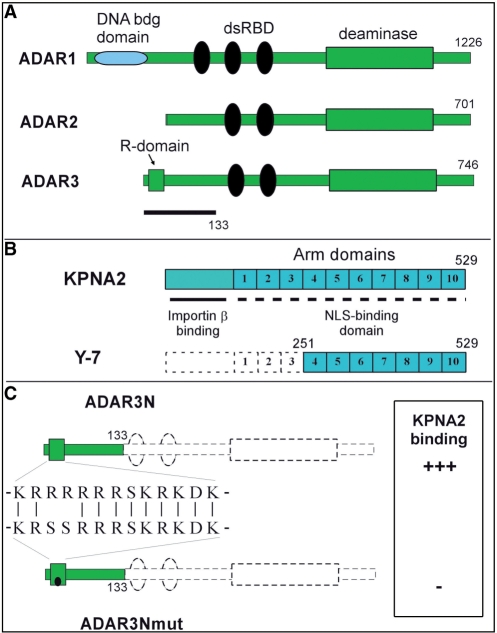
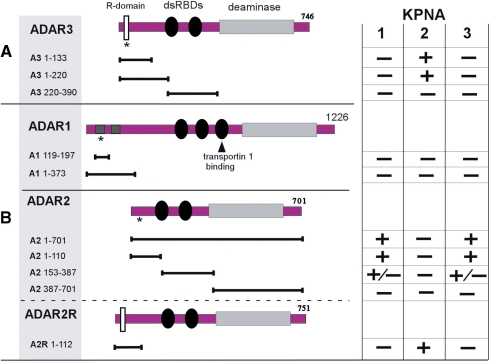
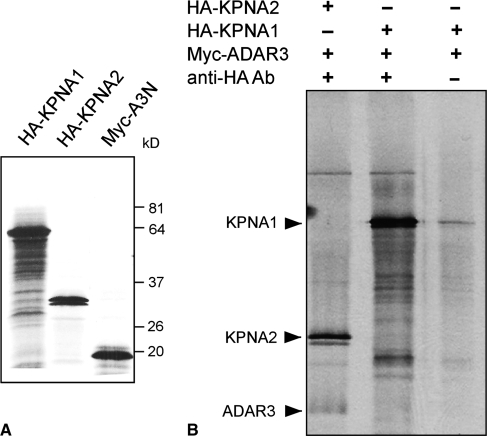
The adenosine deaminases acting on RNA (ADARs) comprise a family of RNA editing enzymes that selectively modify single codons within RNA primary transcripts with often profound impact on protein function. Little is known about the mechanisms that regulate nuclear RNA editing activity. Editing levels show cell-type specific and developmental modulation that does not strictly coincide with observed expression levels of ADARs. Here, we provide evidence for a molecular mechanism that might control nuclear import of specific ADARs and, in turn, nuclear RNA editing. We identify an in vivo ADAR3 interaction partner, importin alpha 1 (KPNA2) that specifically recognizes an arginine-rich ADAR3 sequence motif and show that it acts as a functional nuclear localization sequence. Furthermore, whereas KPNA2, but not KPNA1 or KNPA3, recognizes the ADAR3 NLS, we observe the converse binding specificity with ADAR2. Interestingly, alternative splicing of ADAR2 pre-mRNA introduces an ADAR3-like NLS that alters the interaction profile with the importins. Thus, in vivo RNA editing might be regulated, in part, through controlled subcellular localization of ADARs, which in turn is governed by the coordinated local expression of importin alpha proteins and ADAR protein variants.
作用于RNA的腺苷脱氨酶(ADARs)是一类RNA编辑酶,它们可选择性地修饰RNA初级转录本中的单个密码子,这通常会对蛋白质功能产生深远影响。关于调节核RNA编辑活性的机制,我们所知甚少。编辑水平呈现出细胞类型特异性和发育调节性,且与观察到的ADARs表达水平并不严格一致。在此,我们提供了一种分子机制的证据,该机制可能控制特定ADARs的核输入,进而控制核RNA编辑。我们鉴定出一种体内ADAR3相互作用蛋白——输入蛋白α1(KPNA2),它能特异性识别富含精氨酸的ADAR3序列基序,并表明其作为功能性核定位序列发挥作用。此外,虽然KPNA2能识别ADAR3的核定位信号(NLS),而KPNA1或KNPA3则不能,但我们观察到ADAR2与之具有相反的结合特异性。有趣的是,ADAR2前体mRNA的可变剪接引入了一个类似ADAR3的NLS,从而改变了与输入蛋白的相互作用模式。因此,体内RNA编辑可能部分通过ADARs的亚细胞定位控制来调节,而这又受输入蛋白α蛋白和ADAR蛋白变体的协同局部表达所支配。