CEITEC Masaryk University, Brno 62500, Czech Republic.
RNA. 2022 Oct;28(10):1281-1297. doi: 10.1261/rna.079266.122. Epub 2022 Jul 21.
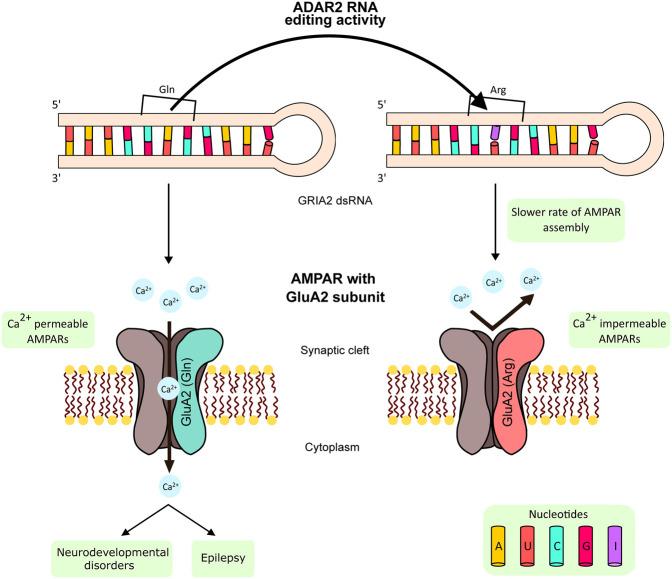
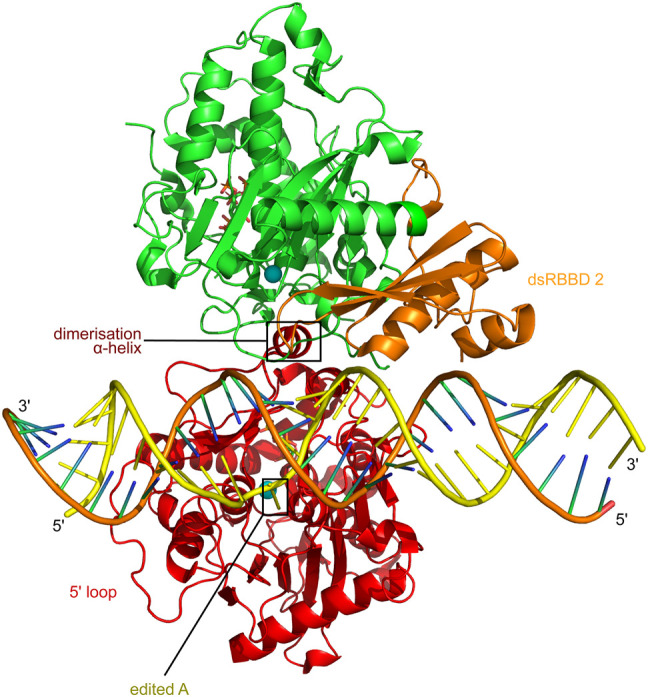
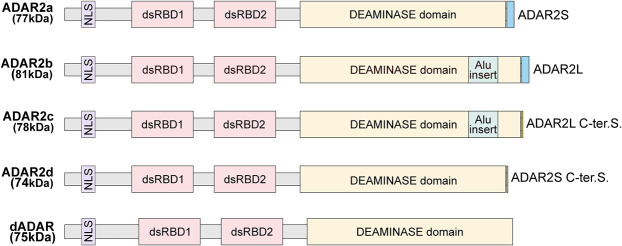
The adenosine deaminase acting on RNA (ADAR) enzymes are essential for neuronal function and innate immune control. ADAR1 RNA editing prevents aberrant activation of antiviral dsRNA sensors through editing of long, double-stranded RNAs (dsRNAs). In this review, we focus on the ADAR2 proteins involved in the efficient, highly site-specific RNA editing to recode open reading frames first discovered in the transcript encoding the key GLUA2 subunit of AMPA receptors; ADAR1 proteins also edit many of these sites. We summarize the history of ADAR2 protein research and give an up-to-date review of ADAR2 structural studies, human (ADAR2) mutants causing severe infant seizures, and mouse disease models. Structural studies on ADARs and their RNA substrates facilitate current efforts to develop ADAR RNA editing gene therapy to edit disease-causing single nucleotide polymorphisms (SNPs). Artificial ADAR guide RNAs are being developed to retarget ADAR RNA editing to new target transcripts in order to correct SNP mutations in them at the RNA level. Site-specific RNA editing has been expanded to recode hundreds of sites in CNS transcripts in and cephalopods. In and , ADAR RNA editing also suppresses responses to self dsRNA.
腺苷脱氨酶作用于 RNA(ADAR)酶对于神经元功能和先天免疫控制至关重要。ADAR1 RNA 编辑通过编辑长的双链 RNA(dsRNA)来防止抗病毒 dsRNA 传感器的异常激活。在这篇综述中,我们重点介绍了 ADAR2 蛋白,它们参与了高效、高度特异性的 RNA 编辑,首先在编码 AMPA 受体关键 GLUA2 亚基的 转录本中发现了这种编辑;ADAR1 蛋白也编辑了许多这些位点。我们总结了 ADAR2 蛋白研究的历史,并对 ADAR2 结构研究、导致严重婴儿癫痫的人类 (ADAR2)突变体以及小鼠疾病模型进行了最新的综述。ADAR 和其 RNA 底物的结构研究促进了当前开发 ADAR RNA 编辑基因治疗以编辑致病单核苷酸多态性(SNP)的努力。人工 ADAR 向导 RNA 正在被开发用于将 ADAR RNA 编辑重新靶向到新的靶转录本中,以便在 RNA 水平上纠正它们中的 SNP 突变。在 和 中,ADAR RNA 编辑还抑制了对自身 dsRNA 的反应。