Uthman Olalekan A, Lawoko Stephen, Moradi Tahereh
Department of Public Health Sciences, Division of Social Medicine, Karolinska Institutet, Stockholm, Sweden.
BMC Int Health Hum Rights. 2009 Jul 20;9:14. doi: 10.1186/1472-698X-9-14.
Violence against women, especially by intimate partners, is a serious public health problem that is associated with physical, reproductive and mental health consequences. Even though most societies proscribe violence against women, the reality is that violations against women's rights are often sanctioned under the garb of cultural practices and norms, or through misinterpretation of religious tenets.
We utilised data from 17 Demographic and Health Surveys (DHS) conducted between 2003 and 2007 in sub-Saharan Africa to assess the net effects of socio-demographic factors on men's and women's attitudes toward intimate partner violence against women (IPVAW) using multiple logistic regression models estimated by likelihood ratio test.
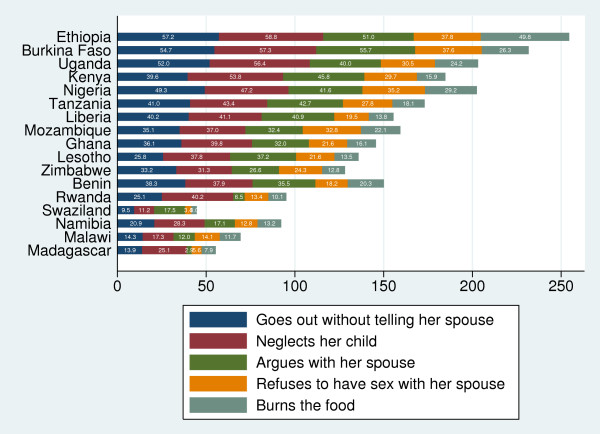
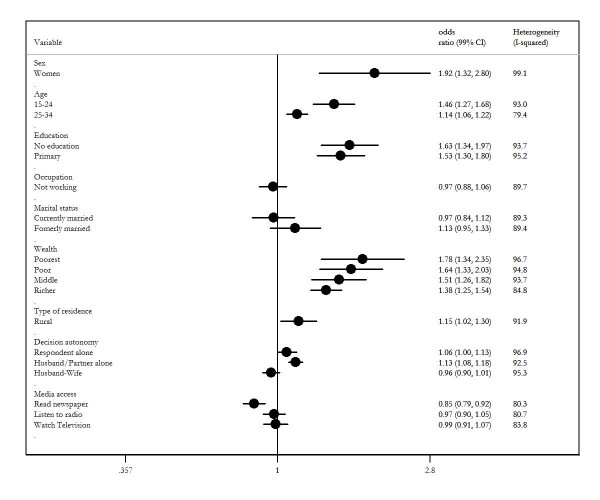
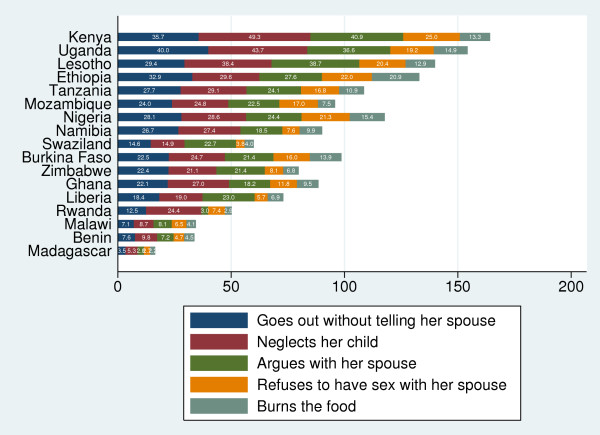
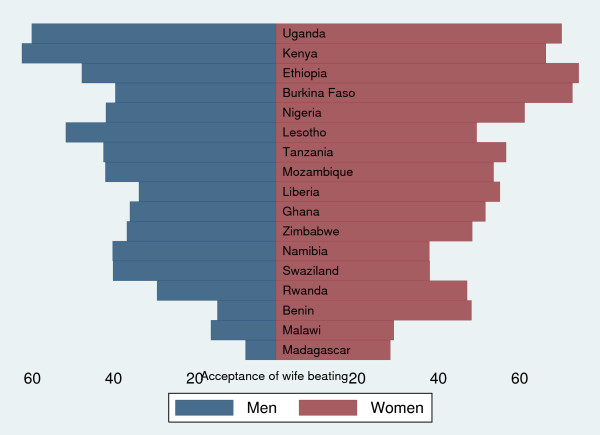
IPVAW was widely accepted under certain circumstances by men and women in all the countries studied. Women were more likely to justify IPVAW than men. "Neglecting the children" was the most common reason agreed to by both women and men for justifying IPVAW followed by "going out without informing husband" and "arguing back with the husband". Increasing wealth status, education attainment, urbanization, access to media, and joint decision making were associated with decreased odds of justifying IPVAW in most countries.
In most Sub-Saharan African countries studied where IPVAW is widely accepted as a response to women's transgressing gender norms, men find less justification for the practice than do women. The present study suggests that proactive efforts are needed to change these norms, such as promotion of higher education and socio-demographic development. The magnitude and direction of factors associated with attitudes towards IPVAW varies widely across the countries, thus suggesting the significance of capitalizing on need-adapted interventions tailored to fit conditions in each country.
针对妇女的暴力行为,尤其是亲密伴侣实施的暴力,是一个严重的公共卫生问题,会对身体、生殖和心理健康产生影响。尽管大多数社会都禁止对妇女的暴力行为,但现实情况是,侵犯妇女权利的行为常常以文化习俗和规范为幌子得到认可,或者通过对宗教教义的错误解读而被认可。
我们利用了2003年至2007年在撒哈拉以南非洲进行的17次人口与健康调查(DHS)的数据,通过似然比检验估计的多元逻辑回归模型,评估社会人口因素对男性和女性对亲密伴侣对妇女暴力行为(IPVAW)态度的净影响。
在所研究的所有国家中,男性和女性在某些情况下都广泛接受IPVAW。女性比男性更有可能为IPVAW辩护。“忽视孩子”是男性和女性都认同的为IPVAW辩护的最常见原因,其次是“未经丈夫告知就外出”和“与丈夫顶嘴”。在大多数国家,财富状况的增加、教育程度的提高、城市化、媒体接触和共同决策与为IPVAW辩护的可能性降低有关。
在大多数所研究的撒哈拉以南非洲国家,IPVAW被广泛视为对妇女违反性别规范的回应,男性为这种行为寻找的正当理由比女性少。本研究表明,需要积极努力改变这些规范,例如促进高等教育和社会人口发展。与对IPVAW态度相关的因素的程度和方向在各国之间差异很大,因此表明利用根据各国情况量身定制的适应需求的干预措施具有重要意义。