Maquart Marianne, Le Flèche Philippe, Foster Geoffrey, Tryland Morten, Ramisse Françoise, Djønne Berit, Al Dahouk Sascha, Jacques Isabelle, Neubauer Heinrich, Walravens Karl, Godfroid Jacques, Cloeckaert Axel, Vergnaud Gilles
INRA, UR1282, Infectiologie Animale et Santé Publique, IASP, Nouzilly, F-37380, France.
BMC Microbiol. 2009 Jul 20;9:145. doi: 10.1186/1471-2180-9-145.
Since 1994, Brucella strains have been isolated from a wide range of marine mammals. They are currently recognized as two new Brucella species, B. pinnipedialis for the pinniped isolates and B. ceti for the cetacean isolates in agreement with host preference and specific phenotypic and molecular markers. In order to investigate the genetic relationships within the marine mammal Brucella isolates and with reference to terrestrial mammal Brucella isolates, we applied in this study the Multiple Loci VNTR (Variable Number of Tandem Repeats) Analysis (MLVA) approach. A previously published assay comprising 16 loci (MLVA-16) that has been shown to be highly relevant and efficient for typing and clustering Brucella strains from animal and human origin was used.
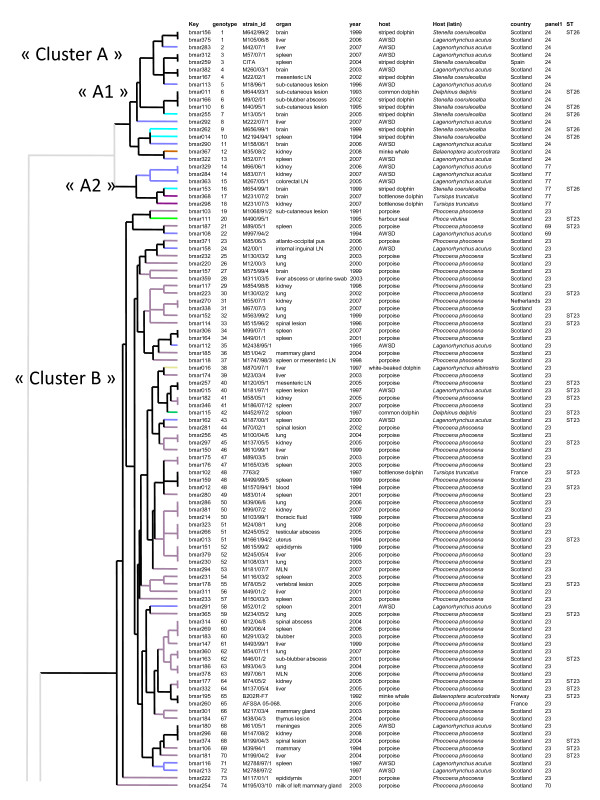
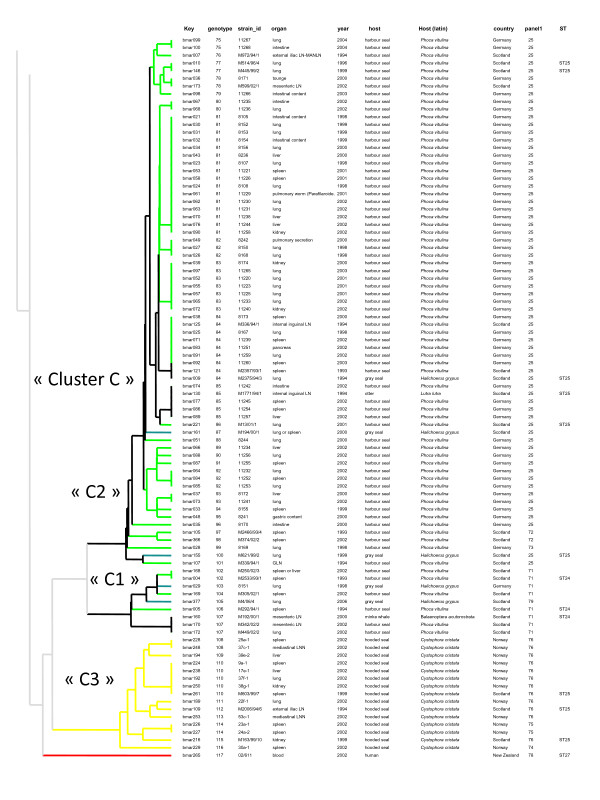
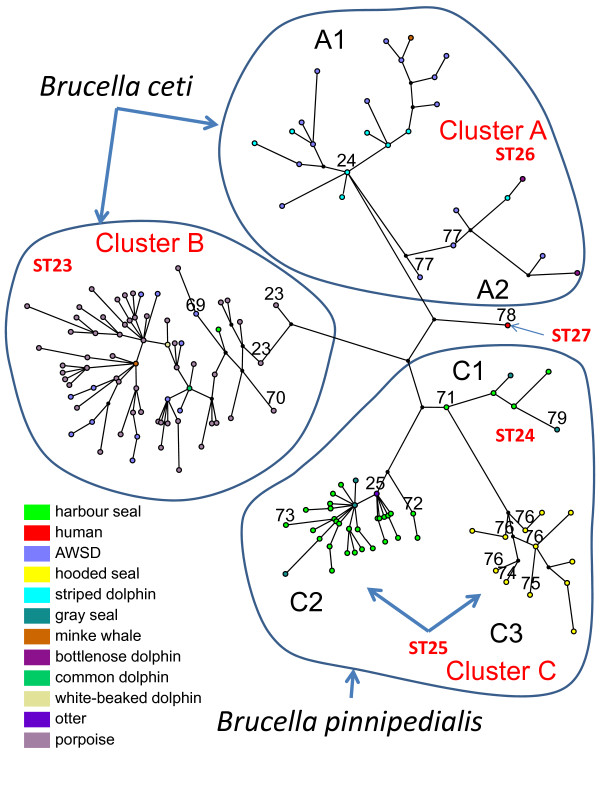
294 marine mammal Brucella strains collected in European waters from 173 animals and a human isolate from New Zealand presumably from marine origin were investigated by MLVA-16. Marine mammal Brucella isolates were shown to be different from the recognized terrestrial mammal Brucella species and biovars and corresponded to 3 major related groups, one specific of the B. ceti strains, one of the B. pinnipedialis strains and the last composed of the human isolate. In the B. ceti group, 3 subclusters were identified, distinguishing a cluster of dolphin, minke whale and porpoise isolates and two clusters mostly composed of dolphin isolates. These results were in accordance with published analyses using other phenotypic or molecular approaches, or different panels of VNTR loci. The B. pinnipedialis group could be similarly subdivided in 3 subclusters, one composed exclusively of isolates from hooded seals (Cystophora cristata) and the two others comprising other seal species isolates.
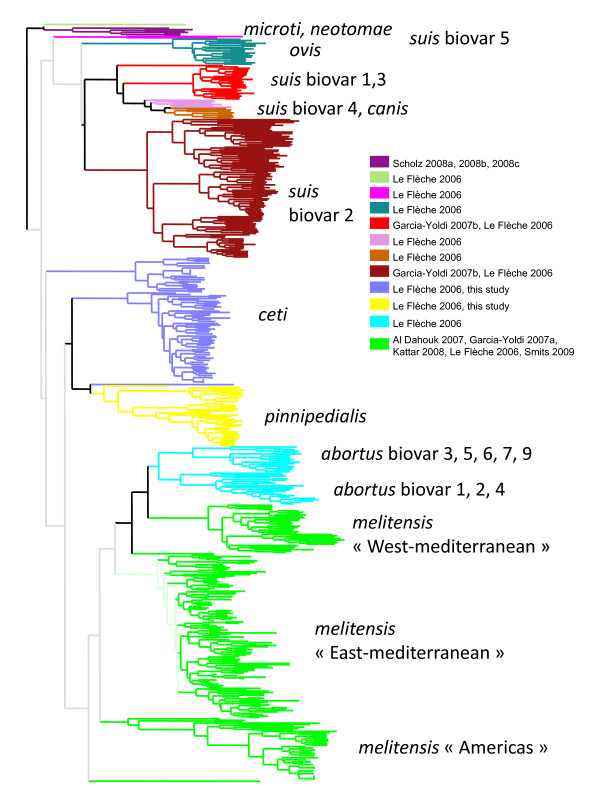
The clustering analysis of a large collection of marine mammal Brucella isolates from European waters significantly strengthens the current view of the population structure of these two species, and their relative position with respect to the rest of the Brucella genus. MLVA-16 is confirmed as being a rapid, highly discriminatory and reproducible method to classify Brucella strains including the marine mammal isolates. The Brucella2009 MLVA-16 genotyping database available at http://mlva.u-psud.fr/ is providing a detailed coverage of all 9 currently recognized Brucella species.
自1994年以来,已从多种海洋哺乳动物中分离出布鲁氏菌菌株。目前,根据宿主偏好以及特定的表型和分子标记,它们被确认为两个新的布鲁氏菌物种,即海豹布鲁氏菌(B. pinnipedialis),用于海豹分离株;鲸布鲁氏菌(B. ceti),用于鲸类分离株。为了研究海洋哺乳动物布鲁氏菌分离株之间以及与陆生哺乳动物布鲁氏菌分离株的遗传关系,我们在本研究中应用了多位点可变数目串联重复序列分析(MLVA)方法。使用了先前发表的包含16个位点的检测方法(MLVA-16),该方法已被证明对于来自动物和人类来源的布鲁氏菌菌株的分型和聚类具有高度相关性和有效性。
通过MLVA-16对在欧洲水域采集的来自173只动物的294株海洋哺乳动物布鲁氏菌菌株以及一株可能来自海洋来源的新西兰人类分离株进行了研究。结果表明,海洋哺乳动物布鲁氏菌分离株与已确认的陆生哺乳动物布鲁氏菌物种和生物变种不同,它们对应于3个主要相关组,一组是鲸布鲁氏菌菌株特有的,一组是海豹布鲁氏菌菌株特有的,最后一组由人类分离株组成。在鲸布鲁氏菌组中,鉴定出3个亚群,区分出海豚、小须鲸和鼠海豚分离株组成的一个亚群以及两个主要由海豚分离株组成的亚群。这些结果与使用其他表型或分子方法或不同VNTR位点组合发表的分析结果一致。海豹布鲁氏菌组也可类似地细分为3个亚群,一个亚群仅由冠海豹(Cystophora cristata)的分离株组成,另外两个亚群包含其他海豹物种的分离株。
对来自欧洲水域的大量海洋哺乳动物布鲁氏菌分离株进行聚类分析,显著强化了目前对这两个物种的种群结构及其相对于布鲁氏菌属其他成员的相对位置的认识。MLVA-16被确认为是一种快速、高度鉴别且可重复的方法,用于对包括海洋哺乳动物分离株在内的布鲁氏菌菌株进行分类。可在http://mlva.u-psud.fr/获取的布鲁氏菌2009 MLVA-16基因分型数据库详细涵盖了目前所有9个已确认的布鲁氏菌物种。