Dawson Claire E, Stubberfield Emma J, Perrett Lorraine L, King Amanda C, Whatmore Adrian M, Bashiruddin John B, Stack Judy A, Macmillan Alastair P
Department of Statutory and Exotic Bacterial Diseases, Veterinary Laboratories Agency, New Haw, Addlestone, Surrey, KT15 3NB, UK.
BMC Microbiol. 2008 Dec 17;8:224. doi: 10.1186/1471-2180-8-224.
Bacteria of the genus Brucella are the causative organisms of brucellosis in animals and man. Previous characterisation of Brucella strains originating from marine mammals showed them to be distinct from the terrestrial species and likely to comprise one or more new taxa. Recently two new species comprising Brucella isolates from marine mammals, B. pinnipedialis and B. ceti, were validly published. Here we report on an extensive study of the molecular and phenotypic characteristics of marine mammal Brucella isolates and on how these characteristics relate to the newly described species.
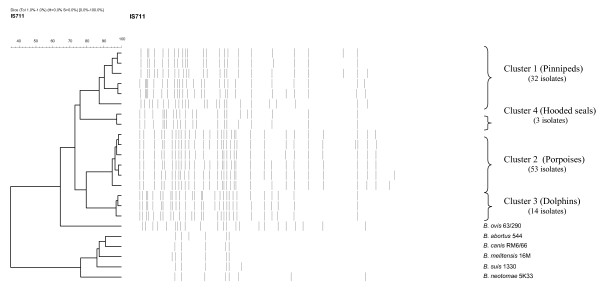
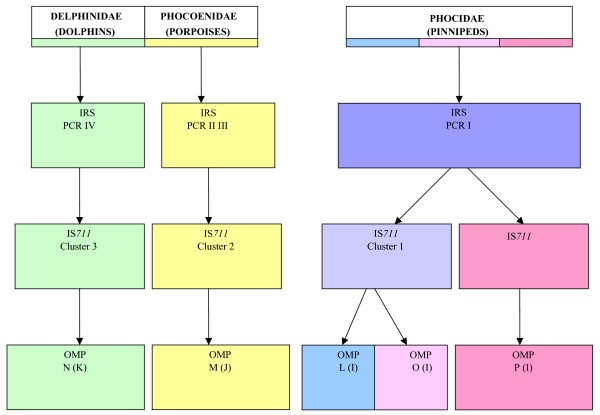
In this study, 102 isolates of Brucella originating from eleven species of marine mammals were characterised. Results obtained by analysis using the Infrequent Restriction Site (IRS)-Derivative PCR, PCR-RFLP of outer membrane protein genes (omp) and IS711 fingerprint profiles showed good consistency with isolates originating from cetaceans, corresponding to B. ceti, falling into two clusters. These correspond to isolates with either dolphins or porpoises as their preferred host. Isolates originating predominantly from seals, and corresponding to B. pinnipedialis, cluster separately on the basis of IS711 fingerprinting and other molecular approaches and can be further subdivided, with isolates from hooded seals comprising a distinct group. There was little correlation between phenotypic characteristics used in classical Brucella biotyping and these groups.
Molecular approaches are clearly valuable in the division of marine mammal Brucella into subtypes that correlate with apparent ecological divisions, whereas conventional bioyping is of less value. The data presented here confirm that there are significant subtypes within the newly described marine mammal Brucella species and add to a body of evidence that could lead to the recognition of additional species or sub-species within this group.
布鲁氏菌属细菌是动物和人类布鲁氏菌病的病原体。先前对源自海洋哺乳动物的布鲁氏菌菌株的特征描述表明,它们与陆地物种不同,可能包含一个或多个新分类单元。最近,两个包含源自海洋哺乳动物的布鲁氏菌分离株的新物种——海兽布鲁氏菌和鲸布鲁氏菌,已正式发表。在此,我们报告了一项关于海洋哺乳动物布鲁氏菌分离株的分子和表型特征的广泛研究,以及这些特征与新描述物种的关系。
在本研究中,对源自11种海洋哺乳动物的102株布鲁氏菌进行了特征描述。使用低频限制性位点(IRS)衍生PCR、外膜蛋白基因(omp)的PCR-RFLP和IS711指纹图谱分析获得的结果与源自鲸类动物的分离株具有良好的一致性,这些分离株属于鲸布鲁氏菌,分为两个簇。这两个簇分别对应以海豚或鼠海豚为首选宿主的分离株。主要源自海豹的分离株,属于海兽布鲁氏菌,根据IS711指纹图谱和其他分子方法单独聚类,并且可以进一步细分,其中来自冠海豹的分离株构成一个独特的组。经典布鲁氏菌生物分型中使用的表型特征与这些组之间几乎没有相关性。
分子方法在将海洋哺乳动物布鲁氏菌分为与明显生态划分相关的亚型方面显然很有价值,而传统的生物分型价值较小。此处提供的数据证实,新描述的海洋哺乳动物布鲁氏菌物种内存在重要的亚型,并增加了一系列证据,可能导致该组内识别出更多的物种或亚种。