Strong Larkin L, Thompson Beti, Koepsell Thomas D, Meischke Hendrika, Coronado Gloria D
Department of Epidemiology, University of Texas MD Anderson Cancer Center, Houston, USA.
J Occup Environ Med. 2009 Aug;51(8):922-33. doi: 10.1097/JOM.0b013e3181ad4995.
To evaluate the effectiveness of a community intervention in promoting adoption of behaviors to reduce the take-home pathway of pesticide exposure in farmworker households.
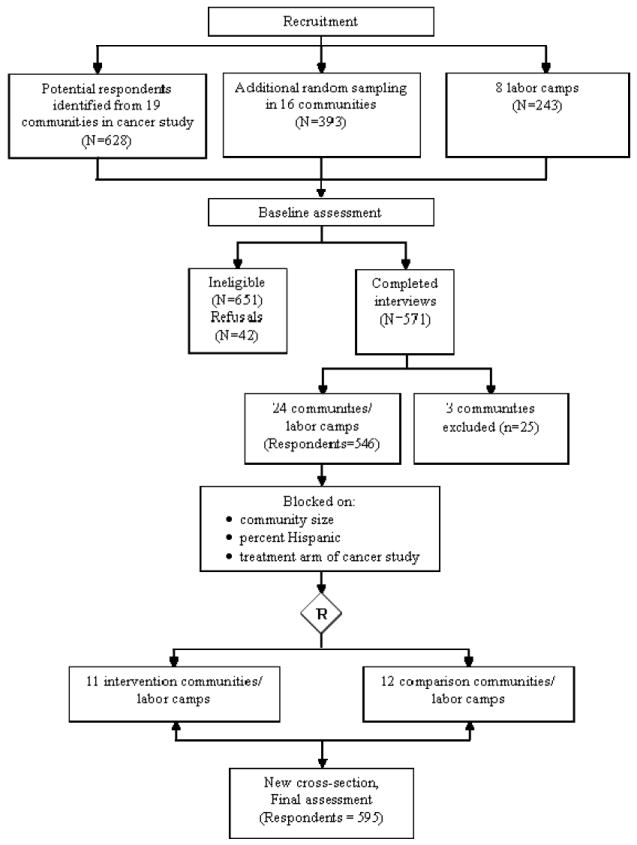
Using two cross-sectional samples of farmworker households in 11 intervention and 12 comparison communities in Washington State, we examined whether differences over time in reported pesticide safety practices varied by community intervention status.
Pesticide safety practices increased in both intervention and comparison communities over time. Changes were significantly greater in intervention communities for removing work shoes before entering the home (P = 0.003) and marginally significantly greater for changing out of work clothes within 1 hour of arriving home (P = 0.05).
The intervention was associated with modest effects in certain behaviors among farmworkers. Further research is needed to identify successful strategies for reducing the take-home pathway of pesticide exposure.
评估一项社区干预措施在促进采用相关行为以减少农场工人家庭中农药带回家接触途径方面的有效性。
利用华盛顿州11个干预社区和12个对照社区的两个农场工人家庭横断面样本,我们研究了报告的农药安全做法随时间的差异是否因社区干预状态而异。
随着时间的推移,干预社区和对照社区的农药安全做法均有所增加。在干预社区,回家前脱工作鞋的变化显著更大(P = 0.003),到家后1小时内换工作服的变化略显著更大(P = 0.05)。
该干预措施与农场工人某些行为的适度效果相关。需要进一步研究以确定减少农药带回家接触途径的成功策略。