Zhang Hailiang, Dong Baijun, Lu Jiade J, Yao Xudong, Zhang Shilin, Dai Bo, Shen Yijun, Zhu Yao, Ye Dingwei, Huang Yiran
Department of Urology, Fudan University Shanghai Cancer Center, Shanghai, PR China.
BMC Cancer. 2009 Jul 21;9:249. doi: 10.1186/1471-2407-9-249.
The effects of sorafenib in the treatment of advanced renal cell carcinoma (RCC) have been confirmed in an international collaborative phase III trial. This study aims to confirm similar efficacy and treatment-induced toxicities of sorafenib in the treatment of metastatic RCC in ethnic Chinese patients.
Ninety-eight consecutive and non-selected patients with pathologically confirmed metastatic RCC were treated according to an institutional treatment protocol. All patients were treated with 400 mg of sorafenib orally twice daily on a continuous basis until disease progression or intolerance to treatment occurred. Dose reduction to 400 mg once daily was required if grade 3 or 4 toxicities occurred. All patients except for 7 received nephrectomy in the course of their disease. All patients were assessed for tumor response, progression-free survival (PFS), overall survival (OS), and treatment-induced toxicities.
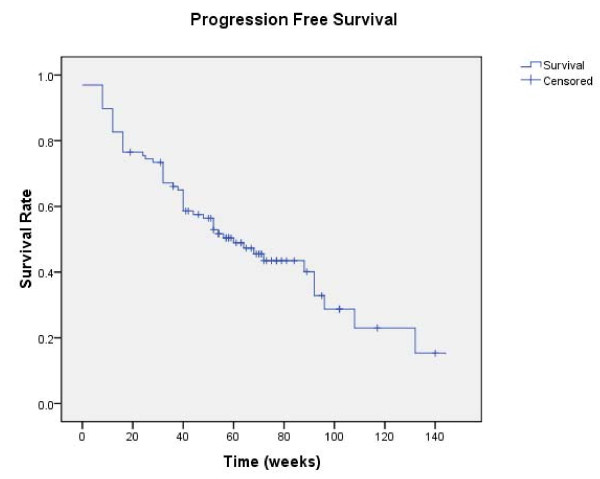
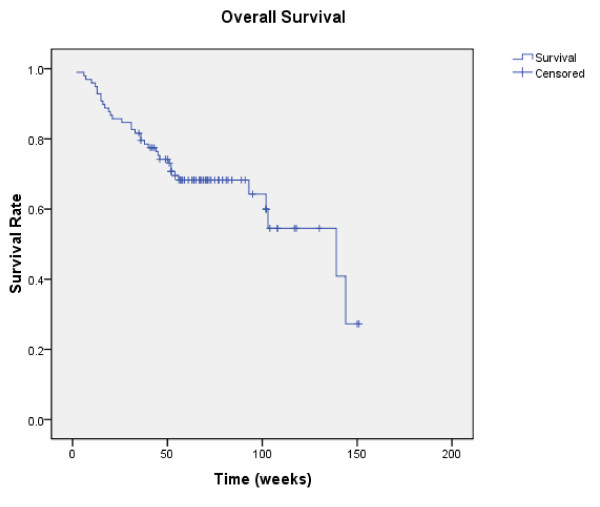
The median follow-up time was 76 weeks (range 2-296 weeks) for the entire group of patients. Radiologically confirmed complete response (CR), partial response (PR), stable disease (SD) of more than 4 months, and disease progression as best objective responses were observed in 1 (1%), 23 (23.5%), 62 (63.3%), and 12 (12.2%) patients, respectively. The tumor control rate (CR+PR+SD of >4 months) was 87.8%. The 1-year estimated PFS and OS were 58.4% and 64.6%, respectively. The median progression-free survival (PFS) time was 60 weeks (95% CI 41-79); and the median overall survival (OS) time was not reached with a follow-up of 76 weeks. Reduction of sorafenib dose was required in 26 patients who developed grade 3 or 4 treatment-cause adverse-effects. An additional 9 patients discontinued sorafenib treatment due to severe adverse-effects. No grade 5 toxicity occurred.Multivariate analysis revealed that independent predictive factors for tumor response to sorafenib treatment included ECOG status, presence of lymph node metastasis, and nephrectomy prior to the development of metastasis.
Sorafenib produced an 87.8% disease control rate for metastatic renal cell carcinoma in Chinese patients, with acceptable rates of toxicity. The medication dosed at 400 mg twice daily is both efficacious and safe in the treatment of metastatic renal cell carcinoma in Chinese patients.
索拉非尼治疗晚期肾细胞癌(RCC)的效果已在一项国际协作的III期试验中得到证实。本研究旨在确认索拉非尼治疗中国汉族转移性RCC患者的疗效及治疗引起的毒性反应是否相似。
98例经病理证实的连续且未筛选的转移性RCC患者按照机构治疗方案接受治疗。所有患者均接受索拉非尼400mg口服,每日两次,持续给药,直至疾病进展或出现治疗不耐受。若发生3级或4级毒性反应,则需将剂量减至400mg每日一次。除7例患者外,所有患者在病程中均接受了肾切除术。对所有患者评估肿瘤反应、无进展生存期(PFS)、总生存期(OS)及治疗引起的毒性反应。
整个患者组的中位随访时间为76周(范围2 - 296周)。经影像学证实的完全缓解(CR)、部分缓解(PR)、超过4个月的疾病稳定(SD)及疾病进展作为最佳客观反应分别见于1例(1%)、23例(23.5%)、62例(63.3%)及12例(12.2%)患者。肿瘤控制率(CR + PR + SD>4个月)为87.8%。1年估计PFS和OS分别为58.4%和64.6%。中位无进展生存期(PFS)时间为60周(95%CI 41 - 79);中位总生存期(OS)时间在76周随访时未达到。26例发生3级或4级治疗引起不良反应的患者需要减少索拉非尼剂量。另外9例患者因严重不良反应停止索拉非尼治疗。未发生5级毒性反应。多因素分析显示,索拉非尼治疗肿瘤反应的独立预测因素包括ECOG状态、淋巴结转移情况及转移发生前是否接受肾切除术。
索拉非尼对中国转移性肾细胞癌患者的疾病控制率为87.8%,毒性反应发生率可接受。每日两次400mg剂量的药物治疗中国转移性肾细胞癌患者有效且安全。